



An 18th-century mansion with water-filled moats, outbuildings, parkland,
and 35 hectares of woods, 1 hour 30 minutes from Paris, in the Sologne sector
and 35 hectares of woods, 1 hour 30 minutes from Paris, in the Sologne sector
Sully-sur-Loire,
LOIRET
center-val-de-loire
45600
FR










Location
This property is located outside a village in the south of the Loiret area, 25 kilometres from Orleans and several minutes from Sully-sur-Loire. Essential shops and services can be found in the municipality. Nearby, Paris can be reached from several railway stations: Saint-Cyr-en-Val - La Source, La Ferté-Saint-Aubin or Orleans. The site has been occupied by mankind since prehistoric times, as shown by Palaeolithic and Neolithic remains, as well as Bronze Age funeral urns.
The village developed on the left banks of the River Loire, not far from the waterway but out of the reach of flooding. The inhabitants are very proud of their neo-Gothic church, which houses remarkable furniture listed as historical monuments.
Description
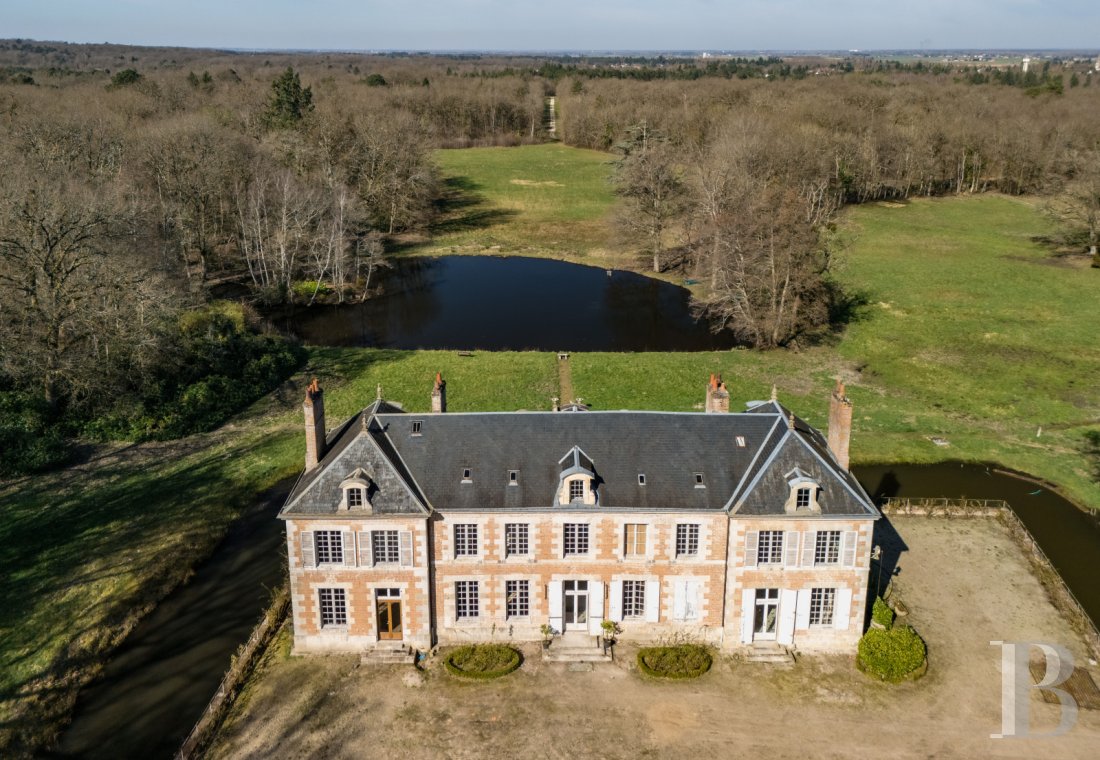
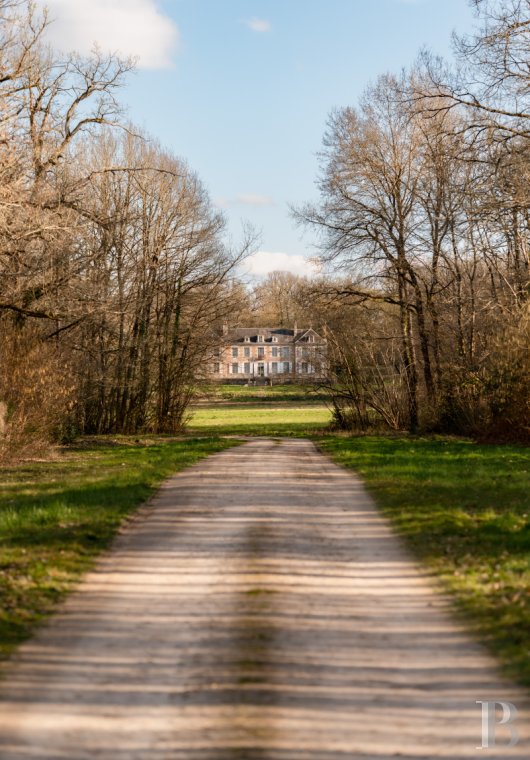
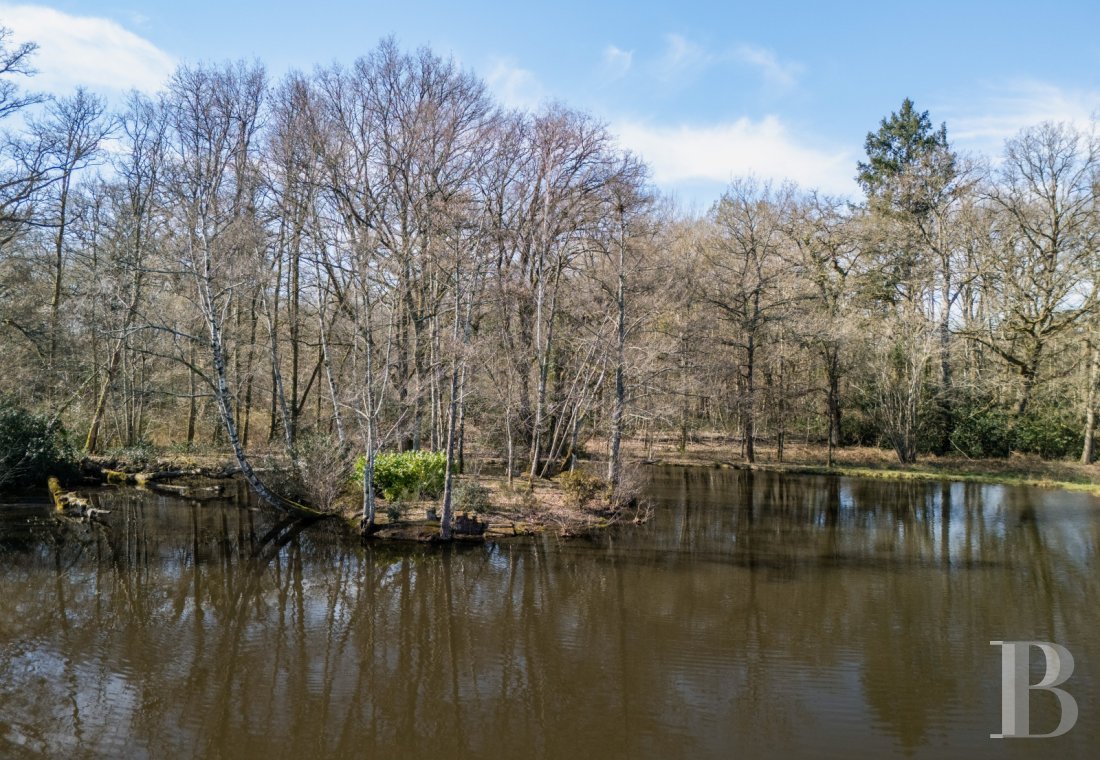
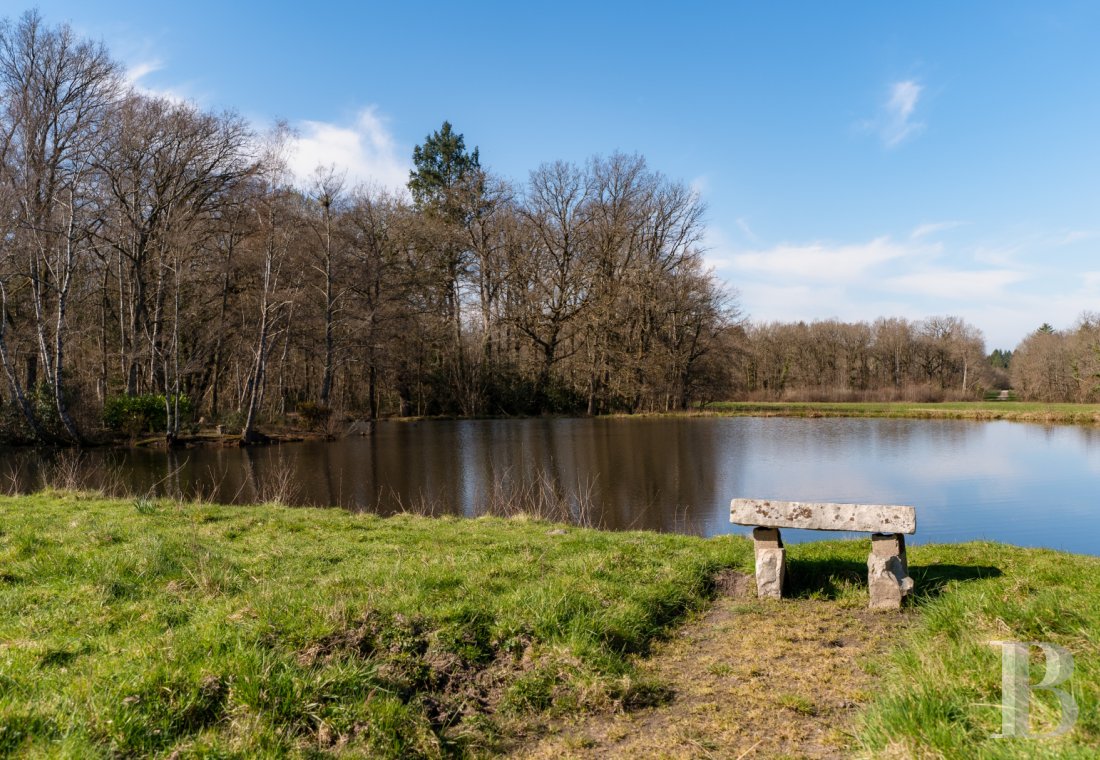
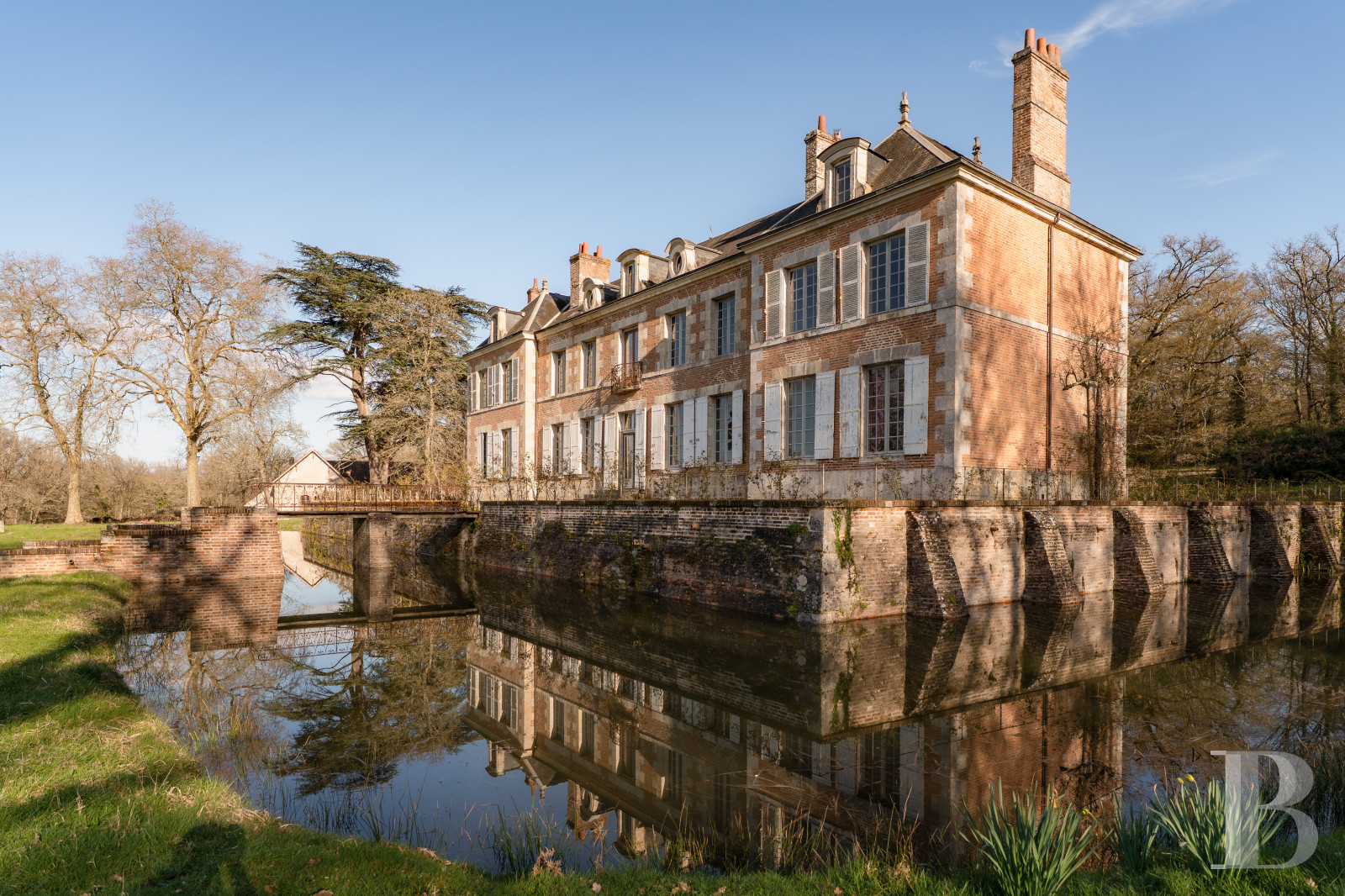
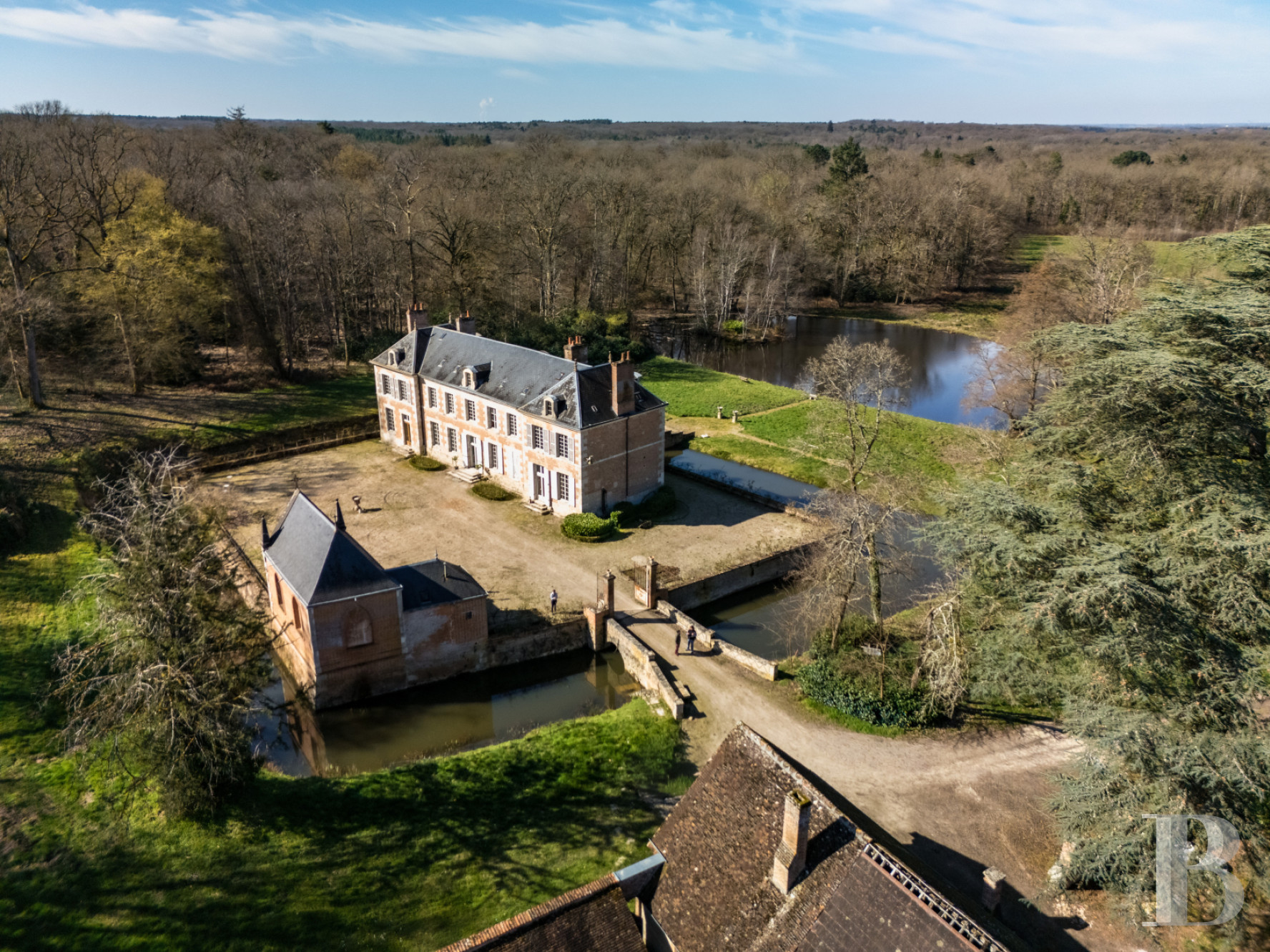
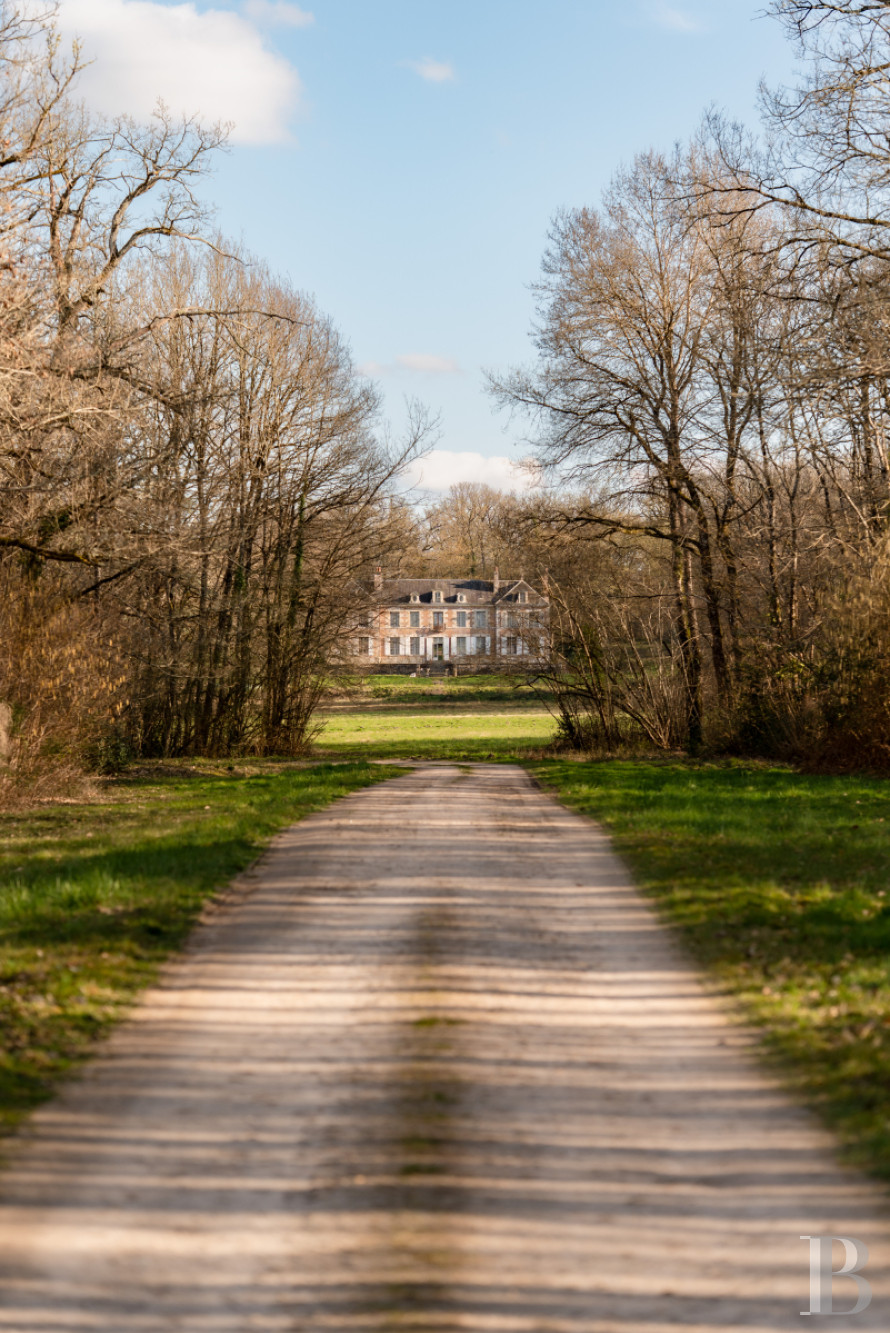
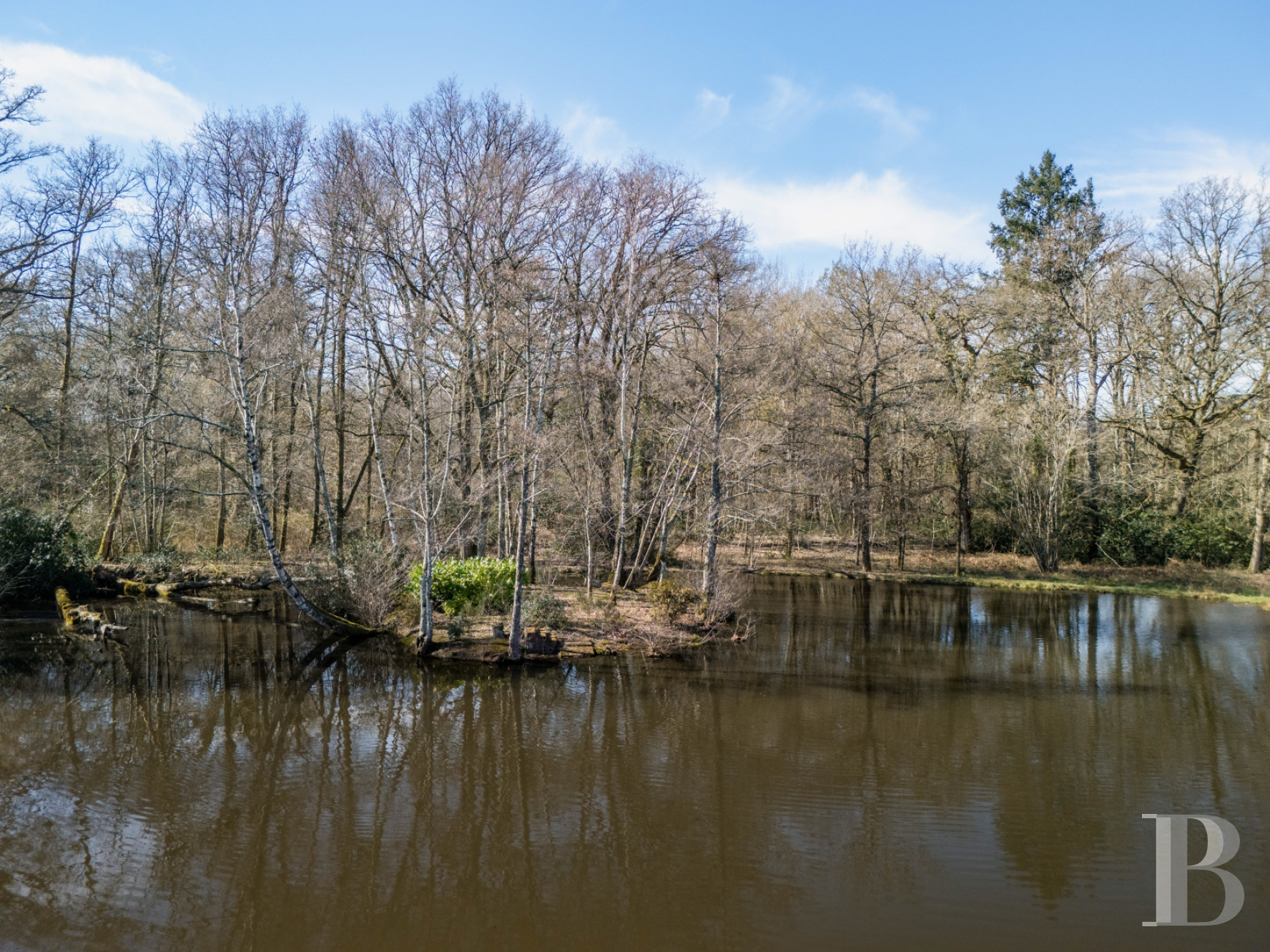
On this property, the tree is king. The very diverse woodlands, whether made up of mature forest or coppices, in which conifers stand alongside oak, birch and hornbeam, are sumptuous in the autumn, when the evergreens contrast with the golden leaves of the deciduous trees. Areas covered in heathland and broom contribute to the distinctive character of the Sologne sector, alongside many ponds created in the Middle Ages to gain control over the waters. A lane winds beneath the trees’ branches like an invitation to discover the ecological sumptuousness and landscape surrounding the property. An earthen track leads slowly towards the majestic mansion that overlooks a pond reflecting the facade.
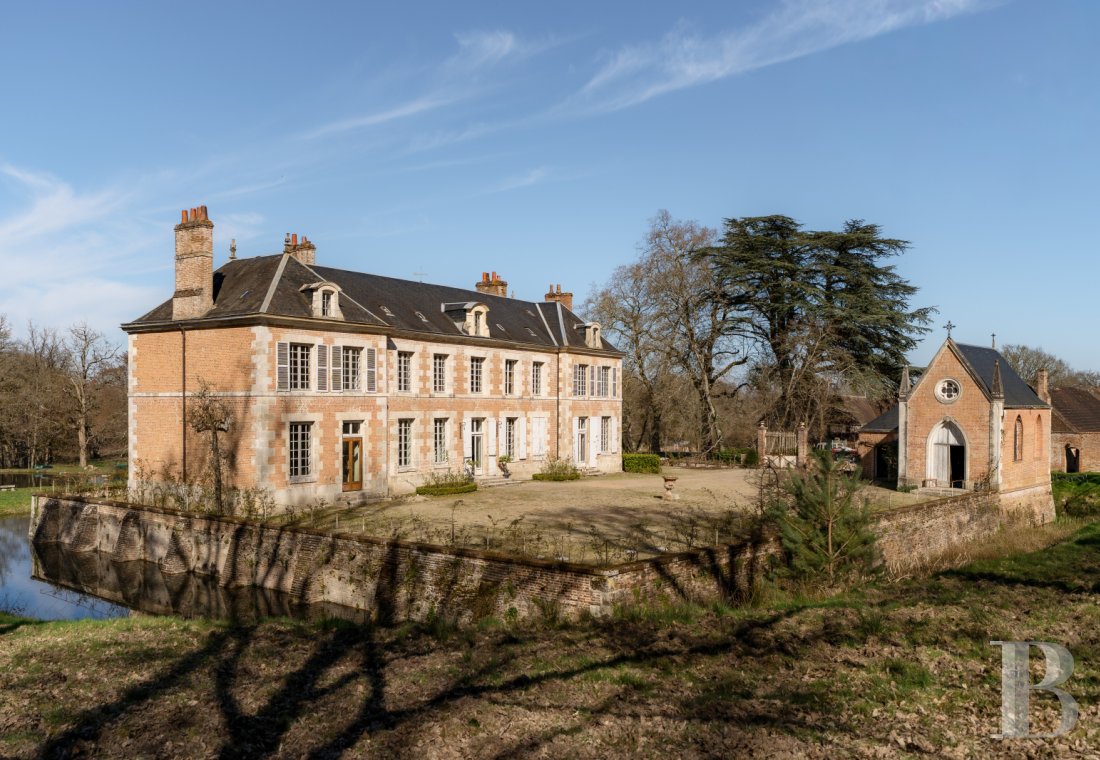
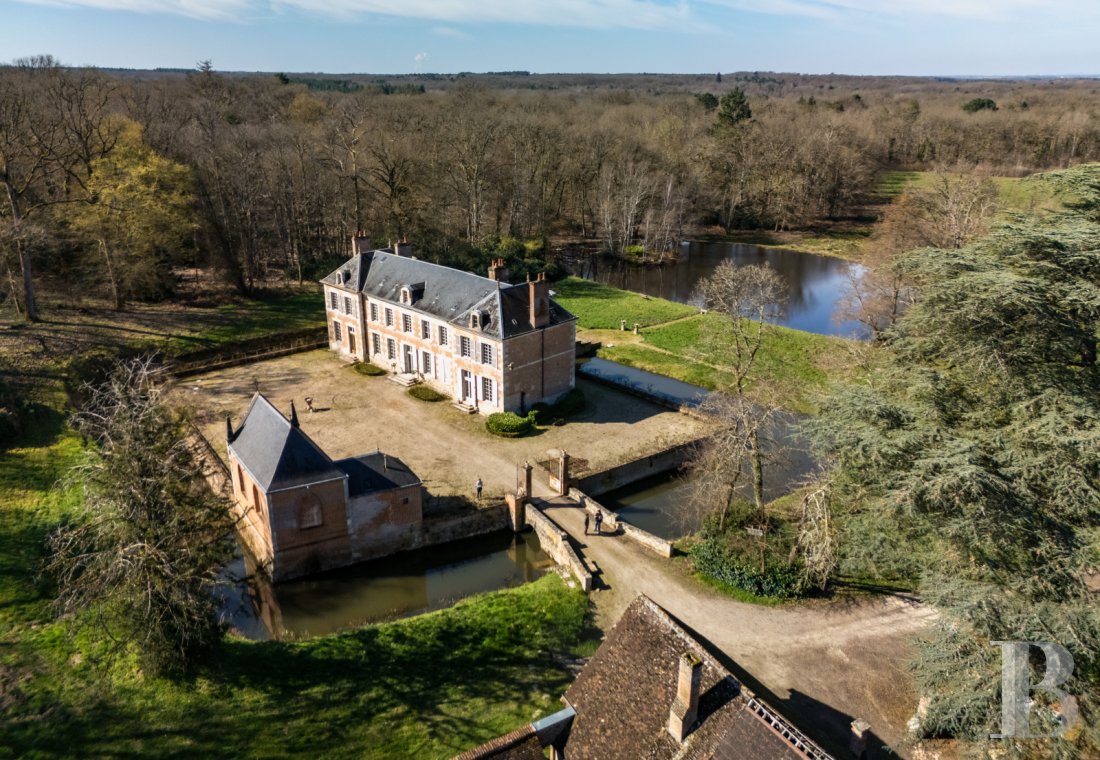
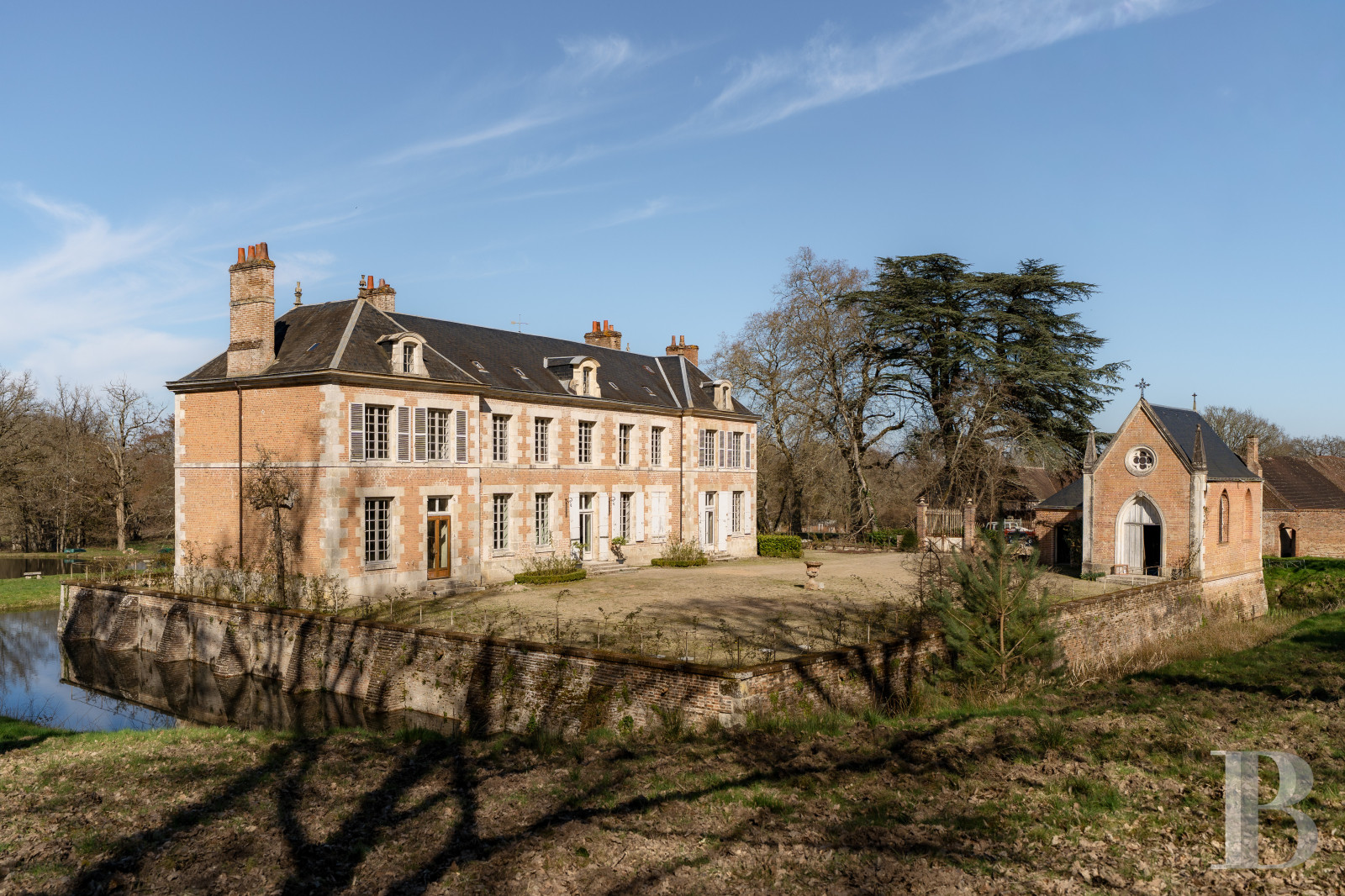
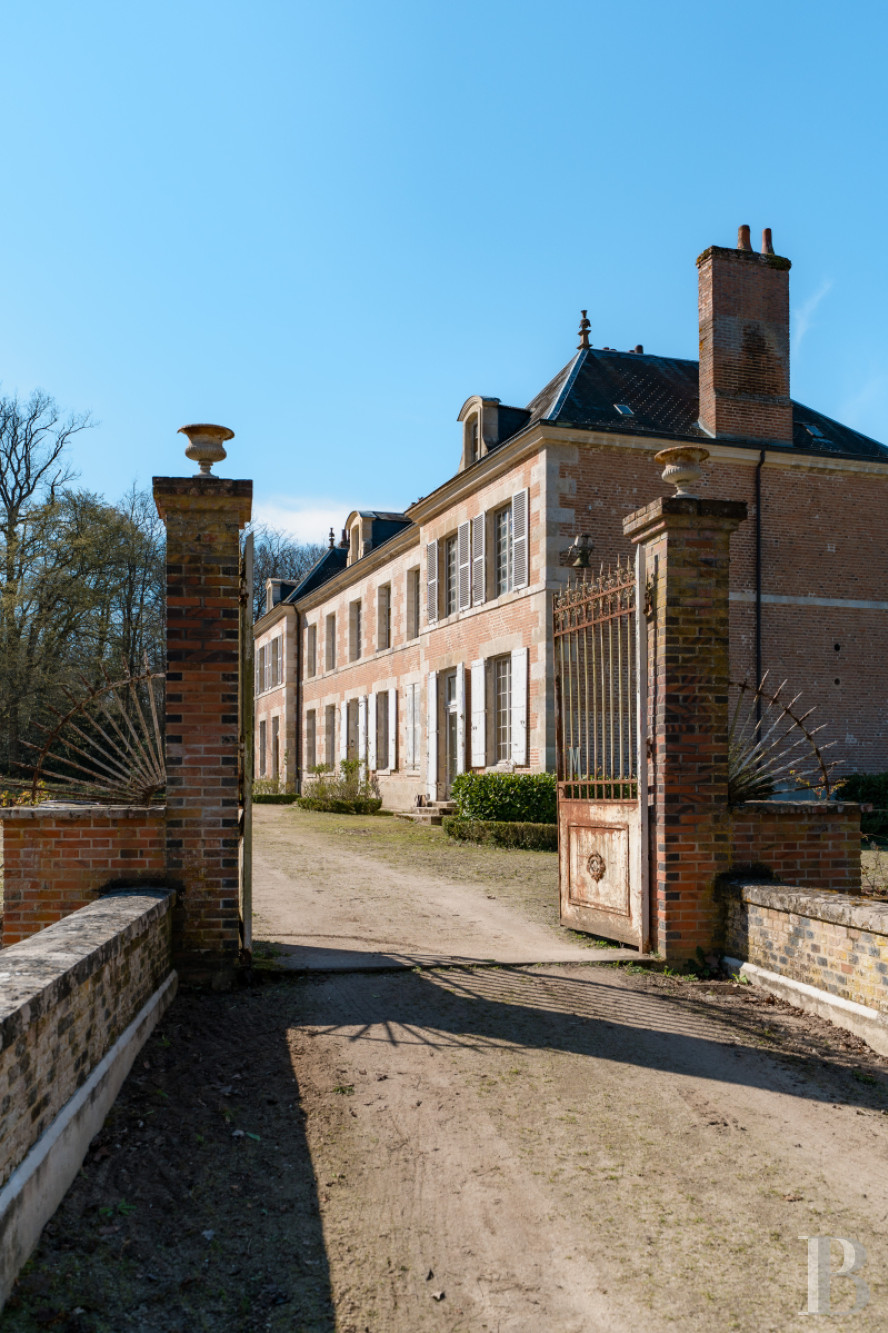
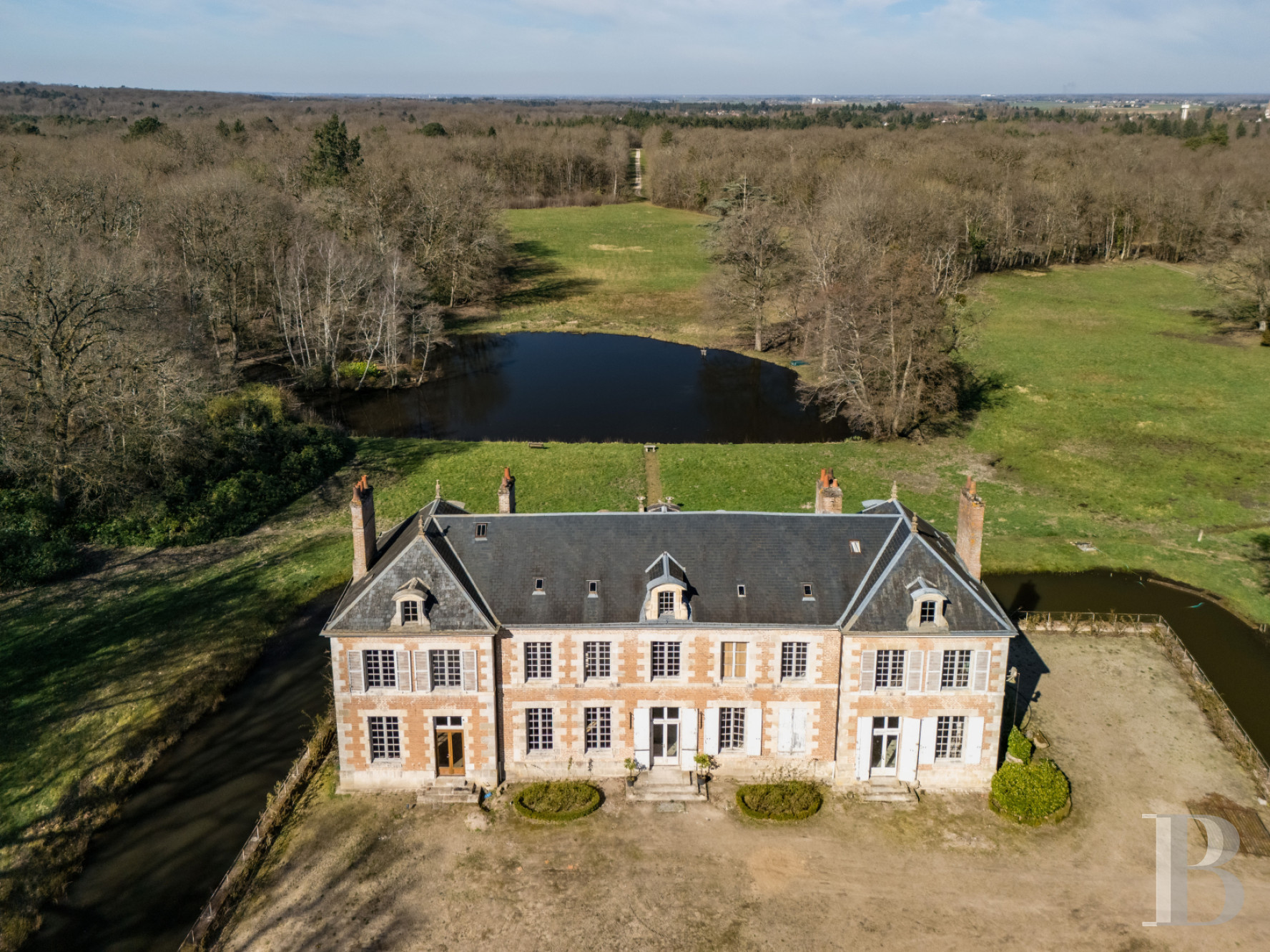
The property’s origins date back to the Middle Ages. The two-storey edifice topped by an attic level and surrounded by a moat, was built in 1742 on the site of a former motte-and-bailey castle and possesses a central section flanked by two pavilions. The mansion overlooks the pond and drive opposite its main facade. The northern facade is punctuated by windows and doors with stone surrounds, lintels and jambs. The large windows on the ground floor are fitted with solid wood shutters whilst on the first floor they are equipped with louvred shutters. The slate roofs are punctuated by oval bullseye windows or dormer windows. On the southern facade, the two pavilions protrude slightly from the central section, emphasising the stone quoins. Their roofs also include dormer windows.
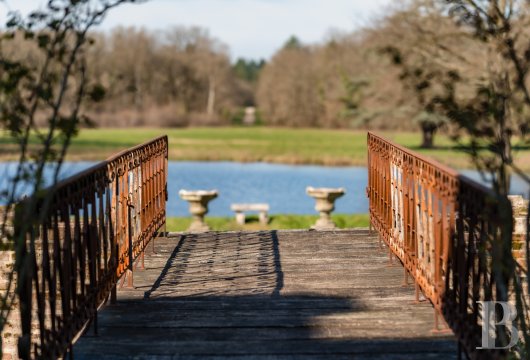
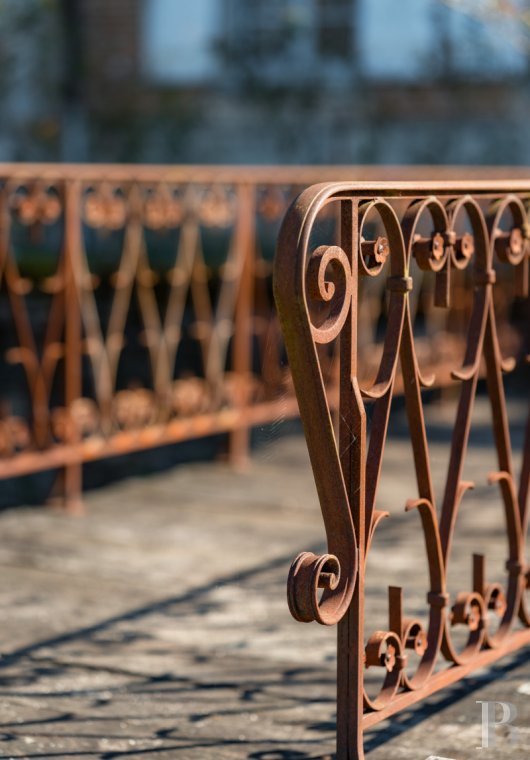
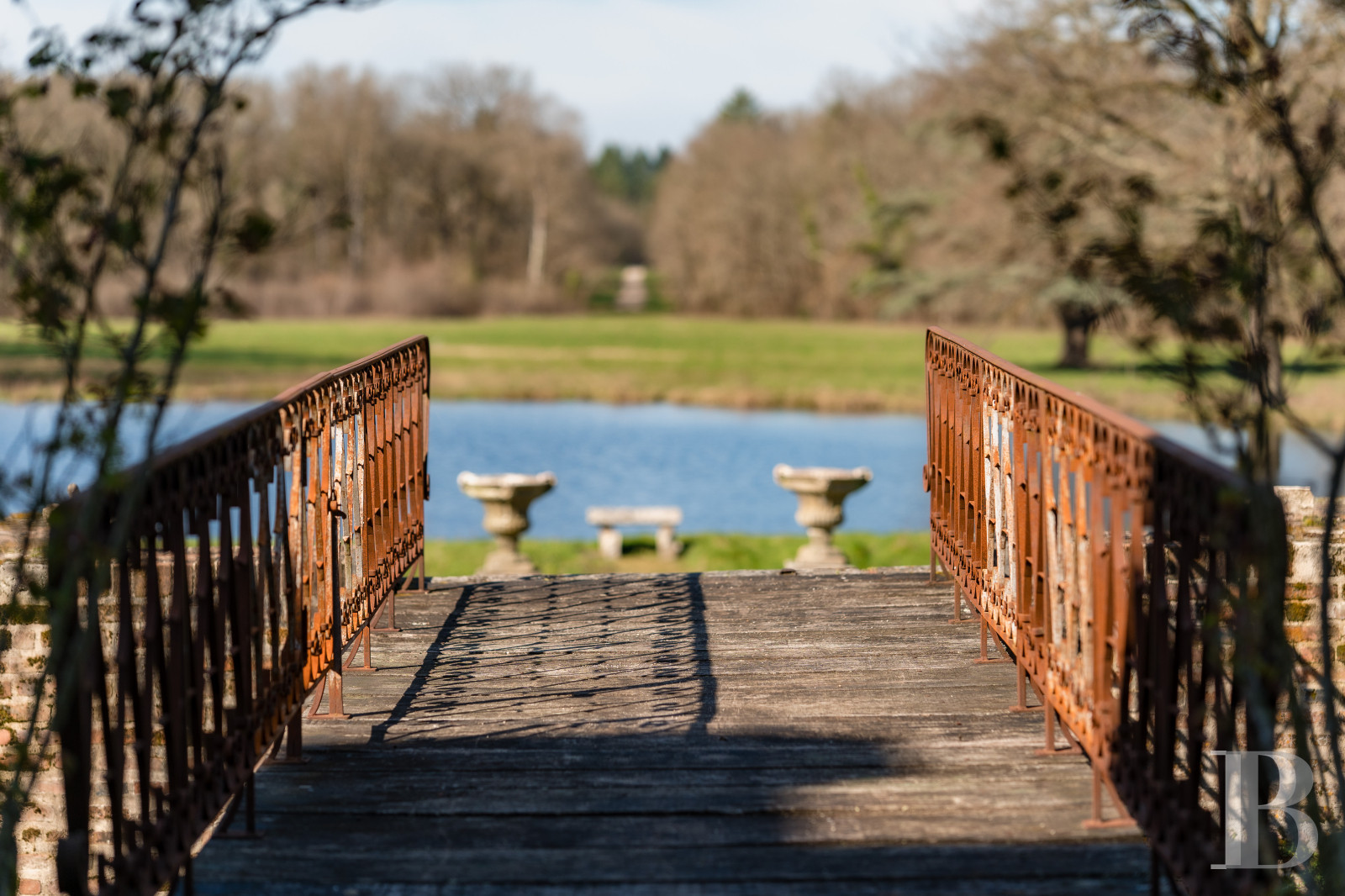
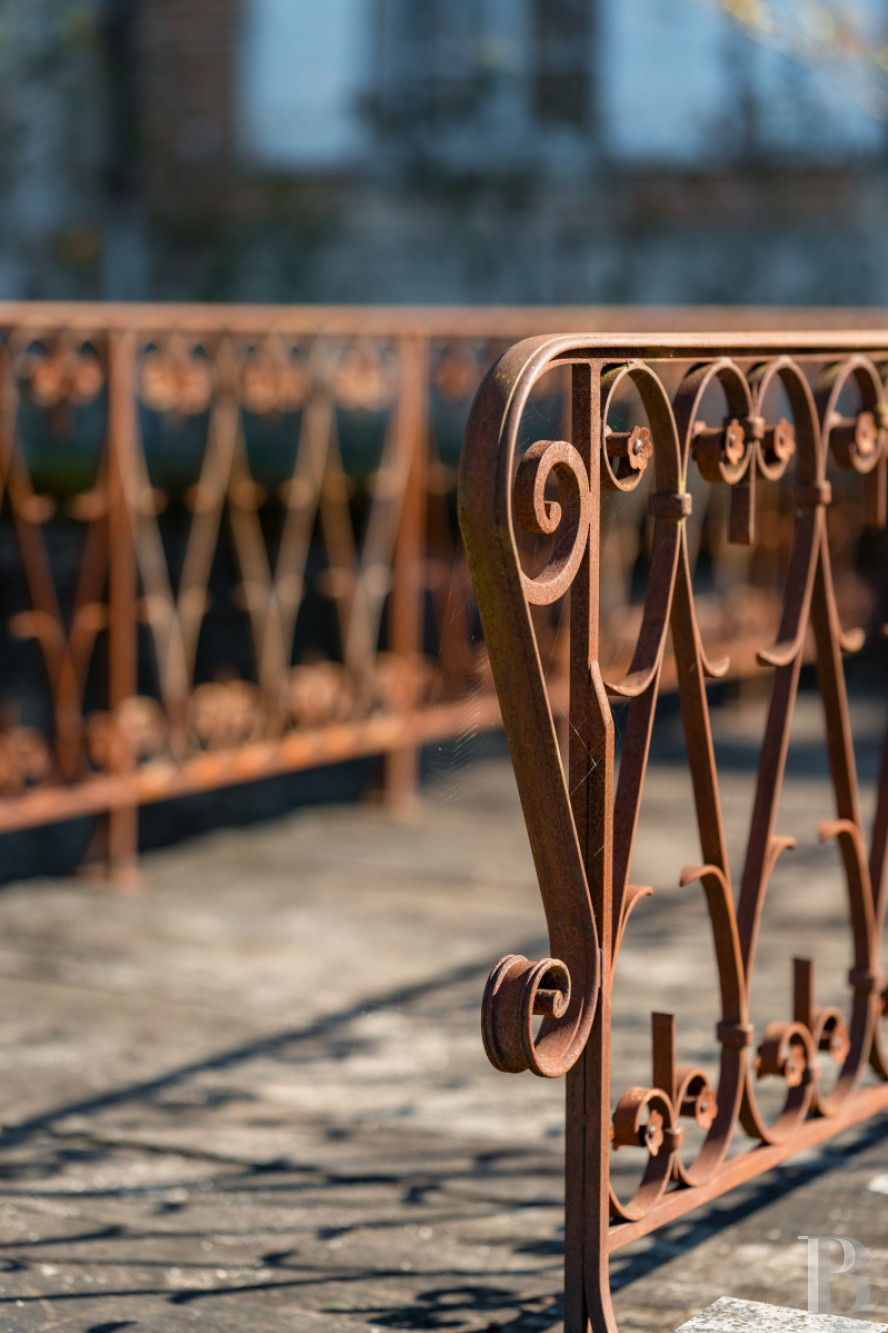
A small bridge over the moat leads to the main entrance. Parkland boasting hundred-year-old trees stands adjacent to the forest. The estate is in the heart of a preserved wildlife reserve where birds plus small and large game all coexist. To the rear of the building, an inner courtyard planted with shimmering-coloured rose bushes plays host to an elegant chapel. It is bordered by large iron railings, erected on the site of the former orangery that previously enclosed the courtyard. Not far away, there are outbuildings, in particular a house referred to as ‘the pavilion’, located in the farmyard. There is also a separate entrance leading to the mansion. On one side of the parkland, a series of statues stand around a former orchard.
The property’s origins date back to the Middle Ages. The two-storey edifice topped by an attic level and surrounded by a moat, was built in 1742 on the site of a former motte-and-bailey castle and possesses a central section flanked by two pavilions. The mansion overlooks the pond and drive opposite its main facade. The northern facade is punctuated by windows and doors with stone surrounds, lintels and jambs. The large windows on the ground floor are fitted with solid wood shutters whilst on the first floor they are equipped with louvred shutters. The slate roofs are punctuated by oval bullseye windows or dormer windows. On the southern facade, the two pavilions protrude slightly from the central section, emphasising the stone quoins. Their roofs also include dormer windows.
A small bridge over the moat leads to the main entrance. Parkland boasting hundred-year-old trees stands adjacent to the forest. The estate is in the heart of a preserved wildlife reserve where birds plus small and large game all coexist. To the rear of the building, an inner courtyard planted with shimmering-coloured rose bushes plays host to an elegant chapel. It is bordered by large iron railings, erected on the site of the former orangery that previously enclosed the courtyard. Not far away, there are outbuildings, in particular a house referred to as ‘the pavilion’, located in the farmyard. There is also a separate entrance leading to the mansion. On one side of the parkland, a series of statues stand around a former orchard.
The mansion
The ground floor
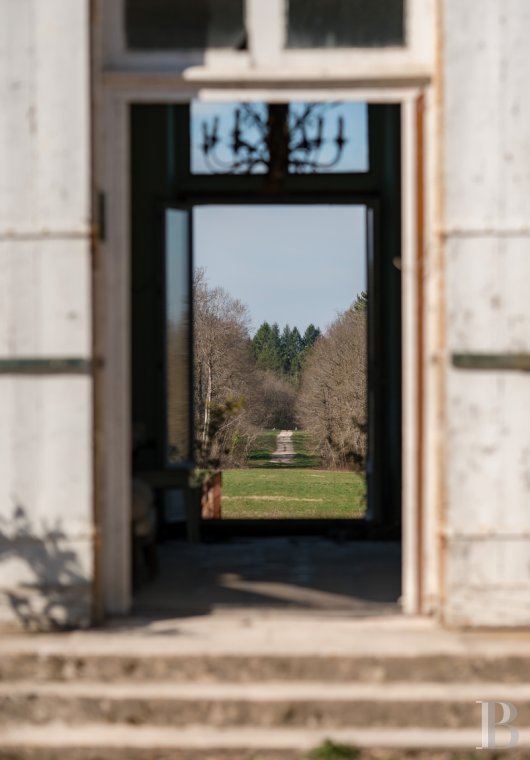
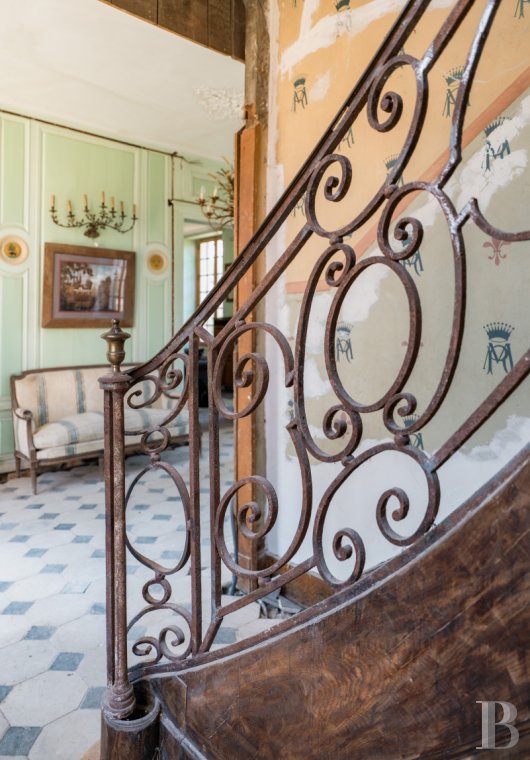
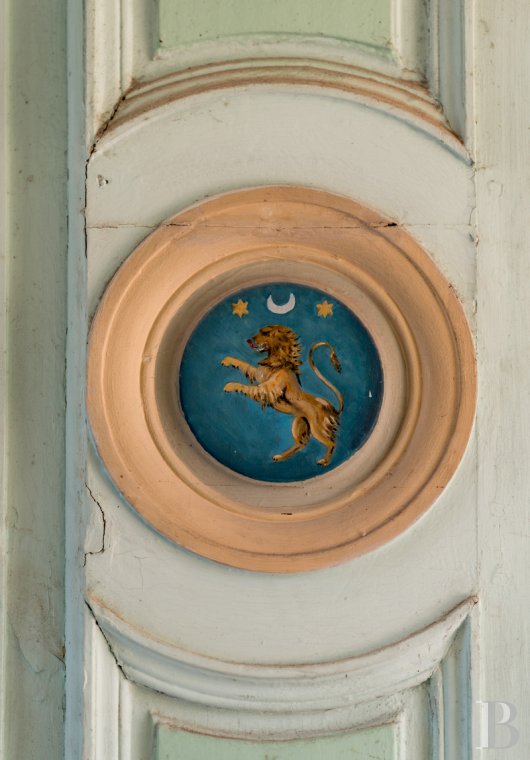
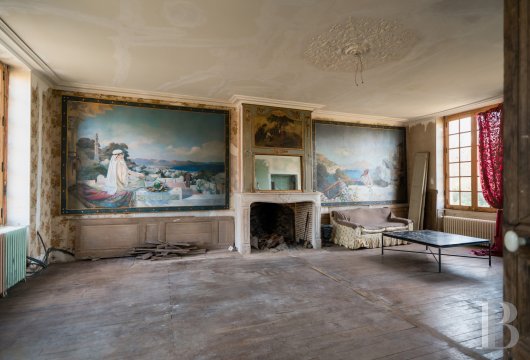
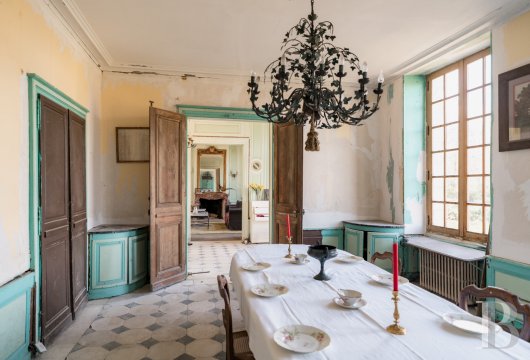
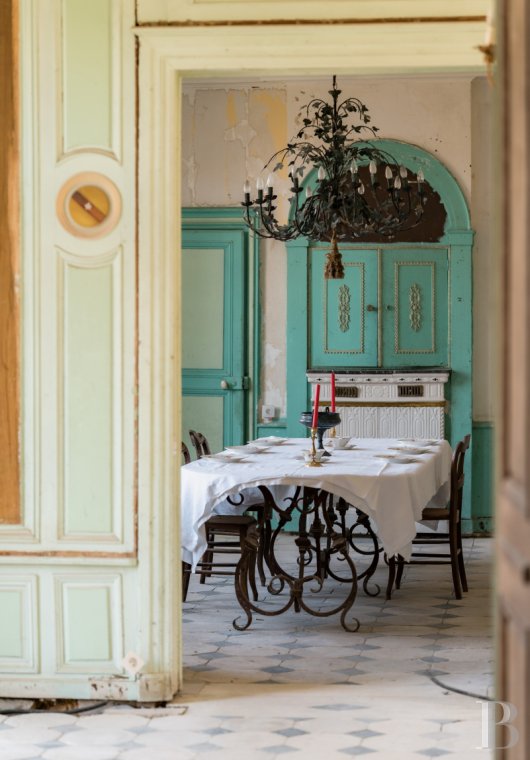
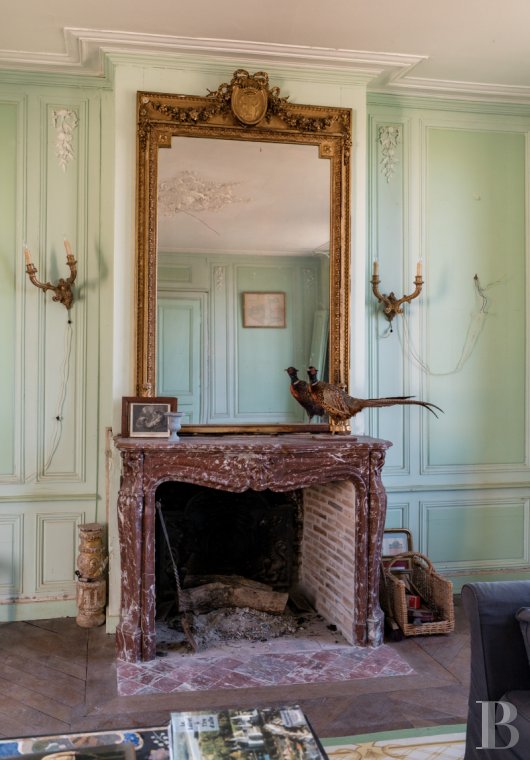
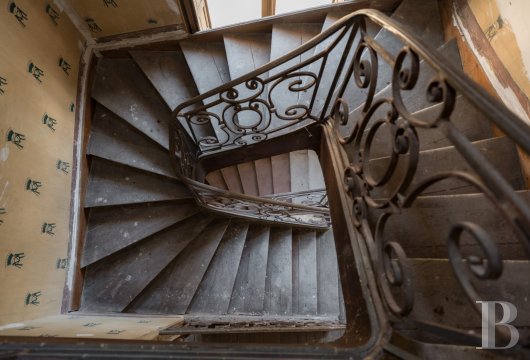
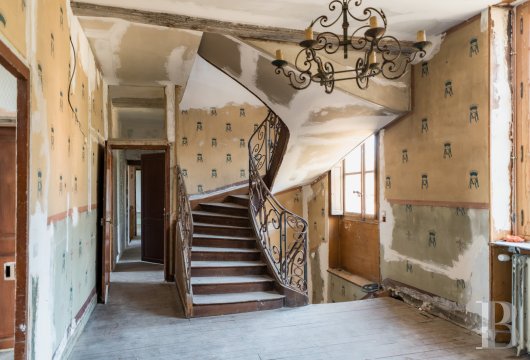
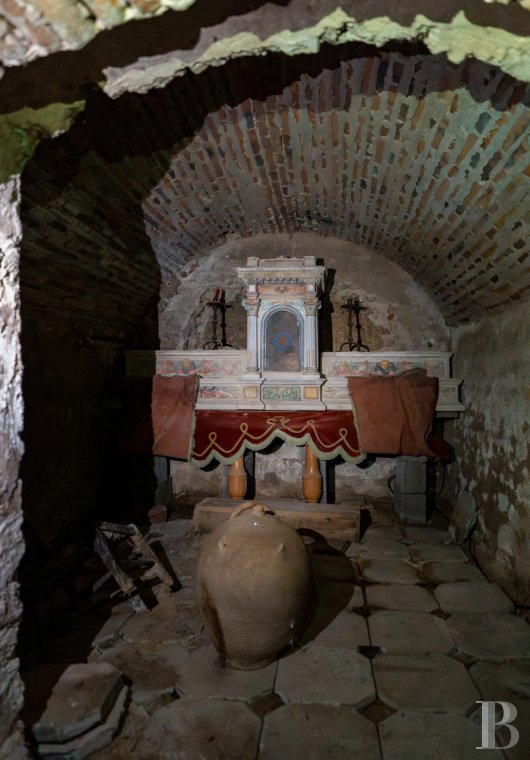
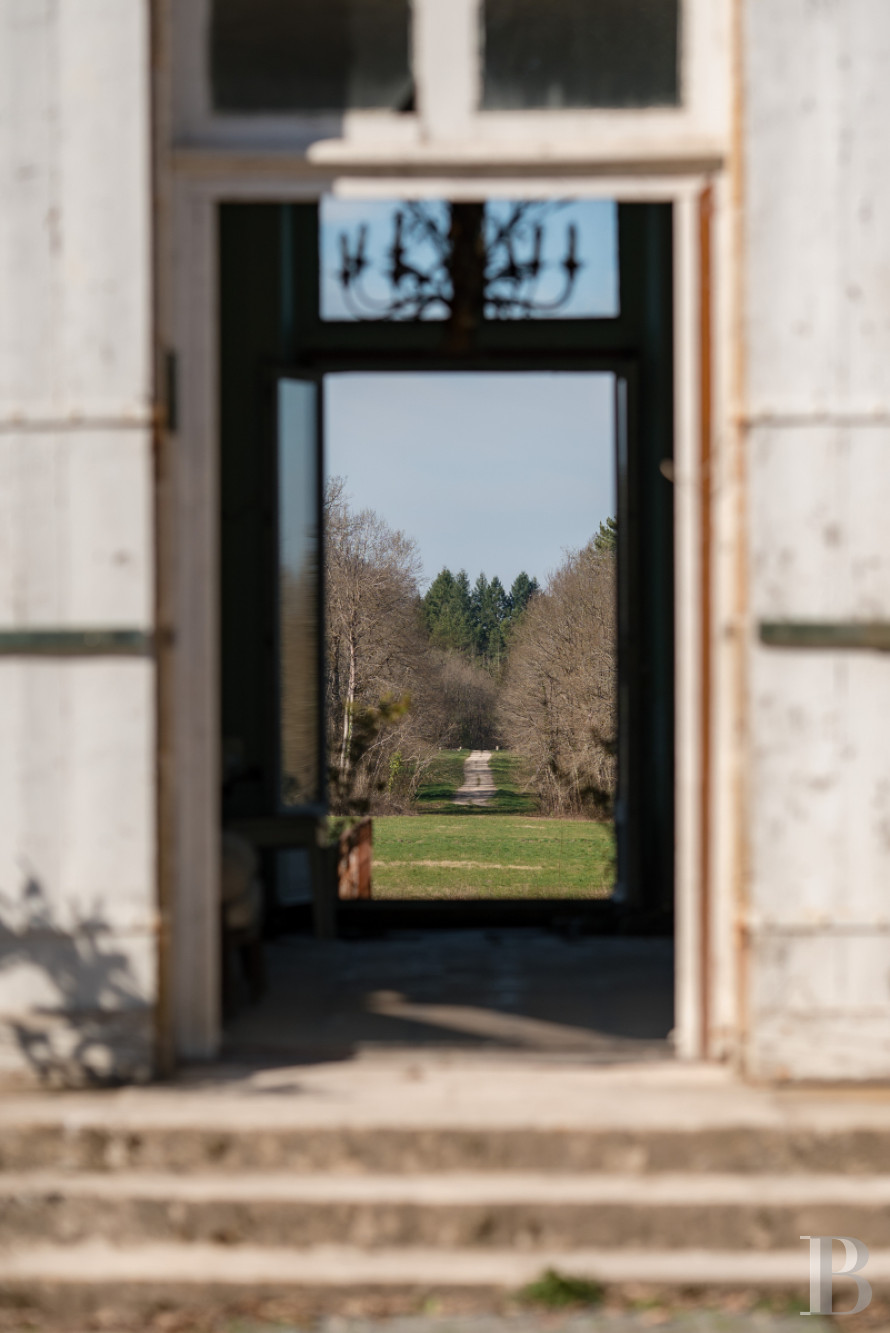
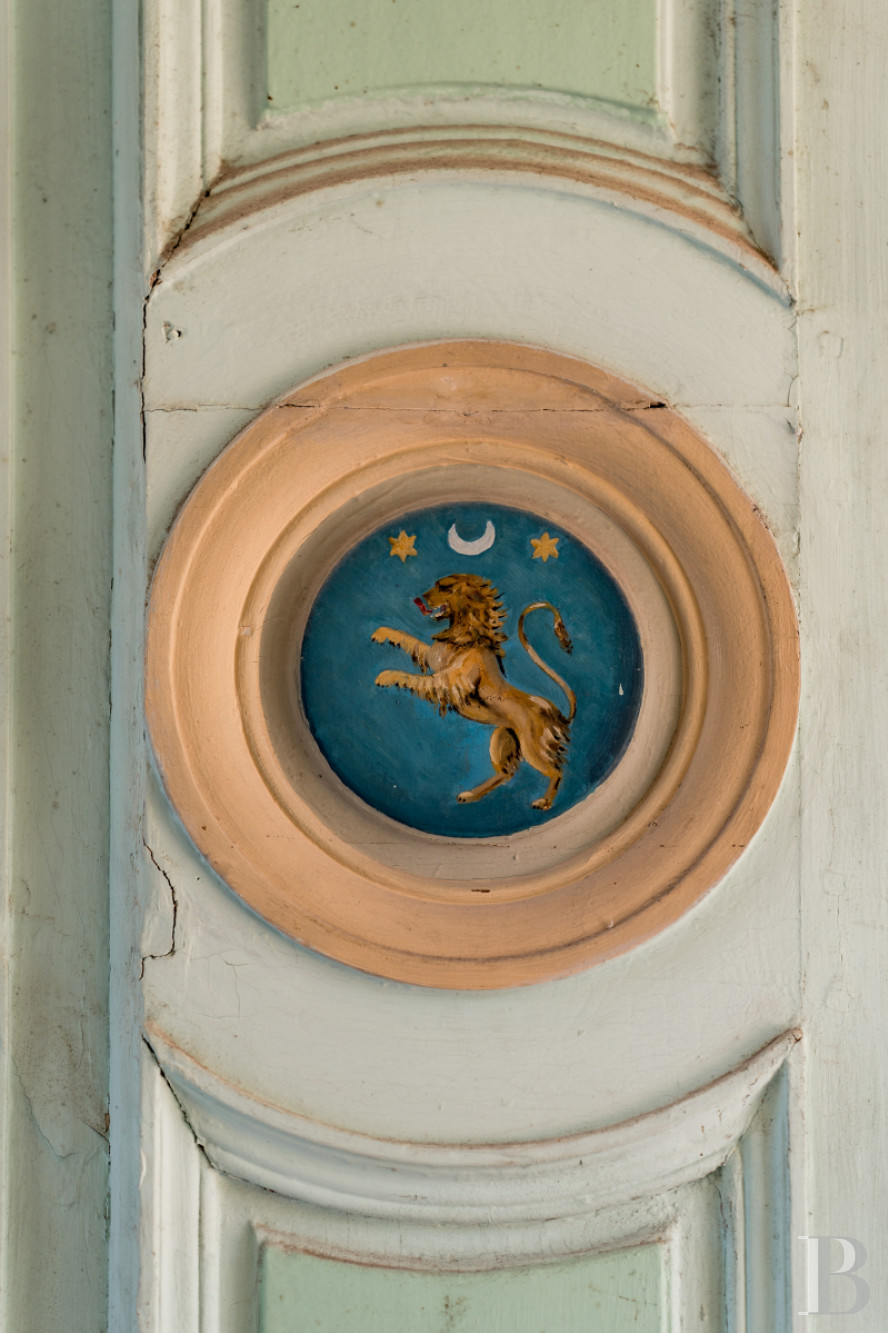
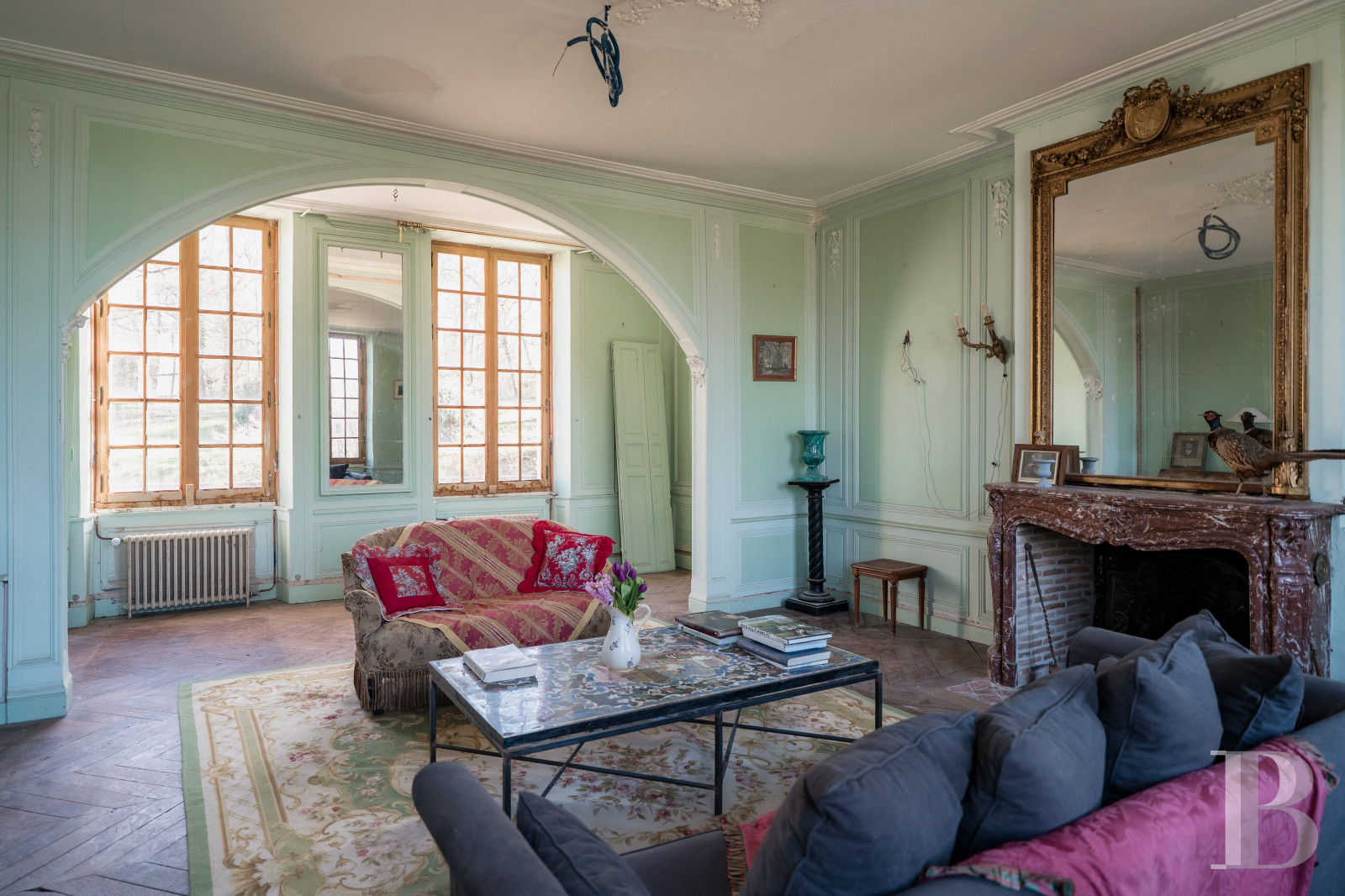
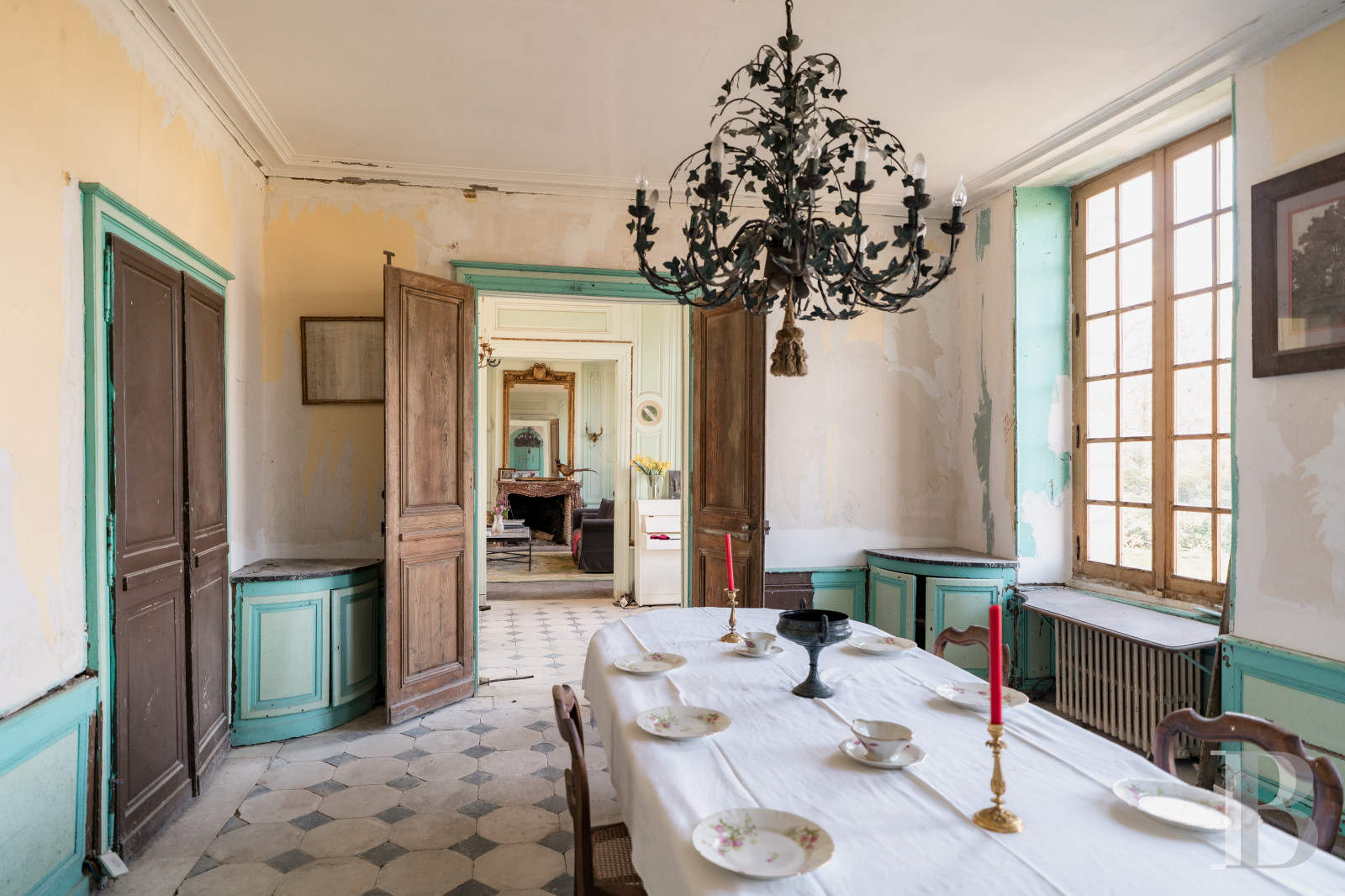
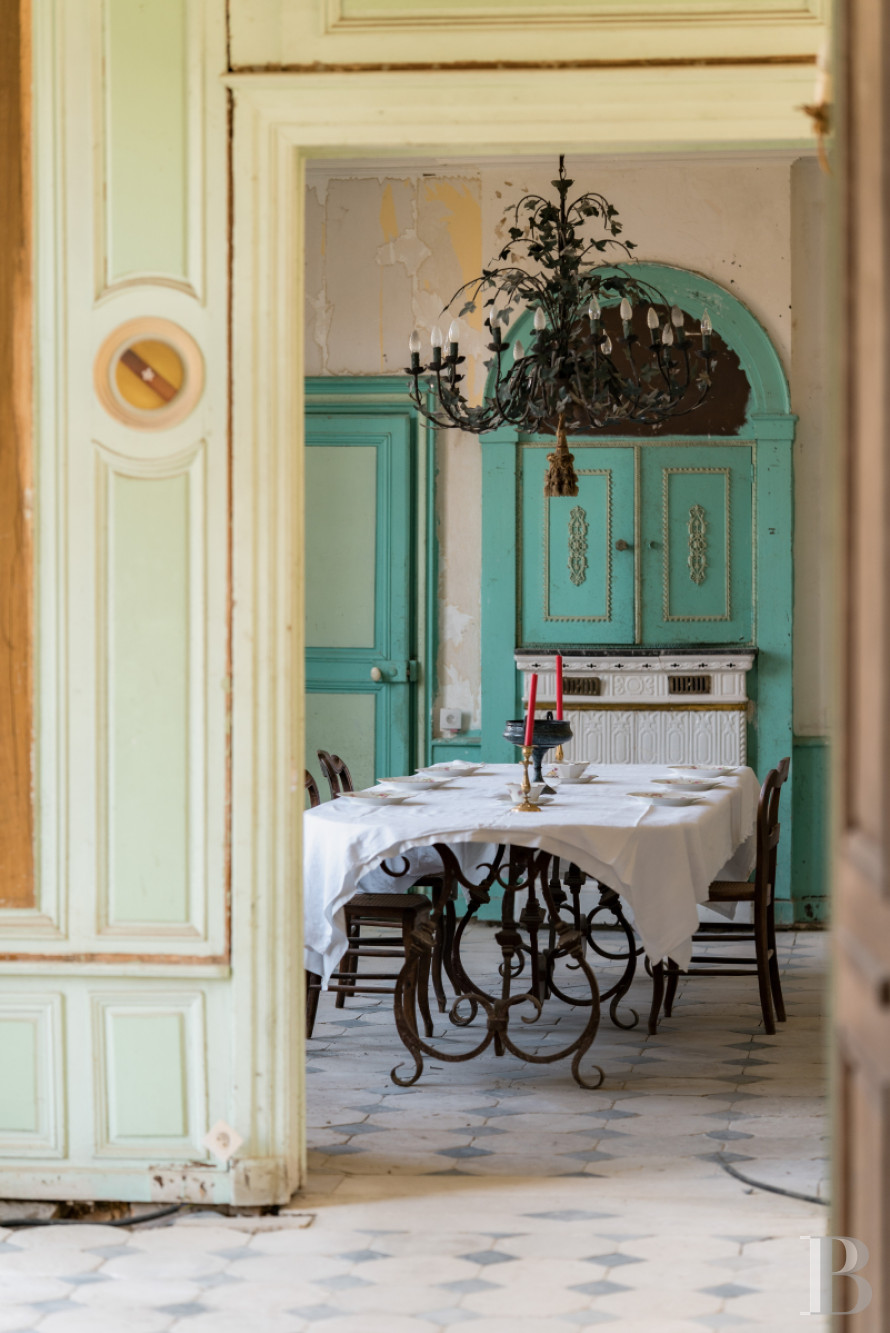
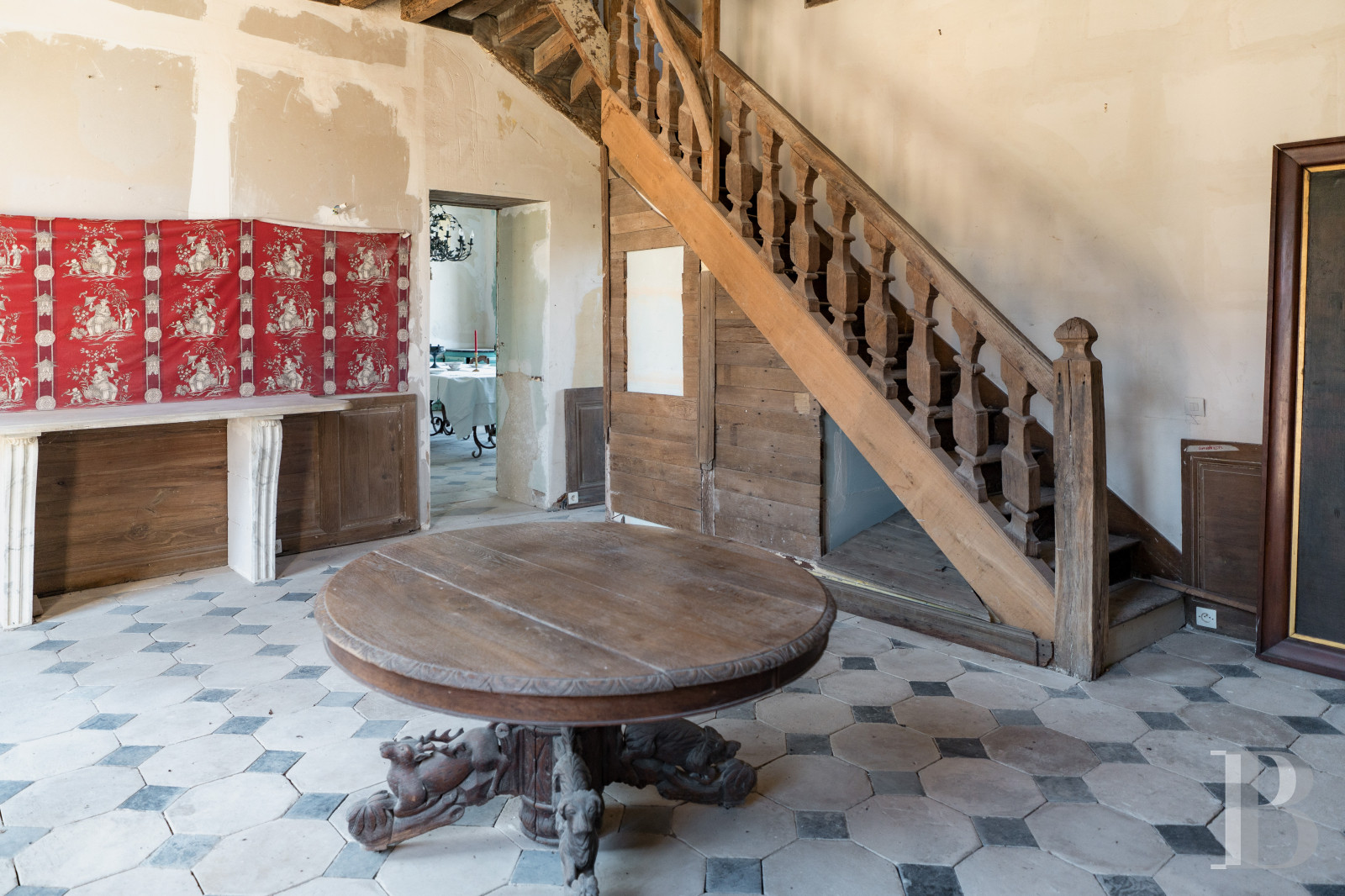
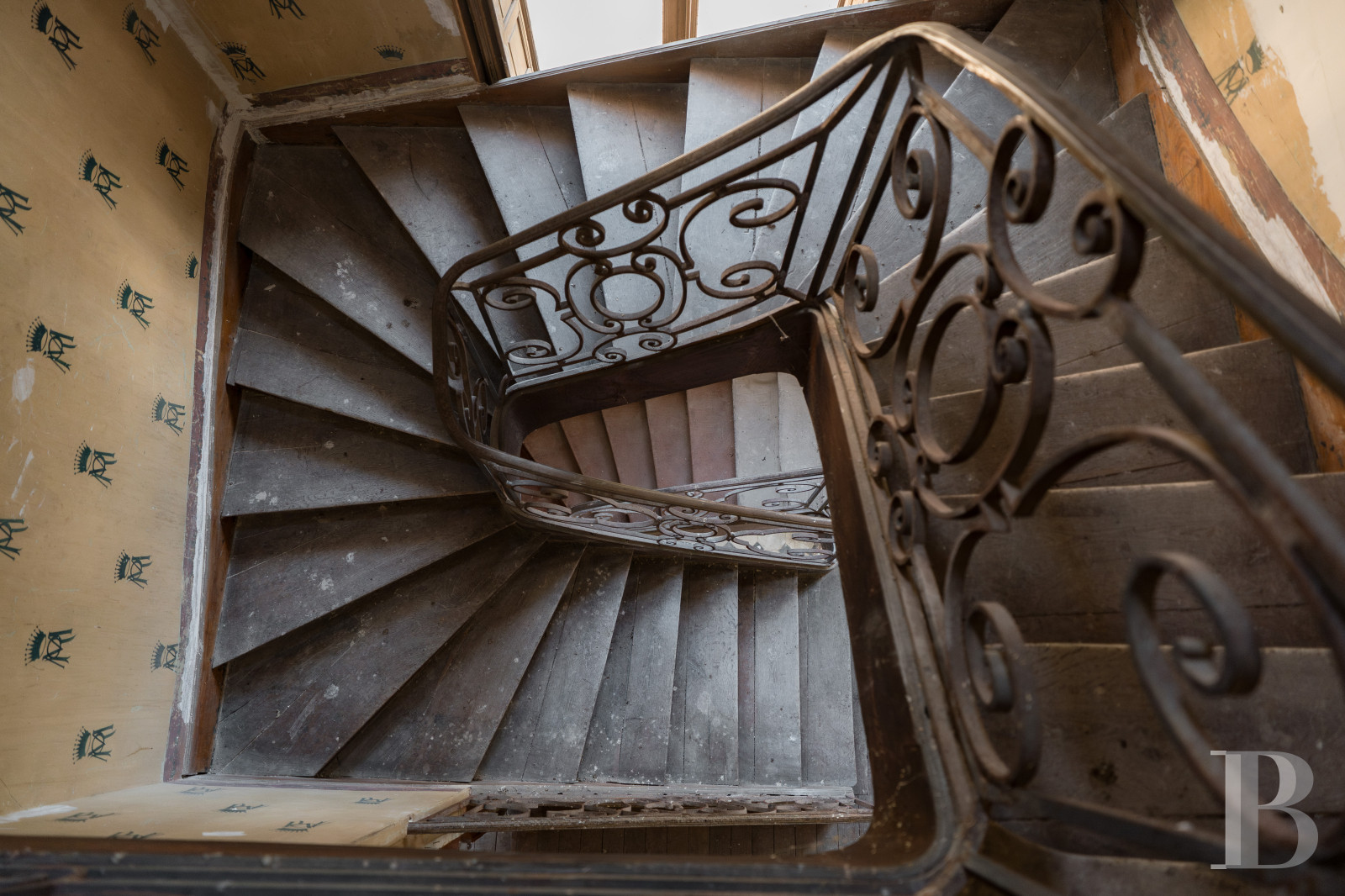
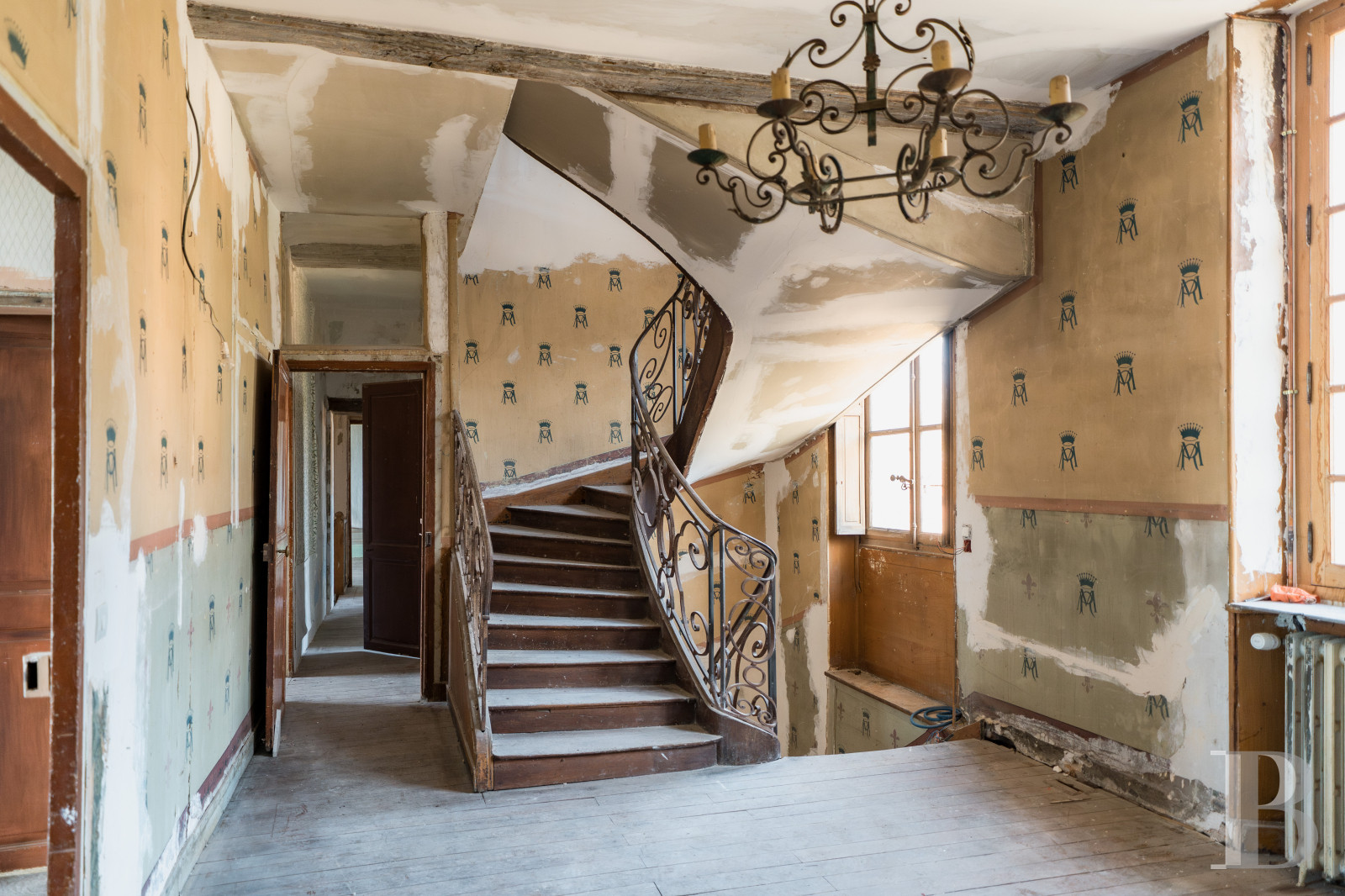
In the entrance hall with taco tiling that runs through the house, a wooden staircase with a wrought-iron banister climbs to the upper floors. The stairwell is adorned with wallpaper bearing the initials of the people who had the mansion built. The vestibule boasts a striking decoration thanks to its wood panelling adorned with small, painted medallions. A double-leaf oakwood door opens into a first lounge with an open-hearth marble fireplace topped by a trumeau mirror. Panels with large frames, finely crafted mouldings, an alcove adorned with shells at its edges and chevron parquet flooring enhance the room’s splendour. A second lounge boasts a marble fireplace above which there is an overmantel depicting a rural scene. Both of the lounges are dual aspect and are fitted with interior shutters. From the hall, a door leads into the dining room which is bathed in light and fitted with an Austrian style wood burner tucked away in an alcove between two openings. The flooring is the same as in the entrance and cupboards have been installed in the corners at each end of the room. It is adjacent to a smoking room boasting period wall panelling and Versailles parquet flooring. A wooden door opens onto a staircase leading down to the cellar where there is a small oratory.
Back in the dining room, wainscotting, a ceiling rose and painted floral decorations give the room a cheerful feel. Through a door, there is a fitted kitchen whose floor is paved with Burgundy stone slabs beneath a French-style beamed ceiling. A marble console topped by several shelves lends itself to displaying period crockery. Next, there is the former hunting room, with exposed beams on the ceiling, black and white taco tiling on the floor, as well as a stone fireplace. Opposite the hearth, a marble console radiates its beauty throughout the room. A staircase with oakwood balusters and a handrail climbs to the first floor.
The first floor
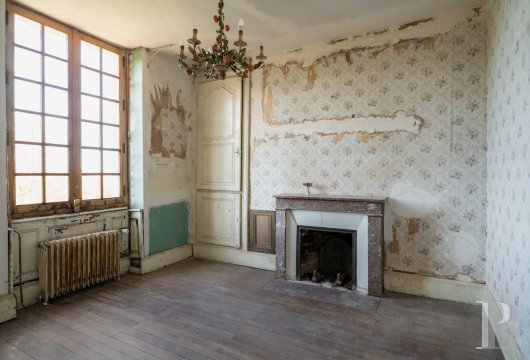
A corridor leads to the bedrooms, which face either north or south towards the inner courtyard, the latter of which are all different. The spacious first one boasts an aristocratic character through its dimensions and oakwood alcove that highlights the period wood panelling, while a stone fireplace further enhances the room. The second one possesses wainscotting, straight oakwood stripped flooring and an open-hearth marble fireplace. Next, to it, there is a bathroom and a lavatory. The third bedroom also boasts oakwood stripped flooring, an open-hearth marble fireplace and is fitted with cupboards. It is followed by bathroom with a lavatory and exposed beams, in which terracotta tiles are available for installation. Two marble washbasins stand on a marble countertop, while the bathtub boasts a moulded oak veneer finish. At the end of the corridor, a large hallway houses a staircase with a finely crafted metal handrail that descends to the entrance on the ground floor. Two other bedrooms complete this level, one of which is wallpapered with toile, a typical 18th-century feature. The hallway leads to two other rooms with fireplaces and straight oakwood stripped flooring. Both have adjoining bathrooms with lavatories. Light streams into the last two bathrooms via a diamond shaped glass screen.
All the baths, taps and lavatories are new and have never been used.
The second floor
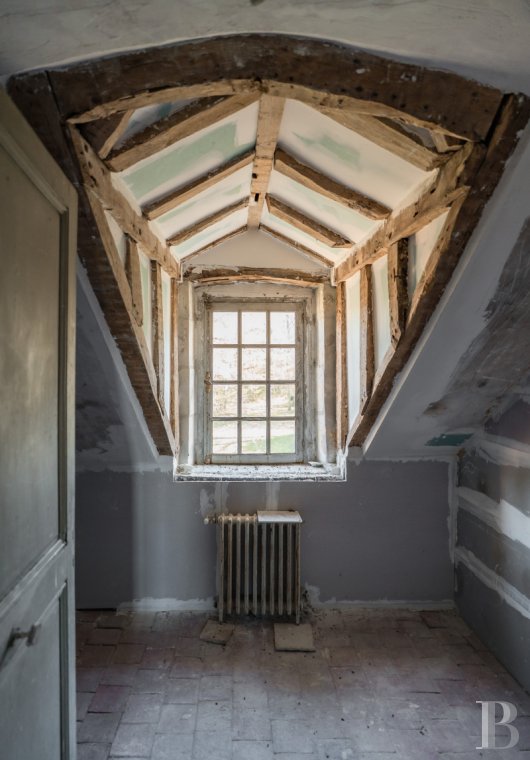
A corridor paved with terracotta tiles runs through the last level beneath the rafters, leading to three bedrooms to be restored as well as four other rooms that could be used as storage space or walk-in wardrobes. This level boasts two bathrooms with lavatories as well as a fitted kitchen. At the end of the corridor, a very large room with an exposed roof frame could be used as a cinema room and possesses a terracotta tiled floor as well as a fireplace.
The chapel
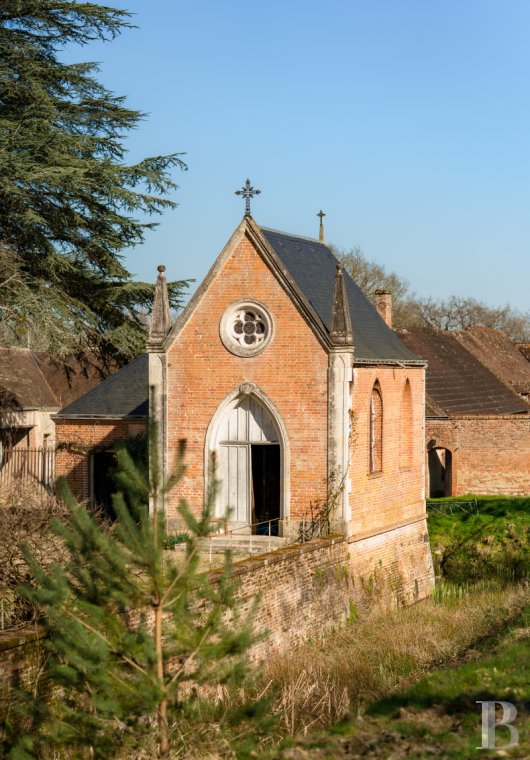
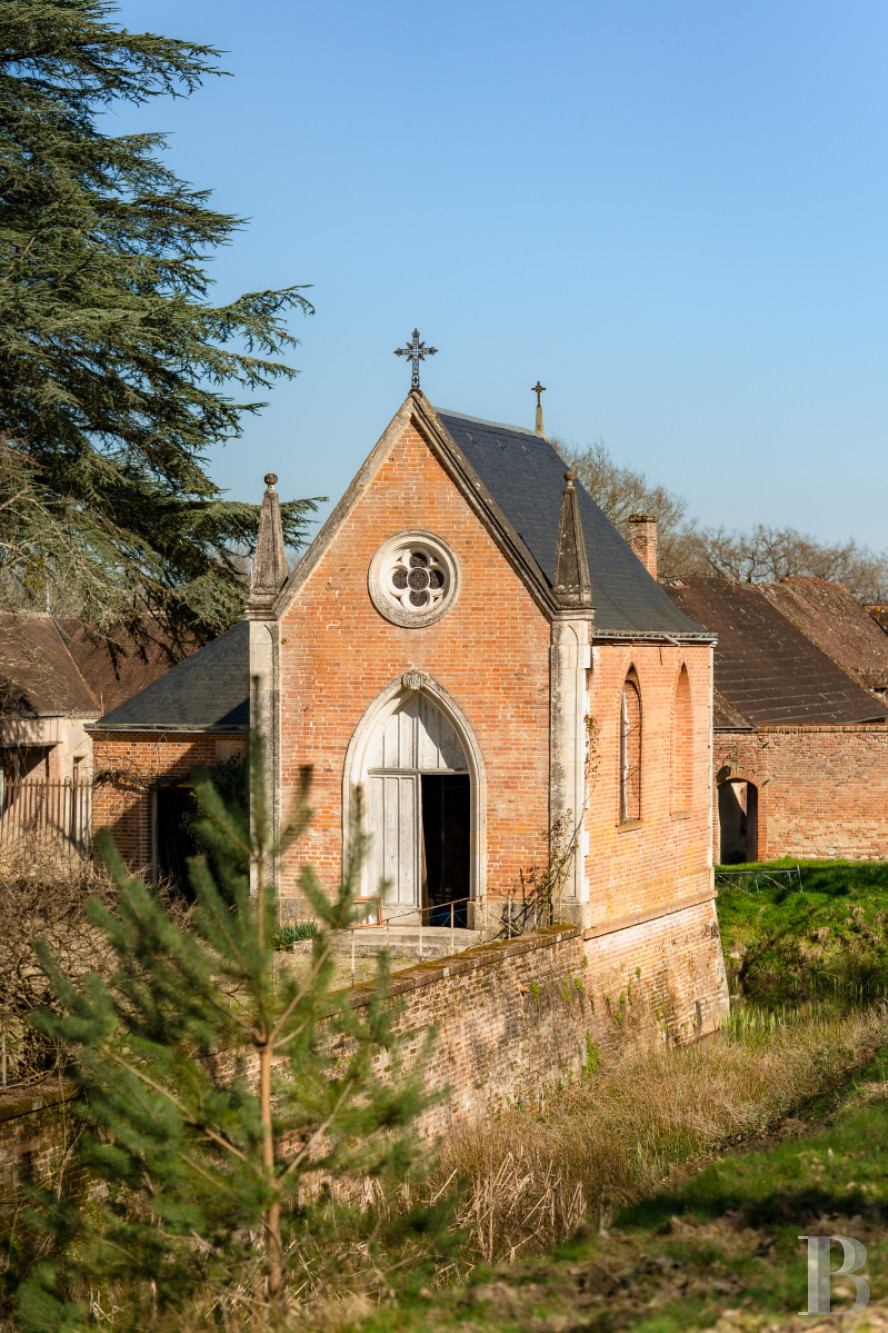
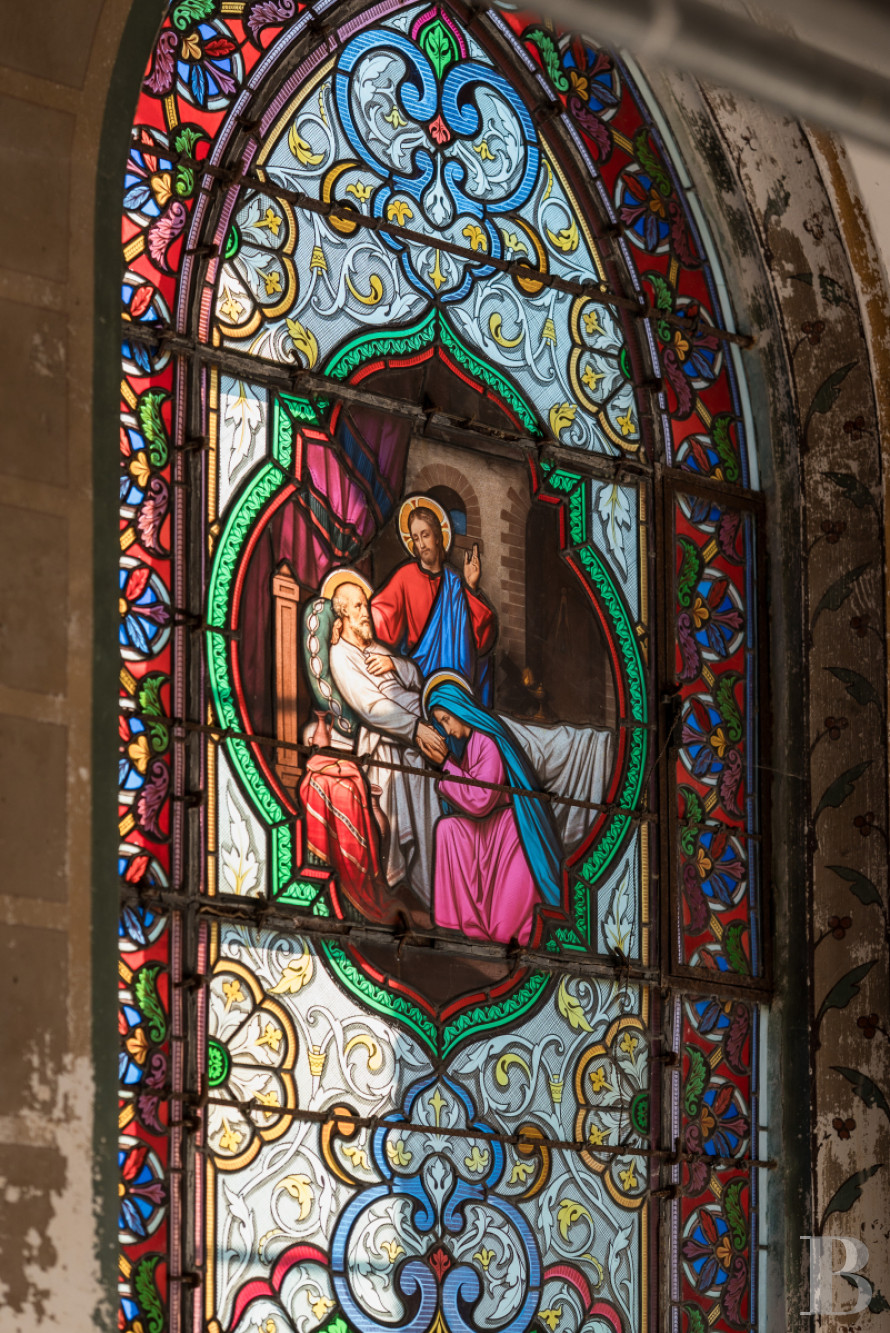
This neo-classical, approximately 30-m² building boasts taco tiling on the floor and is dominated by a painted pointed arch. Its brick-made main facade is framed by two stone pillars. It can be reached through a double-leaf, extended equilateral arch shaped wooden door, topped by a four lobed stained-glass window. Inside, there are two stained glass windows depicting The Last Supper and The Virgin Mary. Friezes of fleur-de-lys surround each stained-glass window. On the alter, an engraved marble slab bears witness to the fact that the chapel, which is now private, was once consecrated. An approximately 8-m² vestry, where the priest prepared for the service, stands adjacent to the chapel. Lastly, outside, there is an around 5-m² lean-to paved with octagonal terracotta tiles.
The caretaker’s house called ‘the pavilion’
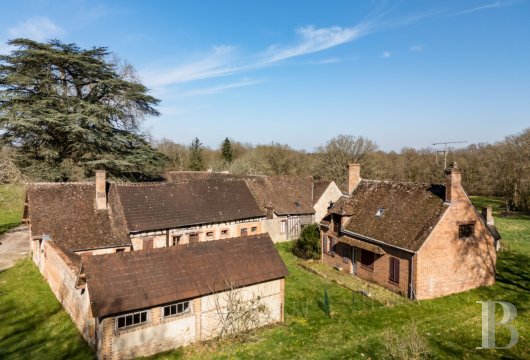
Near to the mansion, there is a caretaker’s house whose architecture is typical of the Sologne sector. Its brick facade is punctuated by several windows with wooden shutters. The gabled roof includes a hipped wall dormer window and skylights, while an awning overhangs the main entrance.
The ground floor
The entrance opens directly into a large room, adorned with wooden pillars and an open-hearth fireplace, which is followed by a second room decorated with an alcove and a fireplace. All the openings are double glazed. On the other side, there is a kitchen fitted with many cupboards, followed by a tiled shower room with a washbasin. A solid wood staircase climbs from the first room to the upper floor.
The upstairs
A landing leads to a lavatory with a hand-washbasin and then three carpeted bedrooms, into which light streams through skylights. One of them boasts an exposed roof frame.
The outbuildings
The caretaker’s house possesses its own outbuildings. Nearby, there is a large, around 87-m² agricultural storage building hooked up to the electric network, plus kennels, a brick-built cold room and a well. Former rabbit hutches and pigsties stand to one side, while other buildings complete the inner courtyard. A double-leaf wooden door leads into one of the outbuildings, as does a security door that opens into an approximately 30-m² room, followed by another which is larger than 30 m² and finally a third, with a surface of more than 25 m². Above them, a loft with the same surface awaits conversion. Behind the caretaker’s house, an around 12-m² workshop stands opposite the kennels. All the roofs and the guttering have been restored.
The mansion’s outbuildings
Surrounding a central courtyard, there are farming buildings whose architecture remains coherent with the pavilion and its own outbuildings. The facades are made of bricks in a herringbone pattern and the roofs are made up of flat local tiles made on site. One of the buildings houses several rooms: a first one boasts a surface of approximately 15 m² plus exposed beams and a fireplace, followed by a larger second room with a surface of around 50 m² and a final room with half-timbered walls. A technical installations building with a surface of approximately 40 m² houses a brand-new wood-fired boiler and fuel-oil tank. A more than 70-m² barn and a more than 15-m² storage room complete the outbuildings.
The former orchard and vegetable garden
They are surrounded by walls and situated near to the outbuildings, containing fruit trees such as pear, apple, quince and apricot. Several stone statues decorate the zone. An old greenhouse is used to store terracotta flower points as it awaits a new purpose. A row of box hedge lines a path linking the two entrances into the orchard, which are marked by stone pillars, between which there is a double-leaf gate topped by a cross, which could point to the possibility of it formerly housing a cemetery for the mansion’s inhabitants.
The grounds
They have retained the original layout and the tracks running through it are well maintained. They boast remarkable several hundred-year-old trees, lawned areas, ‘Pierre de Ronsard’ rose bushes in the inner courtyard and various types of flowers that brighten up the many stone vases. Old oaks stand alongside Lebanon cedars, sequoias and copper beech trees. Opposite the mansion, there is a vast pond teeming with large carp. The grounds are bordered by approximately 35 hectares of forest.
The forest
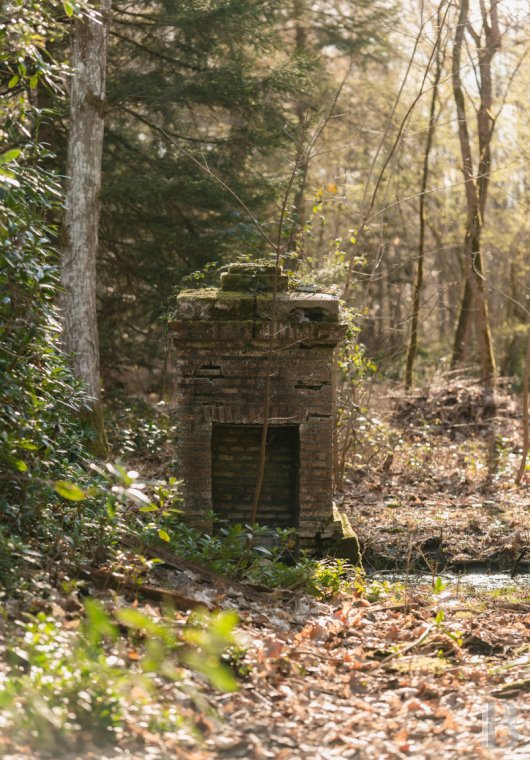
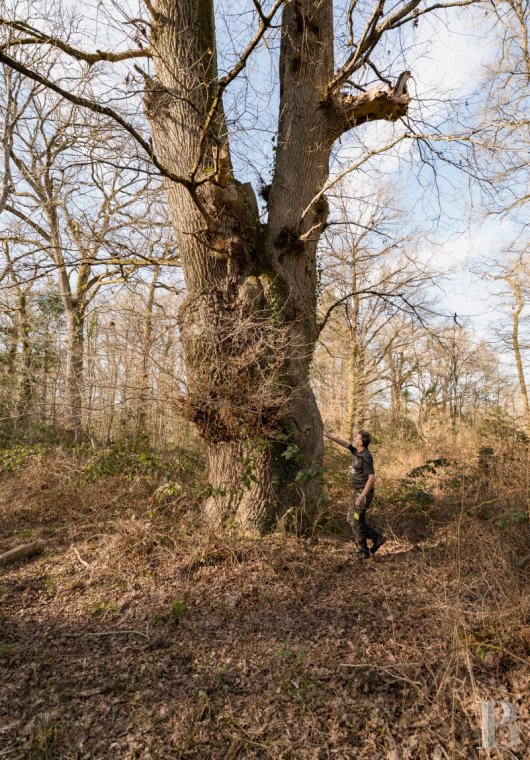
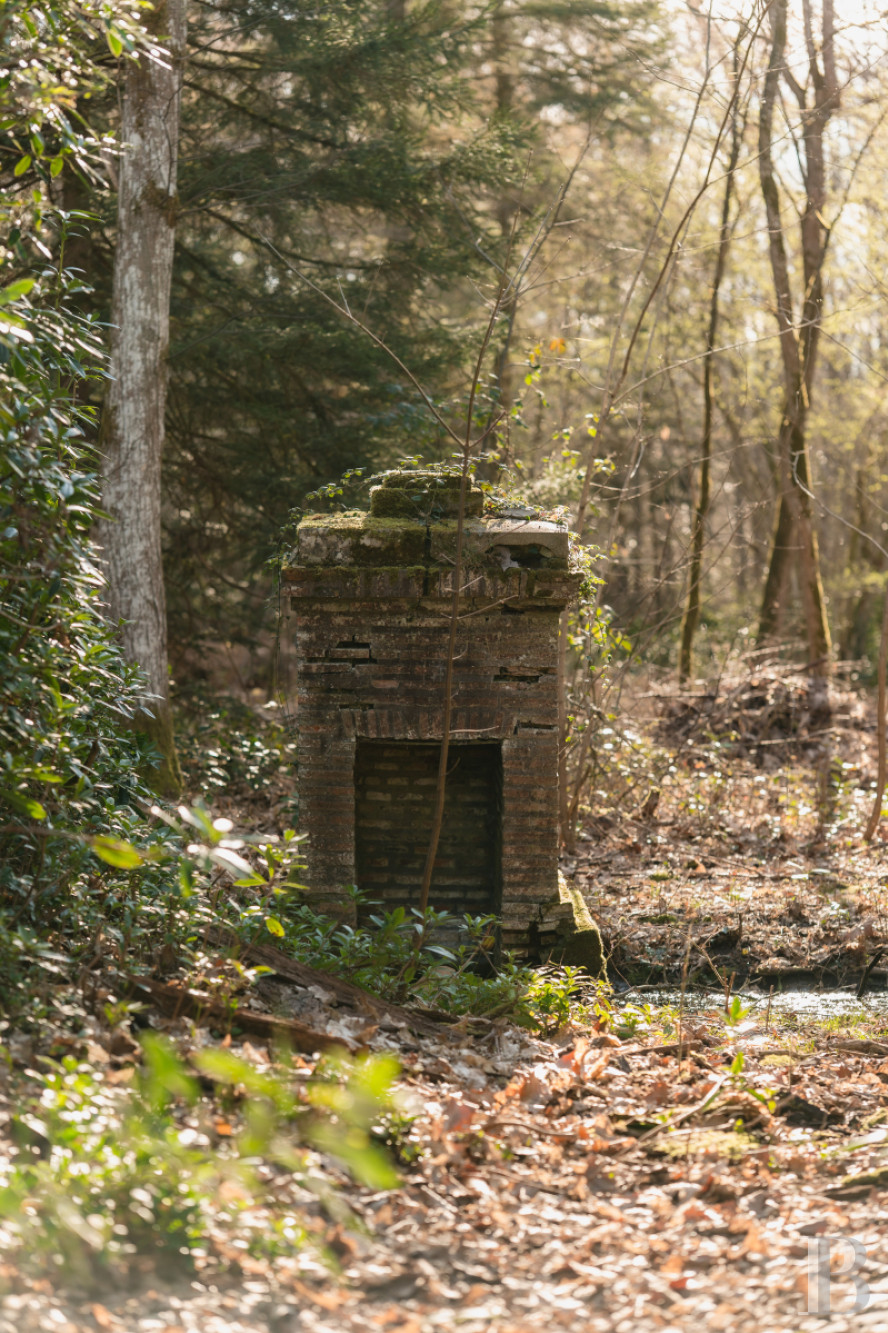
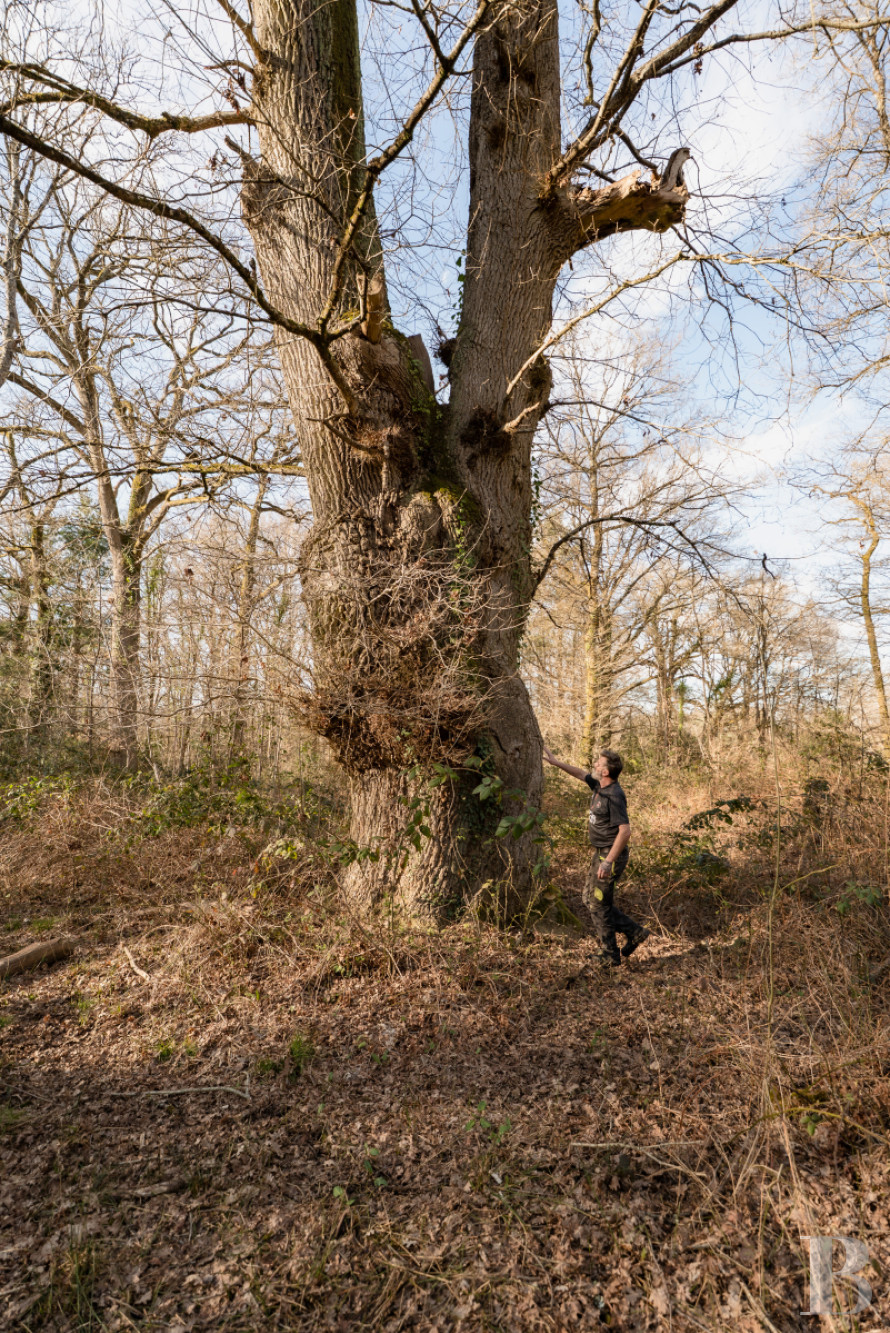
It surrounds the entire property and his home to rich biodiversity, with a variety of species and habitats, as well as unspoilt ponds. Many remarkably old trees stand alongside more ordinary ones. A more than 300-year-old oak has been a landmark on the Saint James Way, with pilgrims leaving the symbolic shells on its trunk. It is located near a spring marked by a small brick monument. There is abundant growth of willow and birch trees as well as ferns, broom and heather. The forest is not currently a managed woodland nor is there a hunting plan.
Our opinion
This elegant residence steeped in history is surrounded by blooming, wild and bucolic nature. It is a family seat that has endured through the centuries, in which the memories of former occupants still echo. There is still some work to be finished, but the structural work was commissioned by an enthusiast of old stones, who was able to preserve and highlight original features. The interior still boasts its authenticity, with parquet flooring, wood panelling, fireplaces and painted décors. It is a property that is rooted in the emblematic landscape of the Sologne sector, combining a forest boasting many types of trees with peaceful ponds. A family, a fishing enthusiast, a solitary rambler, a keen naturalist or an artist could enjoy this unique ambiance, just like the writers Maurice Genevois and Alain Fournier did.
1 540 200 €
Fees at the Vendor’s expense
Reference 501592
| Land registry surface area | 35 ha 28 a 57 ca |
| Main building floor area | 600 m² |
| Number of bedrooms | 10 |
| Outbuildings floor area | 416 m² |
French Energy Performance Diagnosis
Information on the risks to which this property is exposed is available on the website: www.georisques.gouv.fr
Share


NB: The above information is not only the result of our visit to the property; it is also based on information provided by the current owner. It is by no means comprehensive or strictly accurate especially where surface areas and construction dates are concerned. We cannot, therefore, be held liable for any misrepresentation.