



A 19th-century watermill with a reception hall and five hectares of meadows
and woods, nestled inland in Brittany but only 30 minutes from the coast
and woods, nestled inland in Brittany but only 30 minutes from the coast
Saint-Fiacre,
COTES-D'ARMOR
brittany
22720
FR

Location
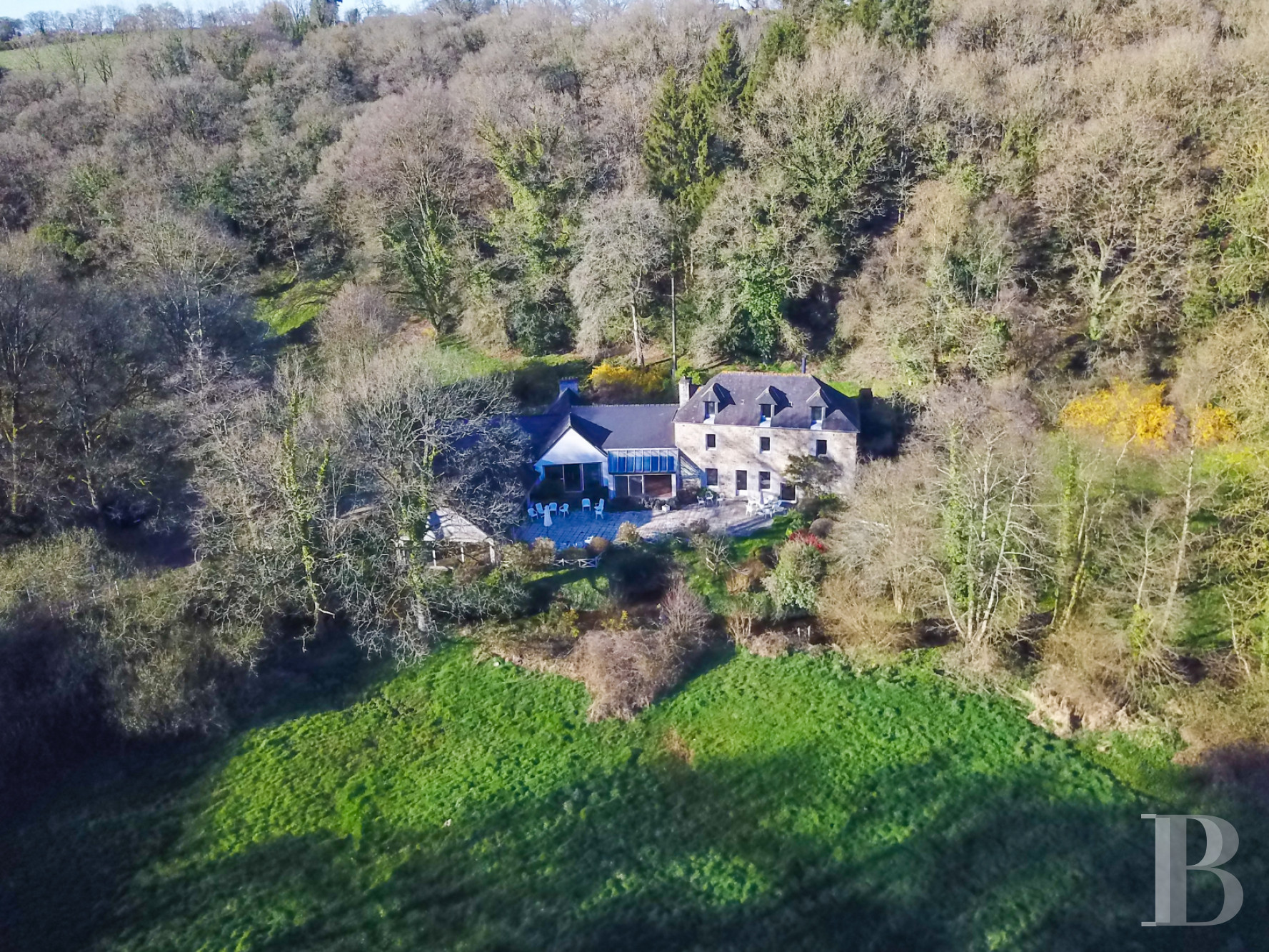
The property is tucked away in calm surroundings, around 20 minutes from the town of Guingamp in Brittany. The former watermill stands in a bucolic backdrop, set back from the urban bustle of the major regional roads. Here, meadows, embankments and woods form a patchwork of lush, dense vegetation. Streams give structure to the land and flow down into the valley of the River Trieux, bringing coolness and ecological continuity. Country lanes run across the unspoilt landscape of farmland that invites you to enjoy rural walks. There are shops and amenities not too far away. And from the train station in Guingamp, you can easily get to the cities of Rennes, Brest and Paris by rail. You can also reach Les Rosaires beach and the town of Saint-Brieuc in only 30 minutes.
Description
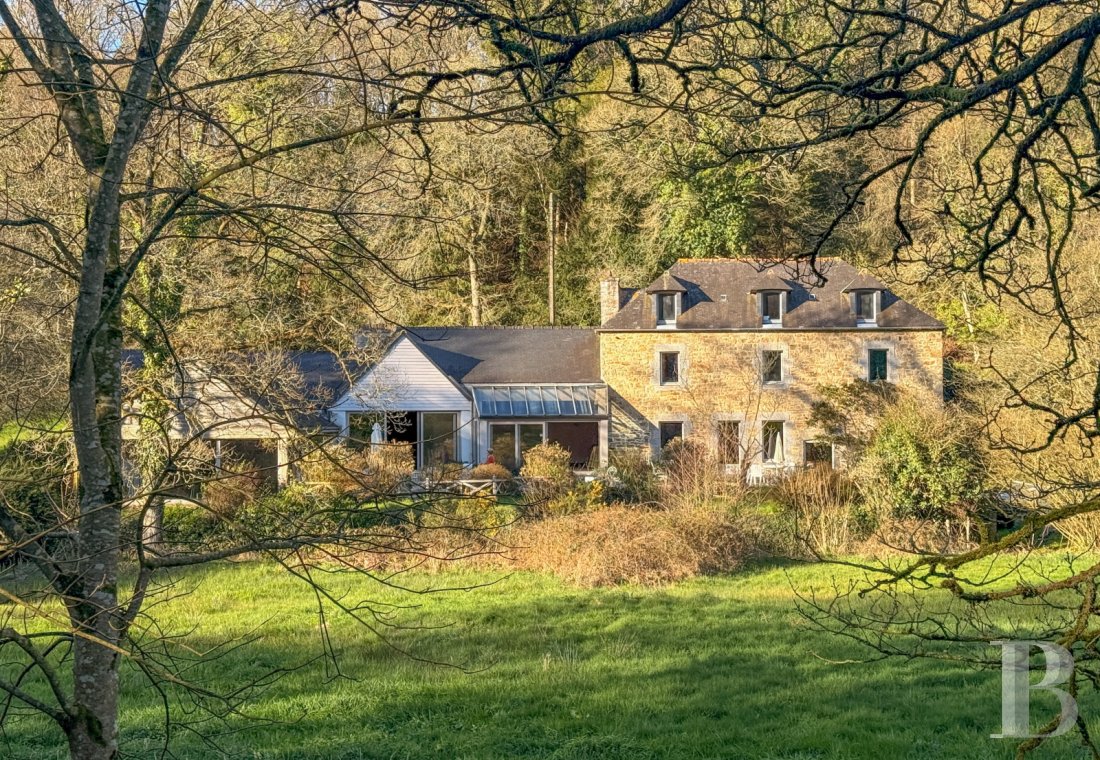
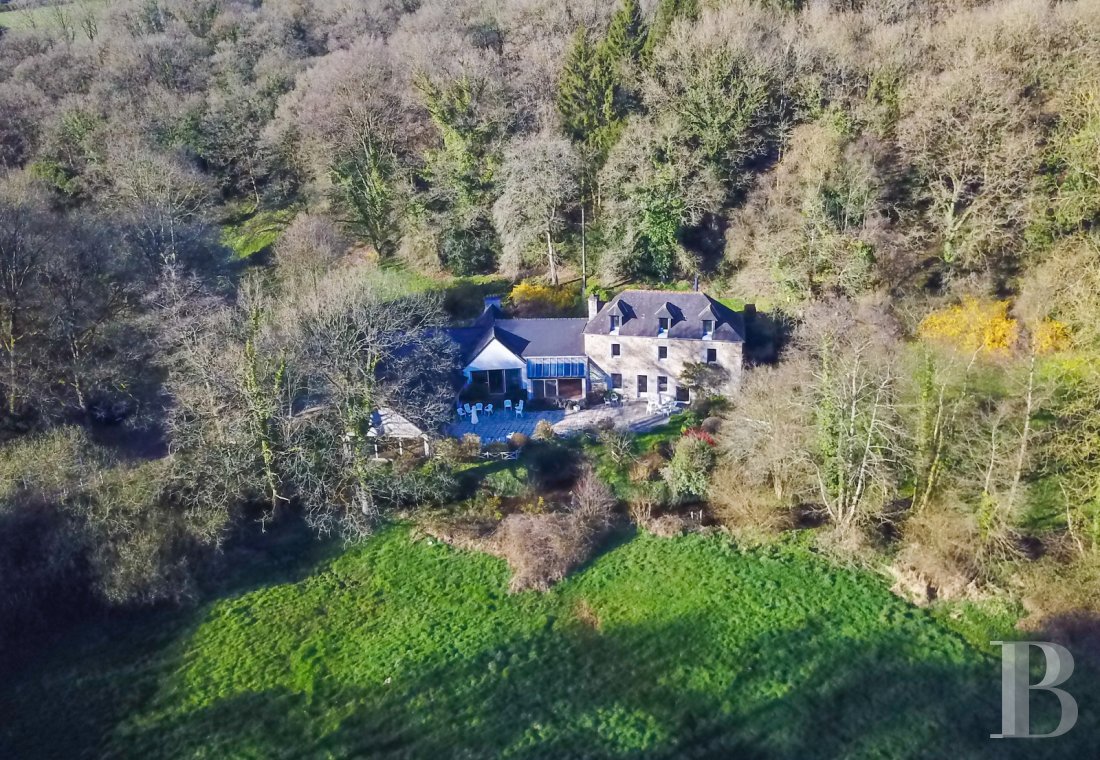
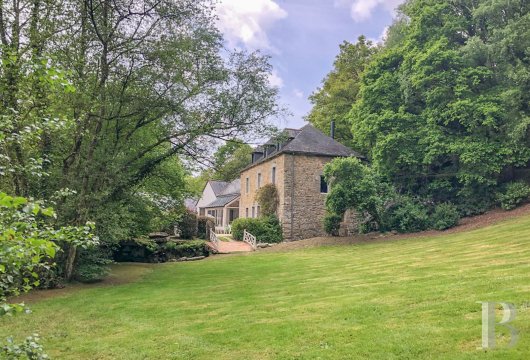
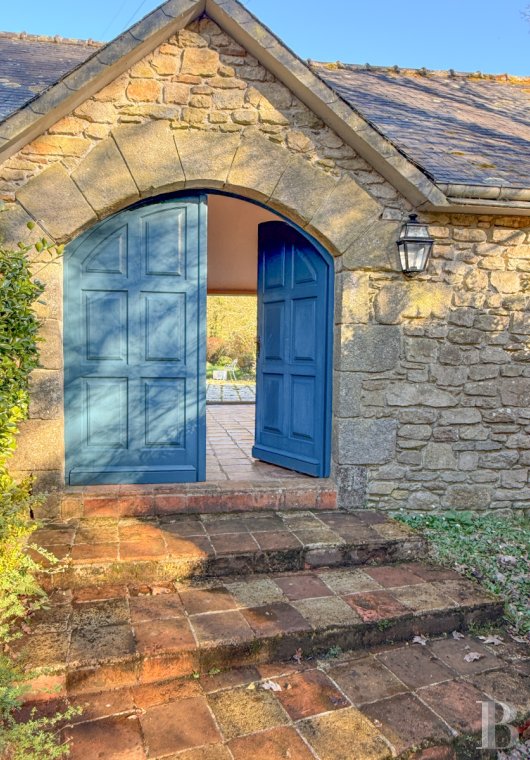
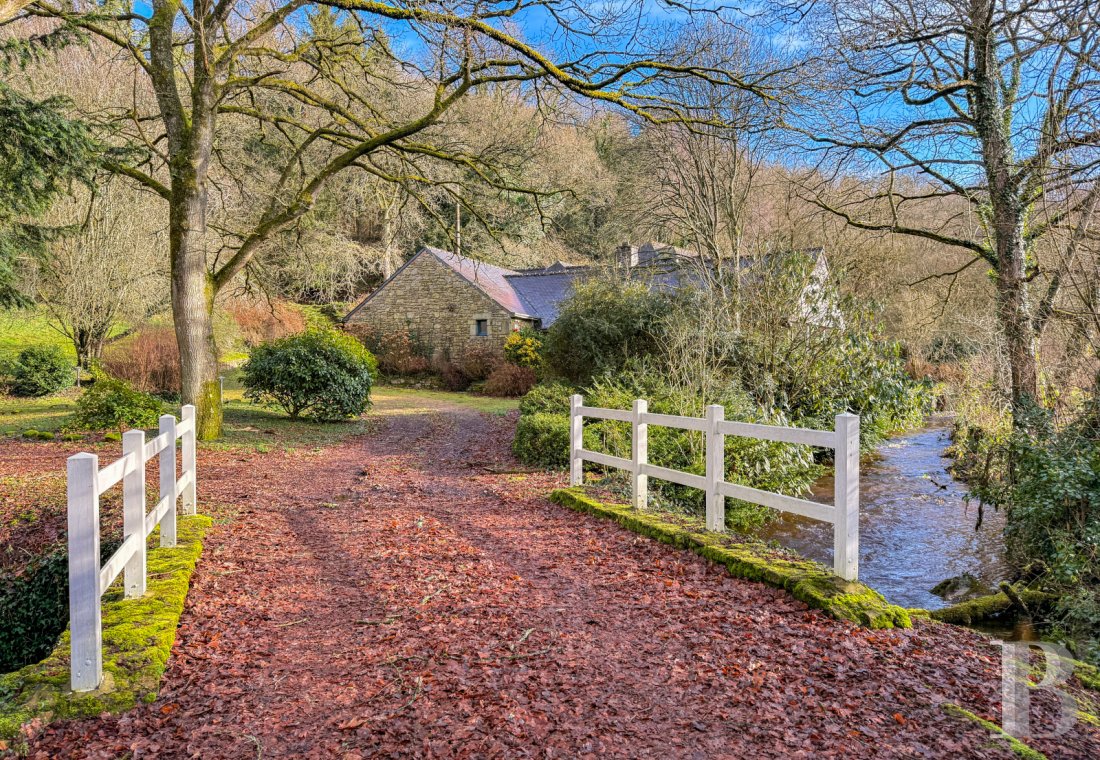
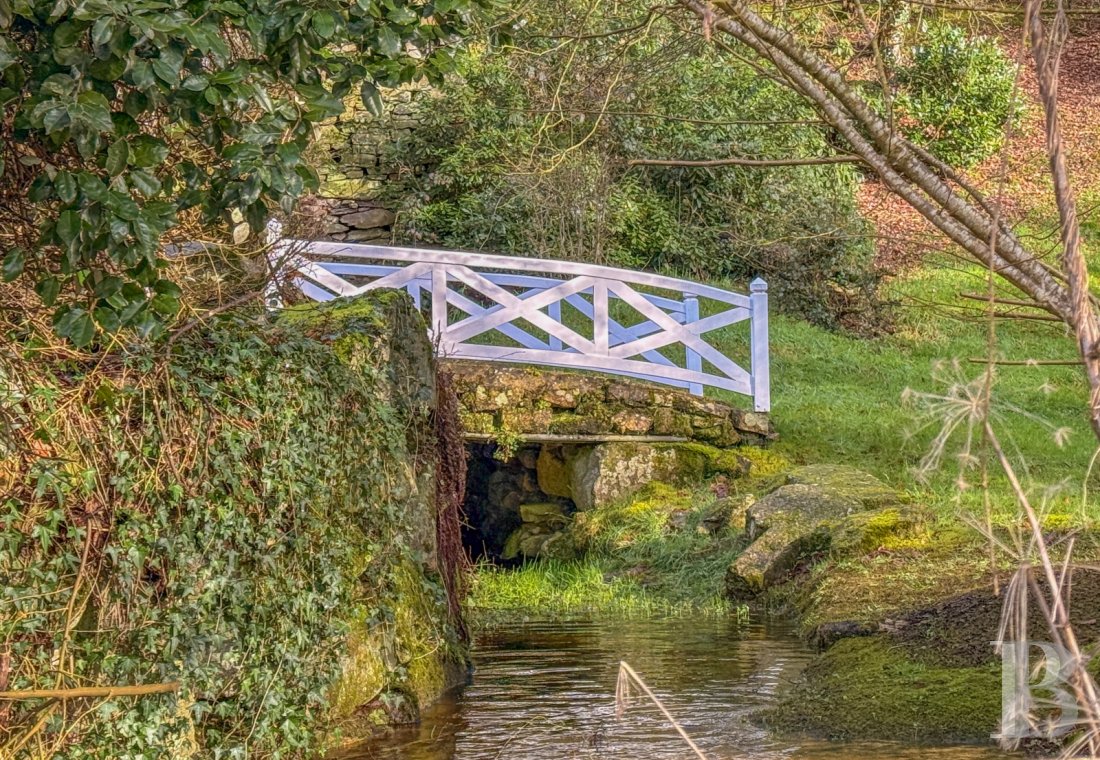
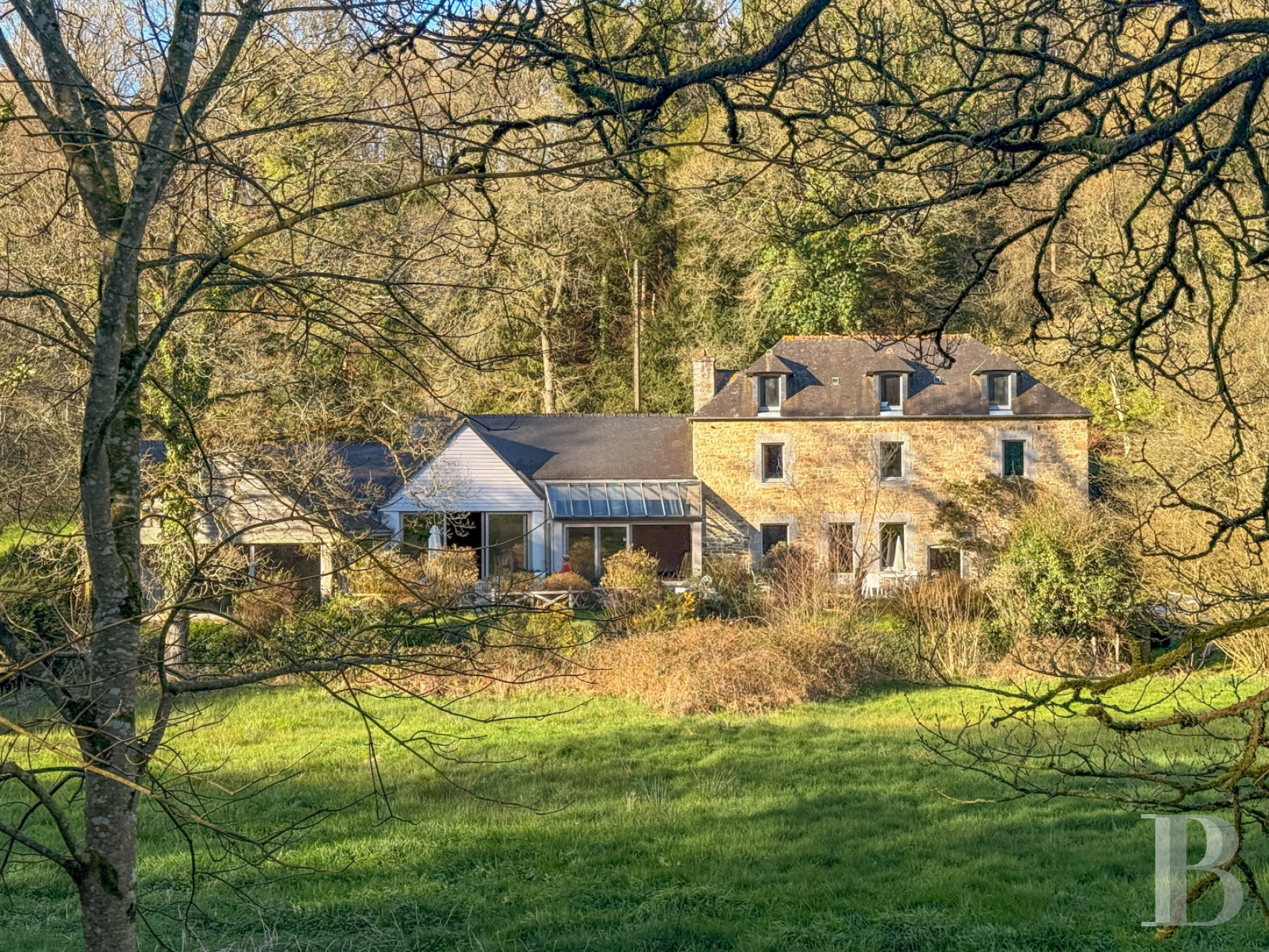
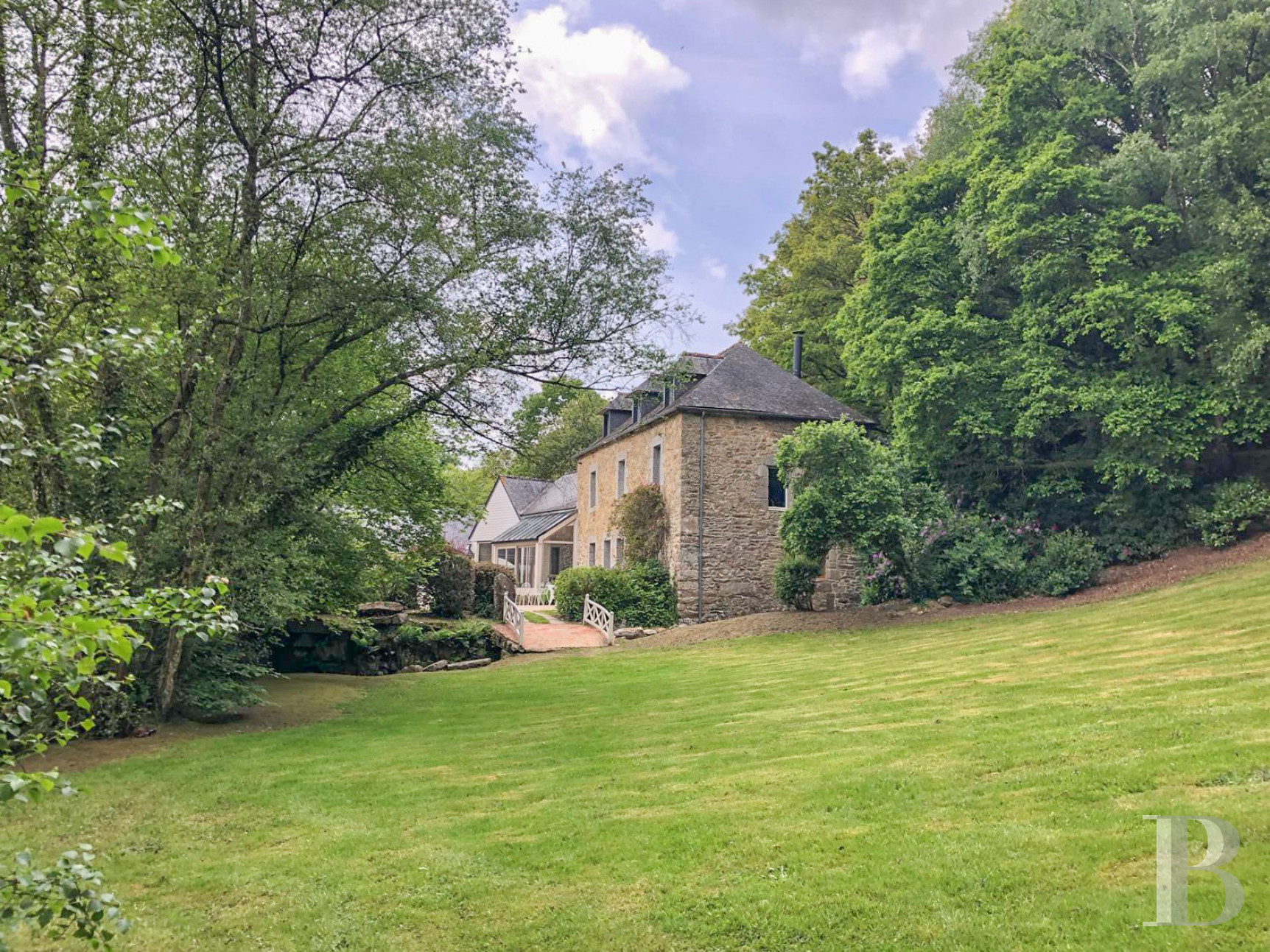
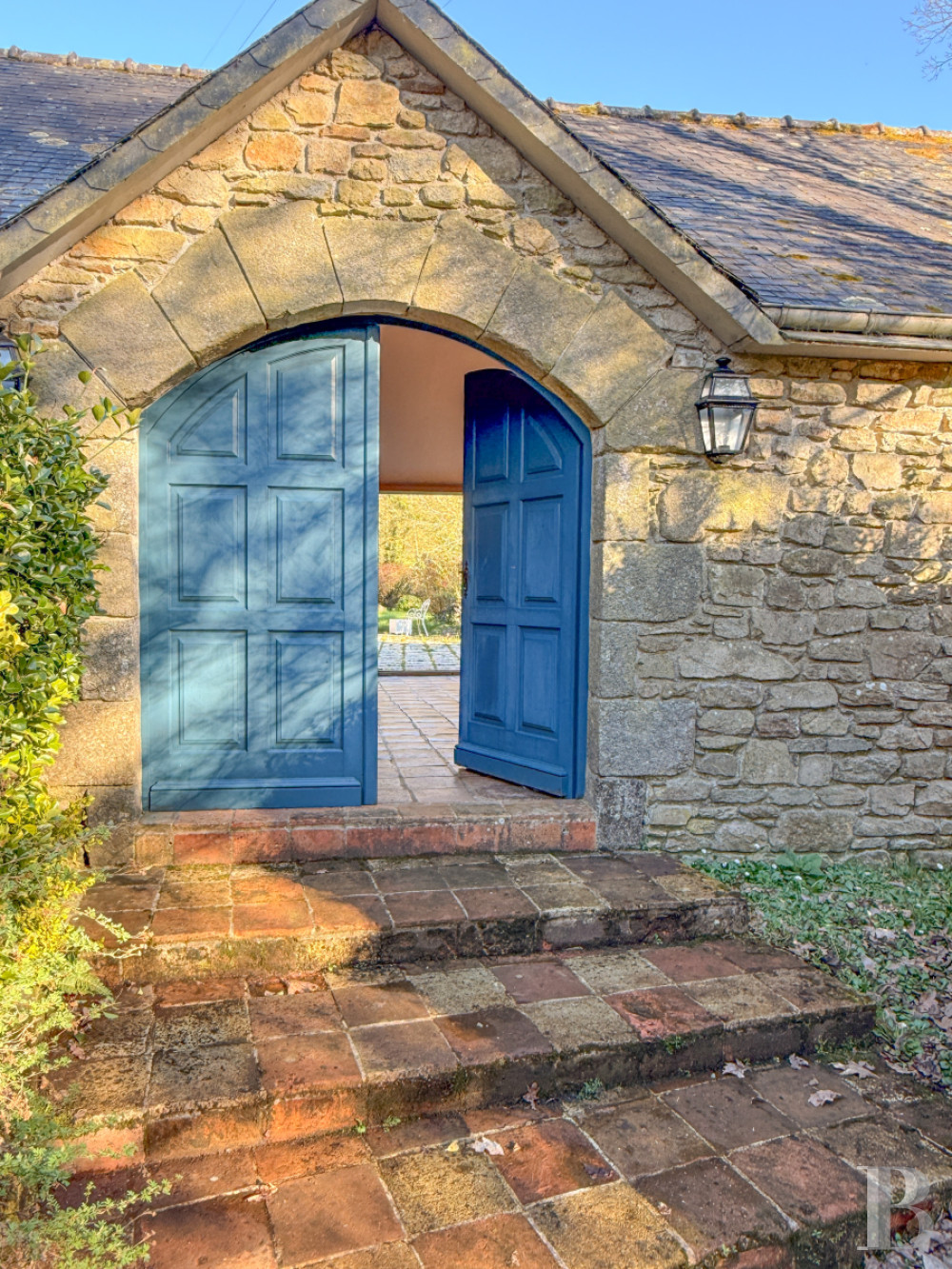
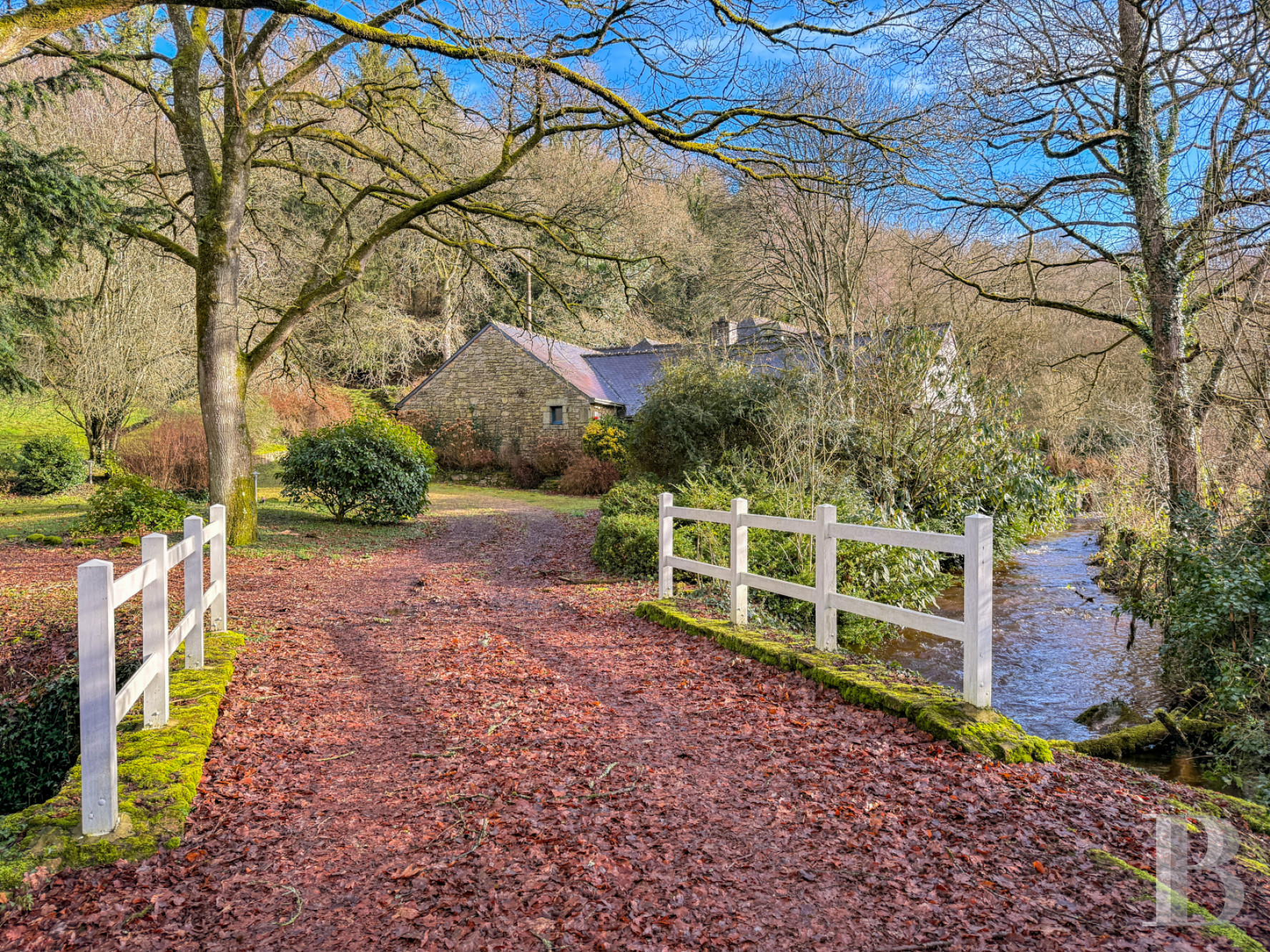
The former watermill is a stone building that stands in the hollow of a small wooded valley. A stream flows beside it, giving structure to the grounds. You reach the property via a tarmacked country lane that slopes down to the valley. You enter the grounds across a little bridge suitable for motor vehicles. This bridge edged with fencing painted white. Just beyond it, there is a circular driveway for turning back around. First, an outbuilding comes into view. It stands out for its broad, arched, panelled double door, painted blue and set in an ashlar surround. A flight of front steps covered with terracotta tiles with a patina of time leads up to this entrance door, beside which there is an outdoor wall lamp. The main building has a ground floor, a first floor and a second floor in the roof space. It is crowned with a slate roof with three hipped dormers. The elevations are built of rubble stone and have plain windows. A stream and traces of a former millrace bear witness to the edifice’s original purpose as a watermill. Around the buildings, there are lawns, shrubs and tall trees, including oaks, beeches and a sequoia. This area leads to meadows and woods. Large parking areas have been created outside too. With its remarkable reception hall, professional kitchen and lavatory, the property used to be rented out as an events venue. Its facilities are ready to be used for special events again or they could be converted, for example to increase the liveable floor area or to build an indoor swimming pool.
The watermill
The ground floor
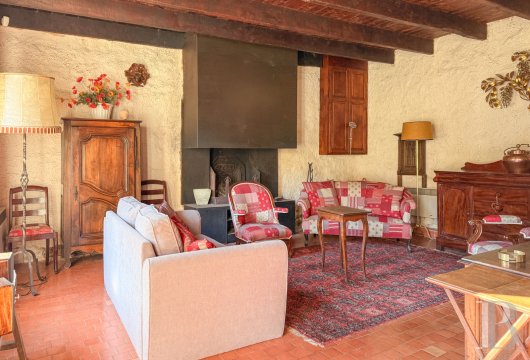
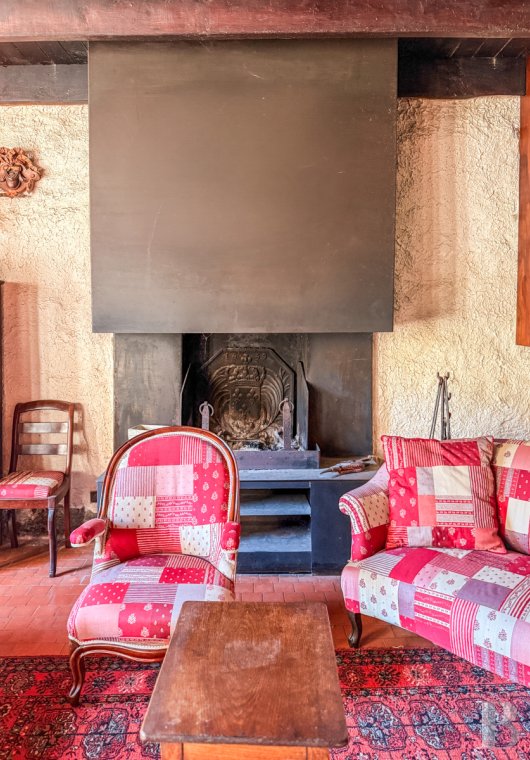
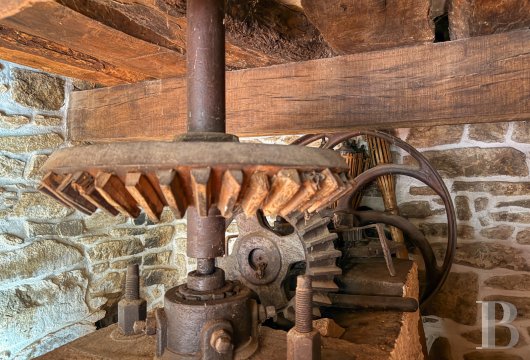
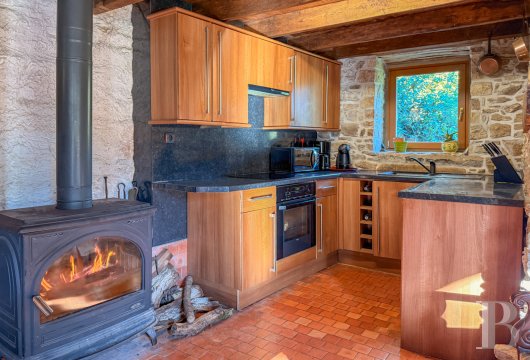
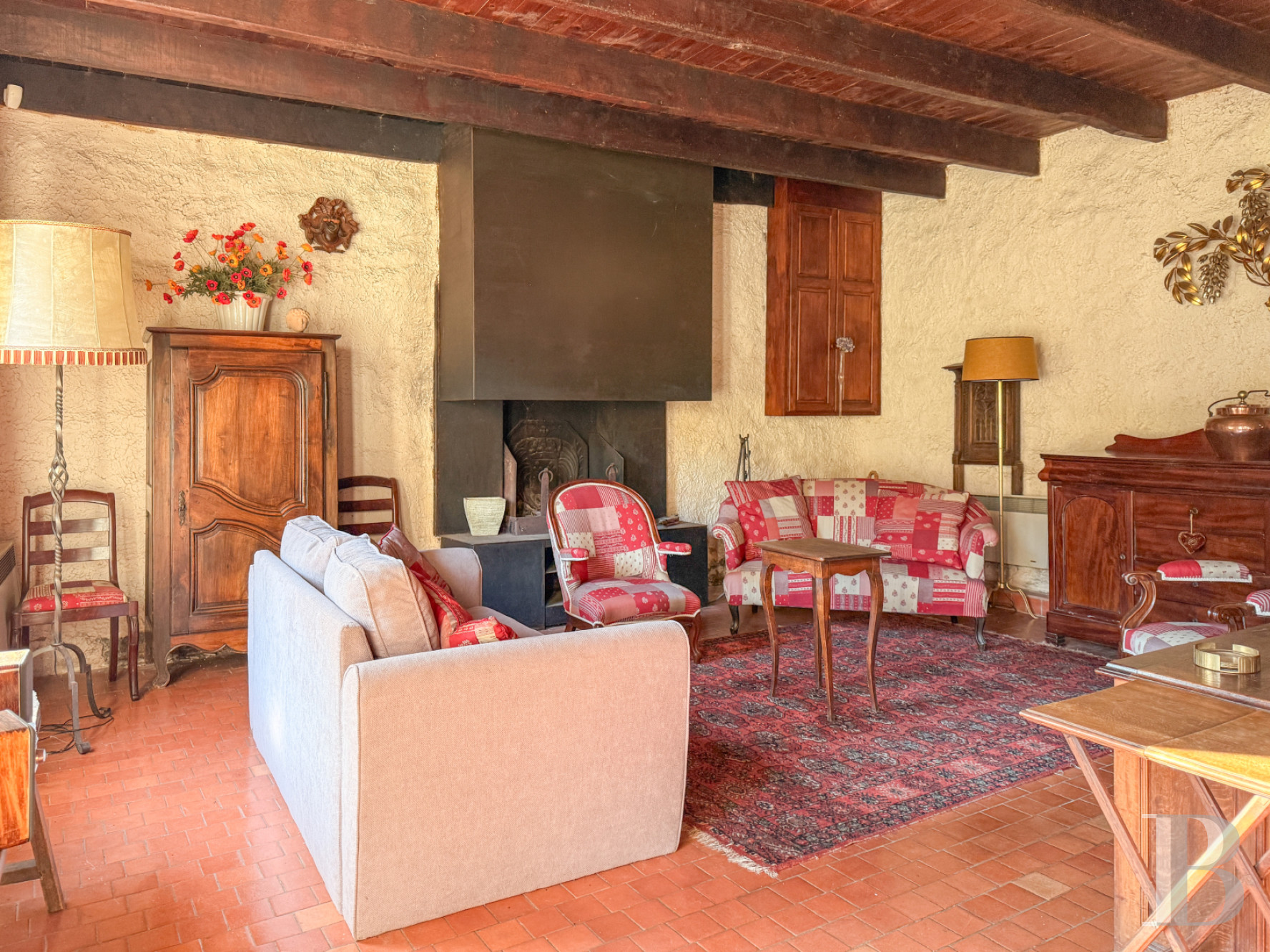
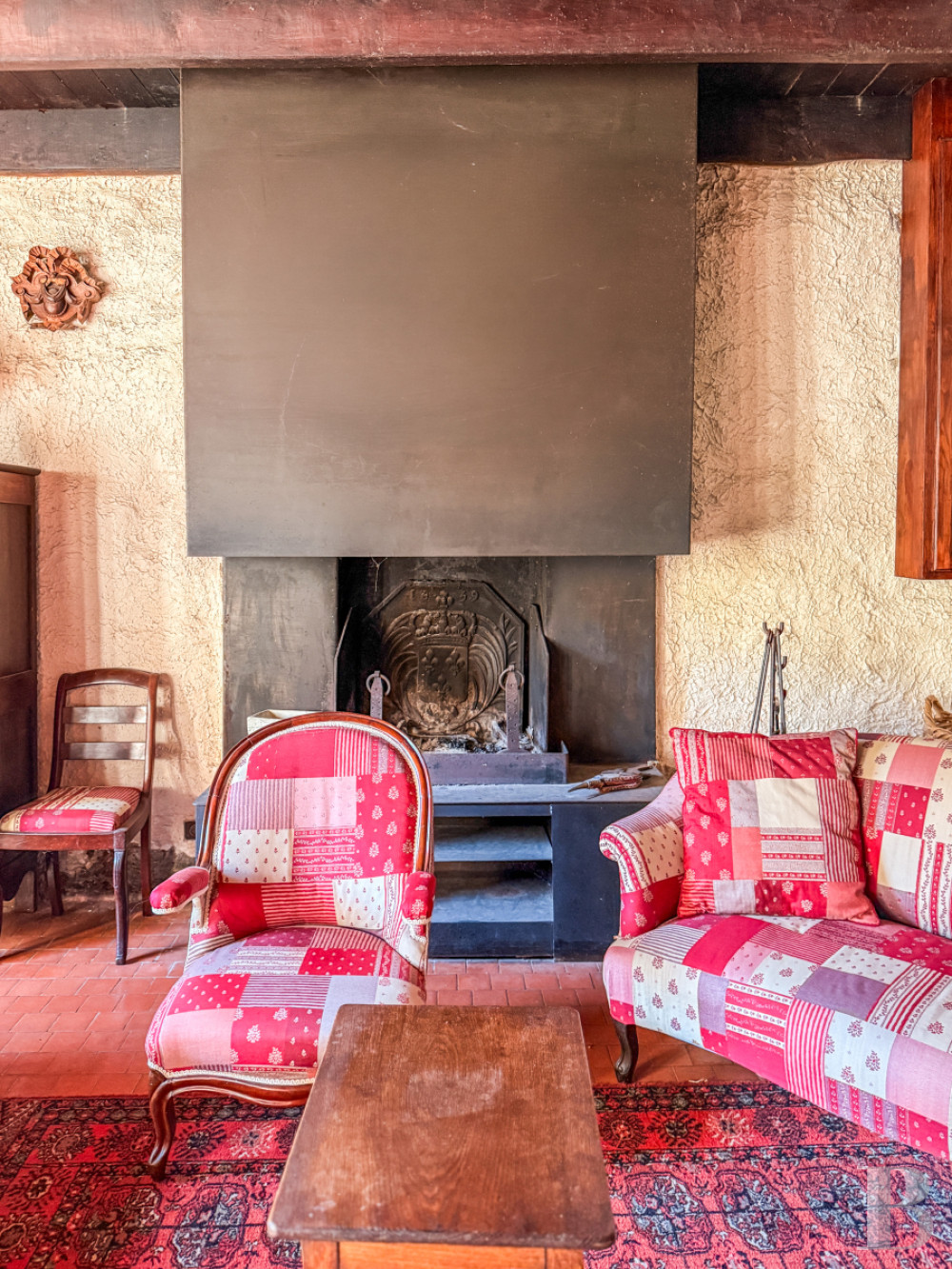
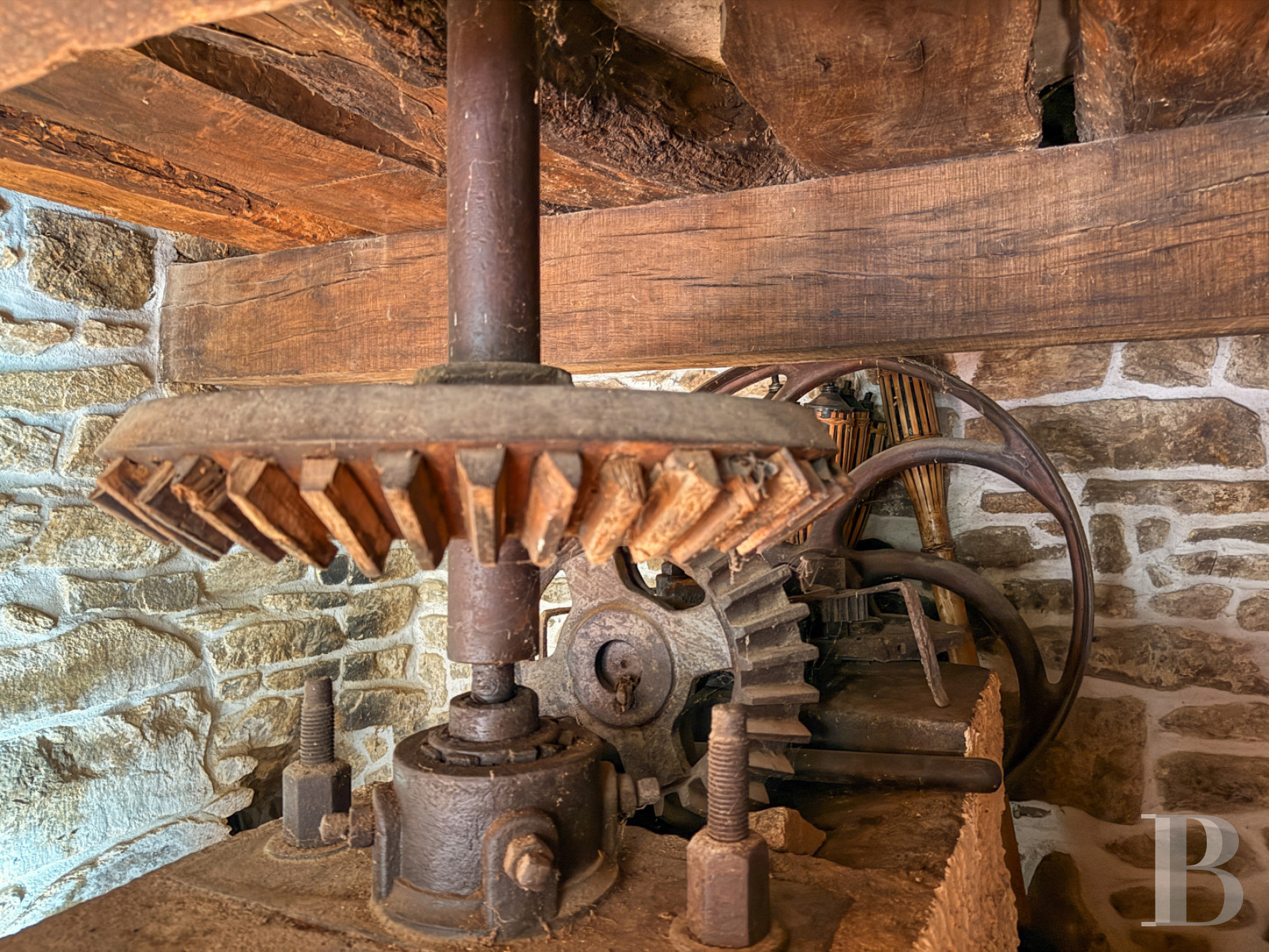
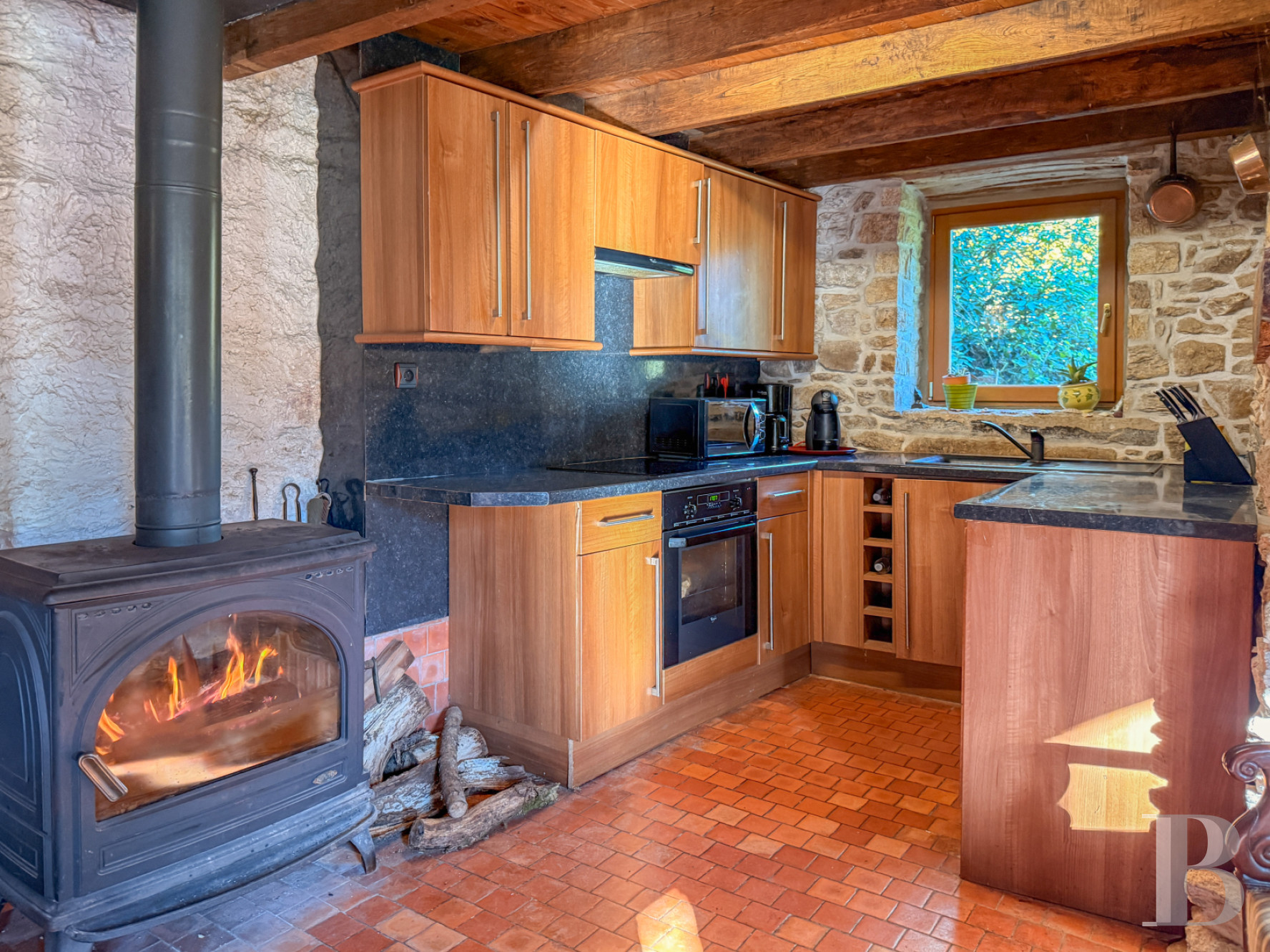
The ground floor is made up of a single room without any partition walls. Square terracotta tiles with red and brown tones cover the floor. Exposed beams run across the ceiling. A lounge is centred around a straight fireplace built into a wall of stone coated with pale beige plastering. At a lower level, there is a small dining room. It faces the watermill’s old mechanism, which has been preserved in its same place and is made up of metal and timber components. Above it, there is a round millstone kept in place by an adjustment system upon a timber structure. A fitted kitchen lies in an alcove with a work surface and units of pale wood. A window in the thick wall of exposed stonework brings natural light inside. There is a cast-iron wood-burning stove with an exposed vertical pipe. A timber staircase in the middle of the open space leads to the different levels. It is an openwork structure with vertical posts, straight steps and a quarter turn. The balustrade, also made of wood, mirrors this verticality with straight balusters creating space for natural light and views. A honey-tone door of solid wood with black metal hinge strips leads into a professional kitchen at the back.
The intermediate level
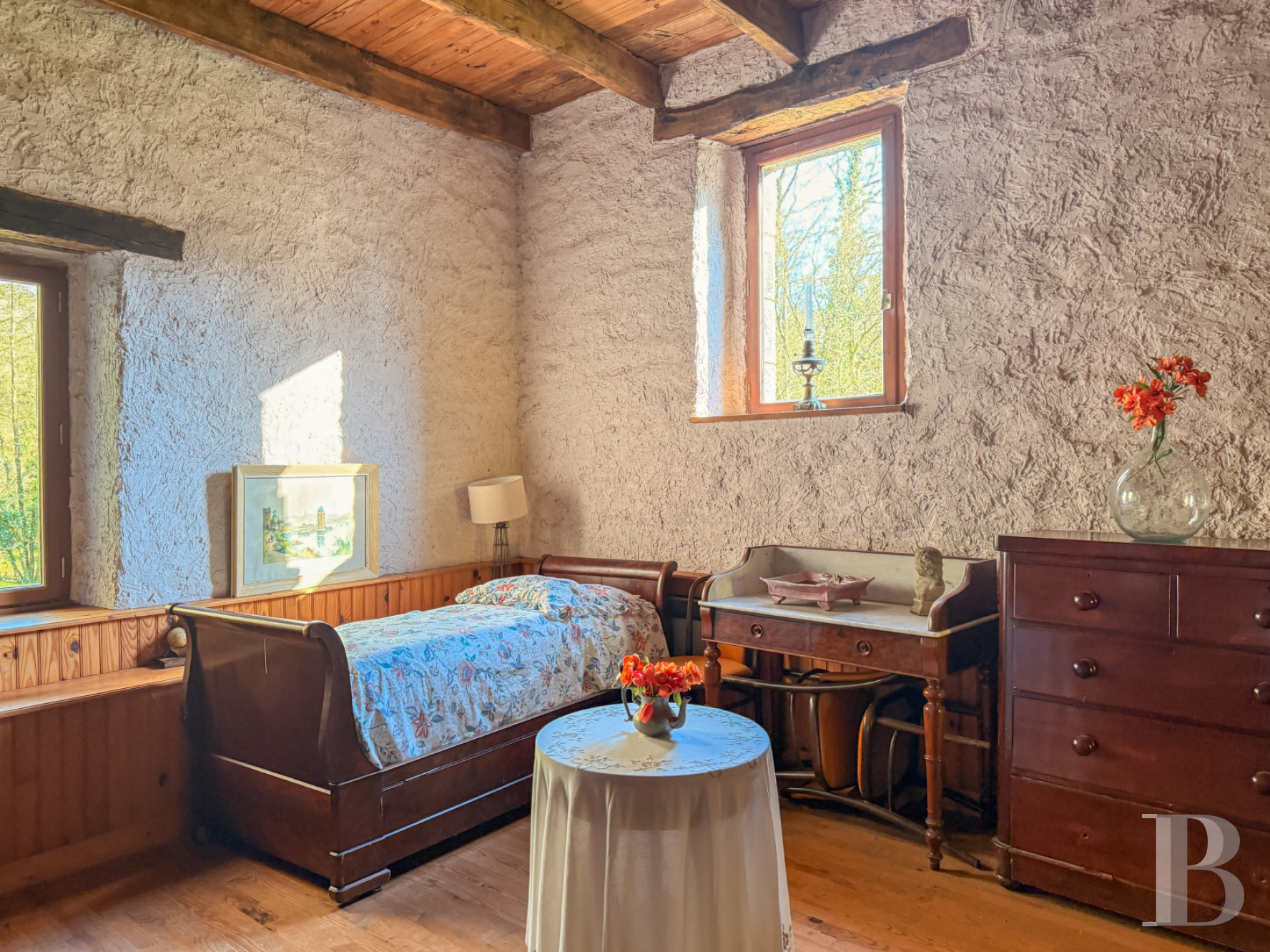
There is an intermediate level with a large room that has white-plastered walls and two wooden-framed windows beneath an exposed lintel. These windows offer beautiful views of the natural surroundings. Honey-toned wood strip flooring extends across the room. Exposed beams run across the ceiling, which is clad with strip panelling.
The first floor
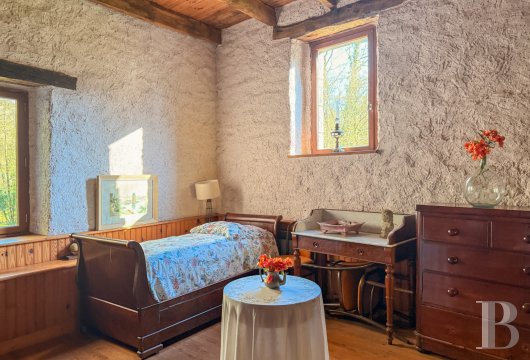
The first floor has three bedrooms, two of which are in a roof space. It also has a bathroom and a lavatory. The rooms are clad with strip panelling. Exposed stonework forms some of the walls. They also have French-style beamed ceilings. The original wooden floors have been preserved, but they are today covered with unfixed squares of carpet. The bathroom, adorned with floral wallpaper, and the main bedroom both enjoy a south-facing position.
The second floor
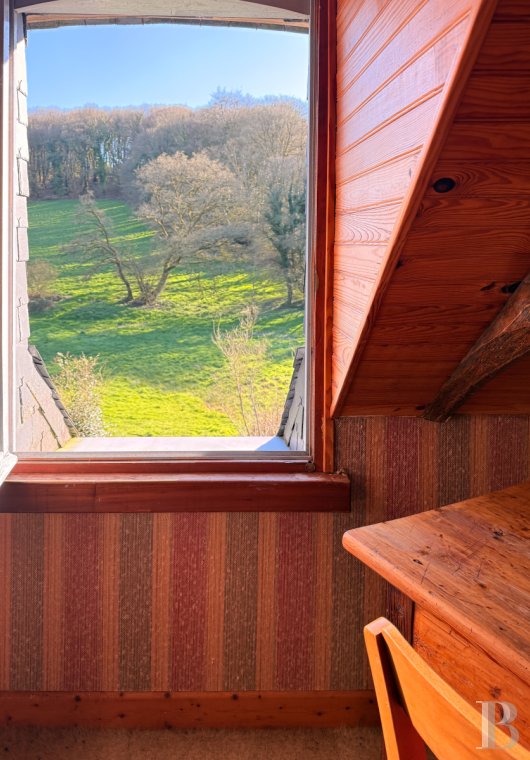
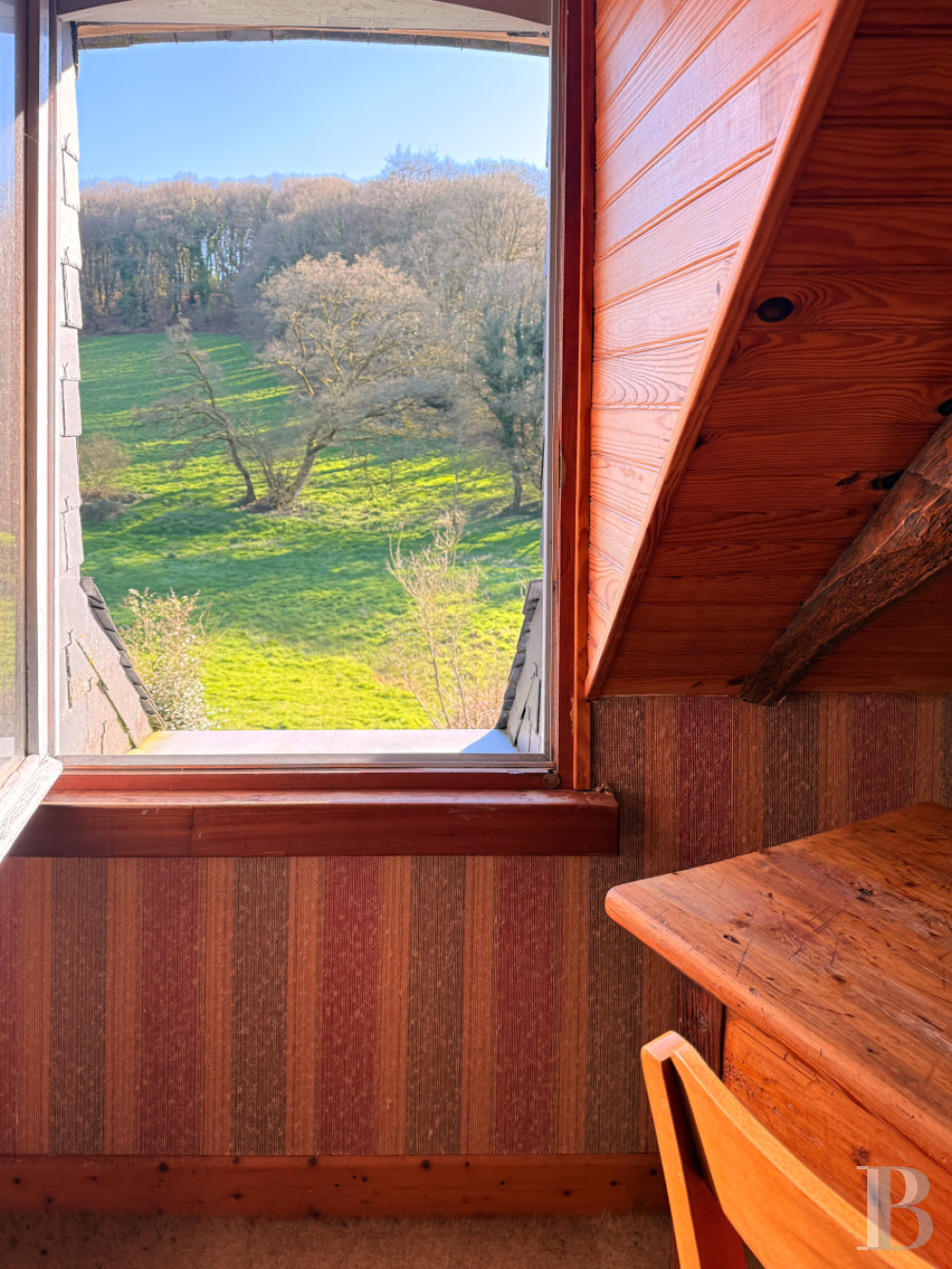
The second floor is made up of two large spaces in the roof. The sloping attic ceilings up here are fully clad with warm-toned wooden strips. You can also see exposed roof beams here. The side walls are adorned with vertically striped wallpaper in pale tones. The flooring is made of melamine boards beneath a fabric covering. There are several beds – some are single beds and others are double beds. The facade-side windows bring natural light inside. The layout is open, with no noticeable partitioning and with the presence of a staircase and its wooden balustrade.
The outbuilding
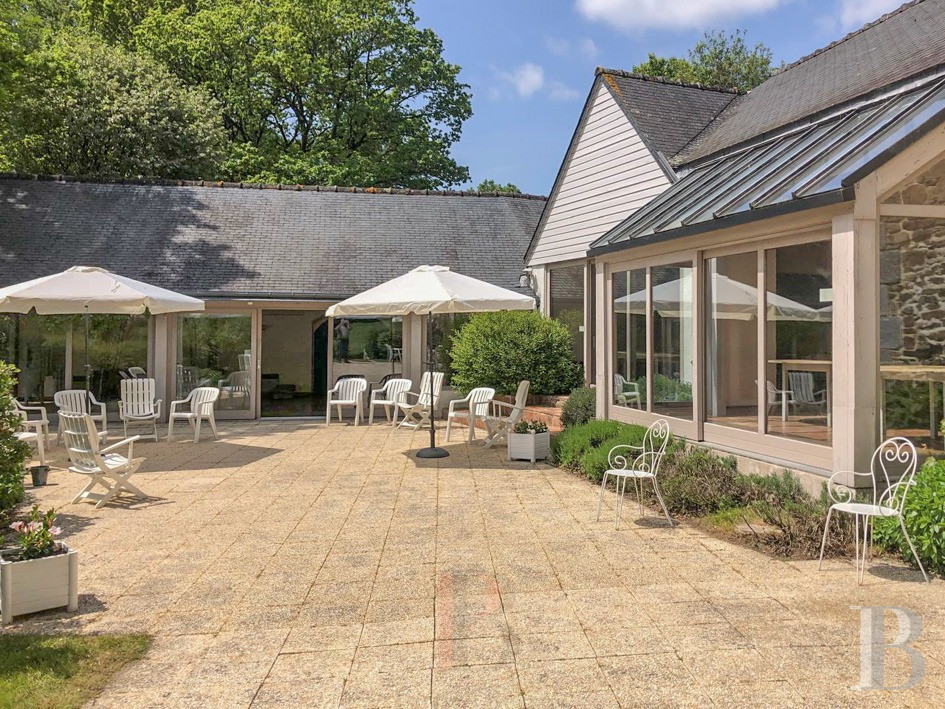
The outbuilding is the entry point for reaching the watermill. It stands at the back and is crowned with a gabled slate roof. It has an elevation of granite rubble. At the front, the walls are almost windowless. There is just one tiny window. Clusters of hydrangeas and evergreen shrubs flourish at the foot of the walls. At the back, the appearance is contemporary. The rear looks out at a court paved with evenly sized slabs.
The garden-level floor
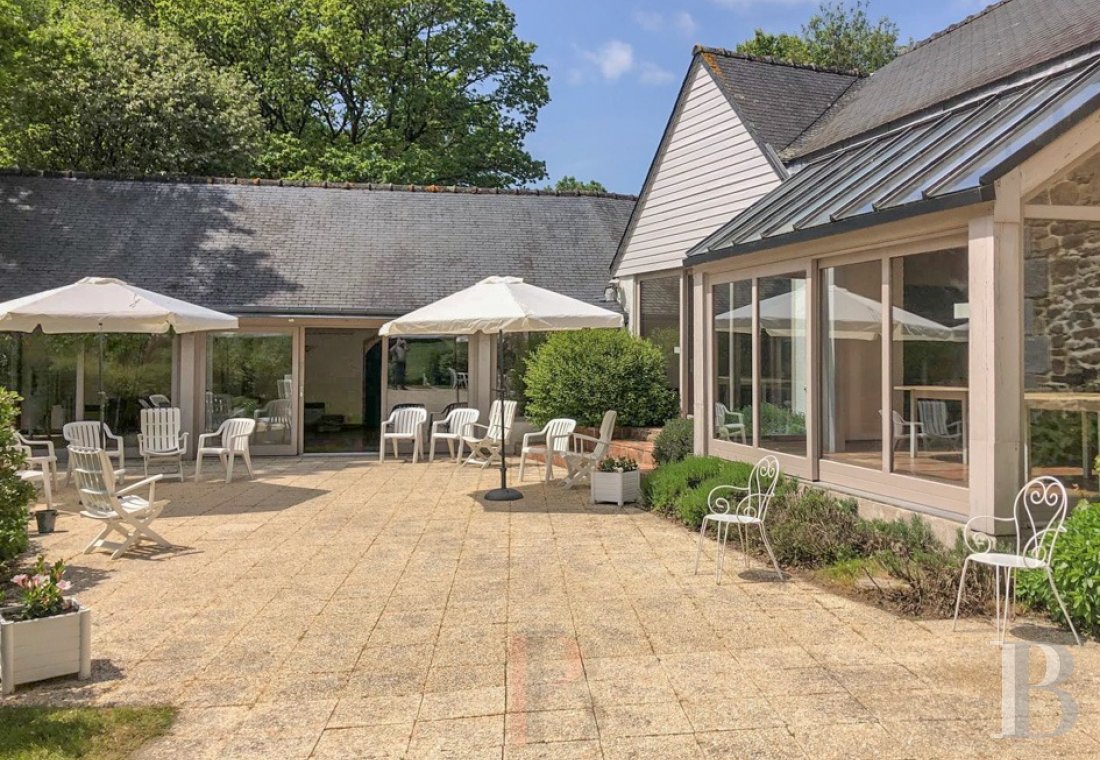
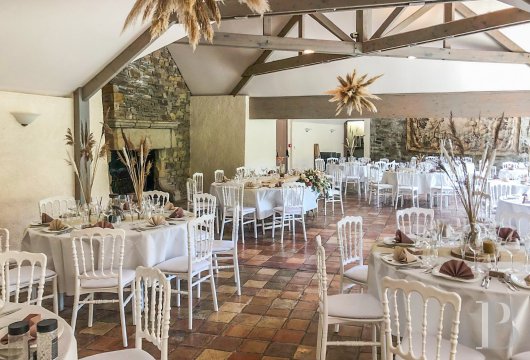
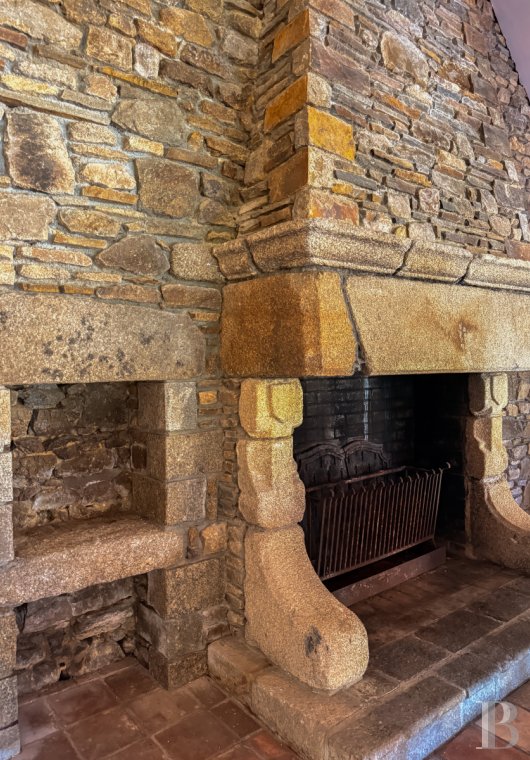
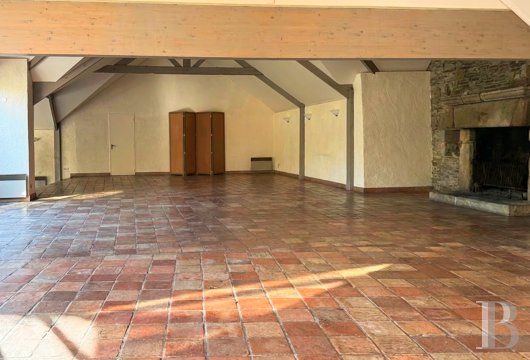
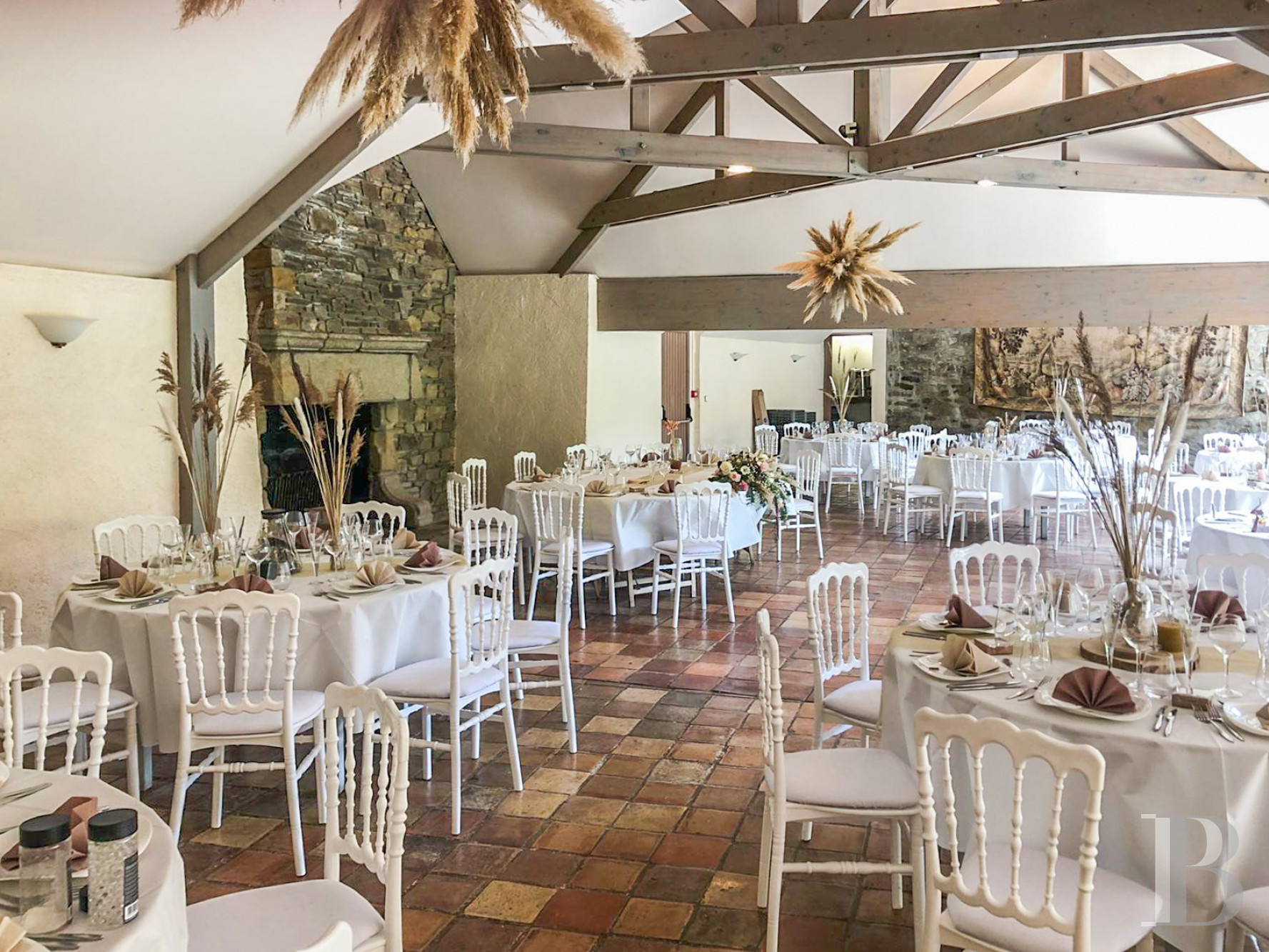
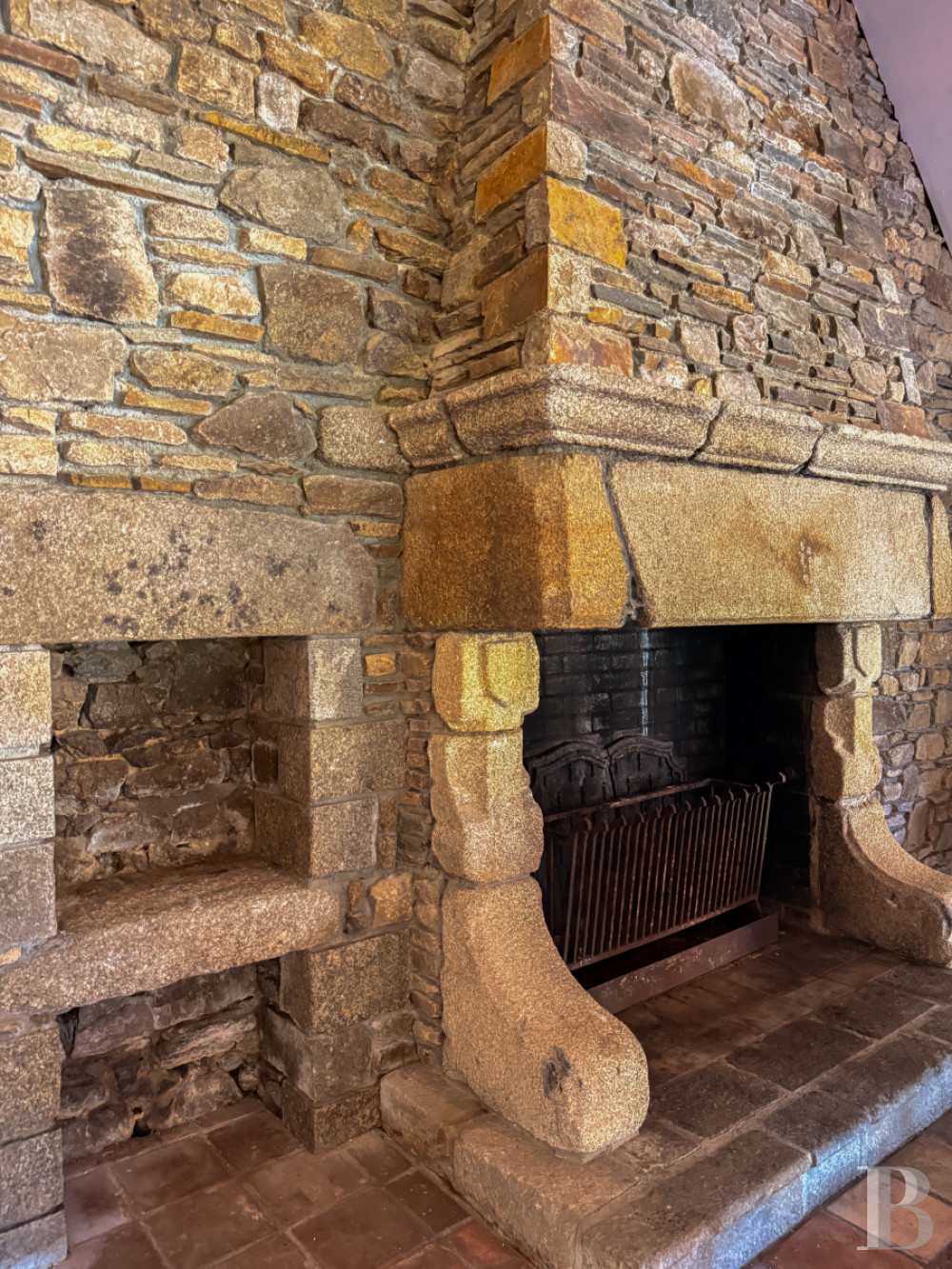
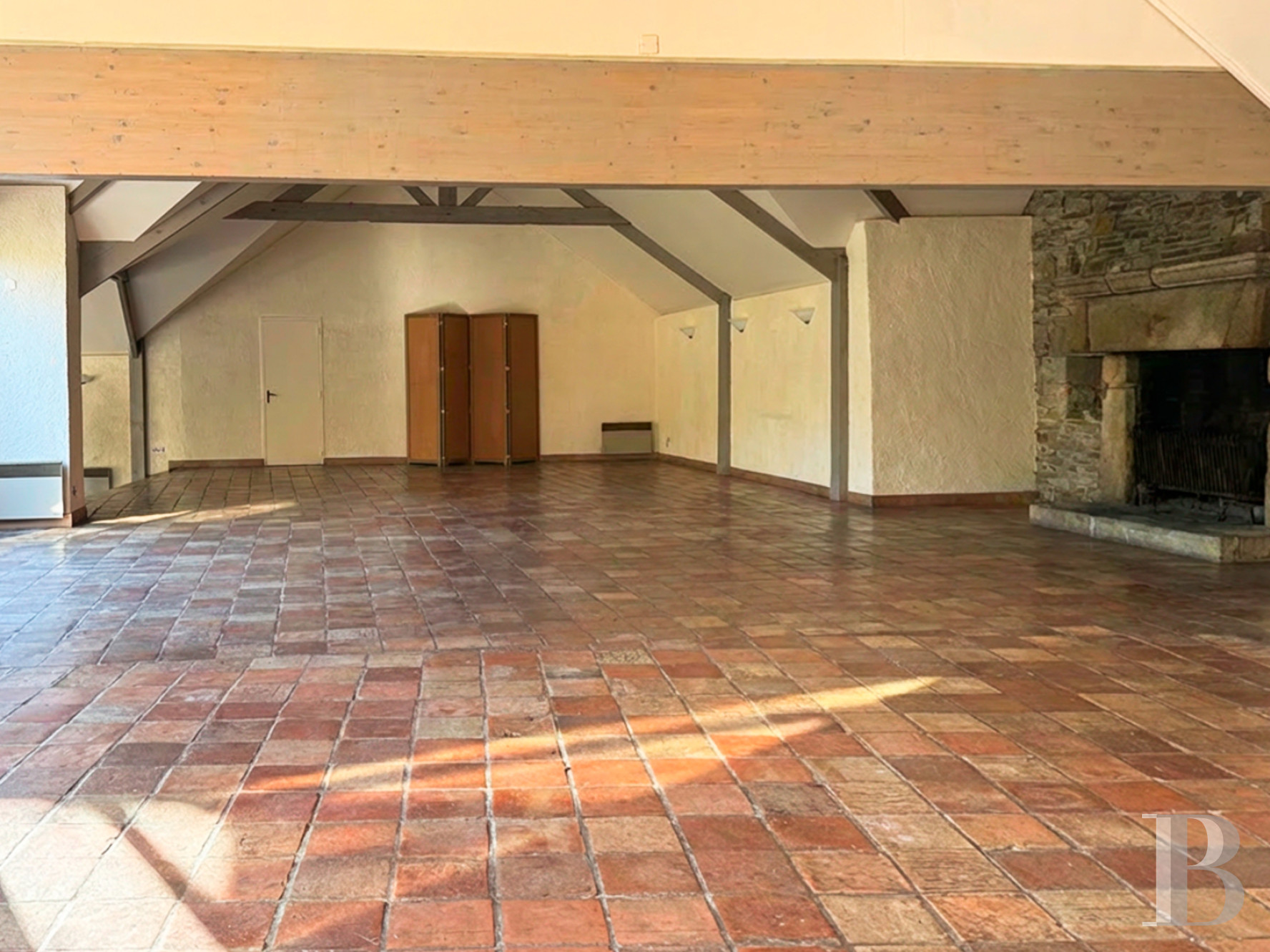
Inside, the reception hall has a capacity for around 180 seated guests. Its vast open-plan space is L-shaped and bathed in natural light from glazed walls of broad panes that take up the entire breadth of one elevation and extend the interior out onto the terrace. The indoor layout is simple and fluid, without any partition walls and with a slightly raised level. You can move around this reception hall very smoothly. Its floor is adorned with large terracotta tiles laid evenly. Their reddish tones contrast with the pale hues of the walls. The exposed beams of the roof frame punctuate the room up to the roof ridge and bring out the true spaciousness of the hall. The glazed walls offer clear views of the surrounding meadows and woods, which blend seamlessly into the plot of lawns and shrubs around the buildings. There is a monumental fireplace made of reused stone in the hall too. It is in working order. It adds to the hall’s character and can be used for supplementary heating. Near the entrance, there is a lavatory room with a washbasin and two toilets. Two doors lead into a professional kitchen, which vehicles such as catering vans can also reach from behind. This kitchen includes a range of equipment, including a triple-door refrigerating cupboard, a gas cooker with an in-built oven, a freezer and a refrigerator.
The garden, meadows and woods
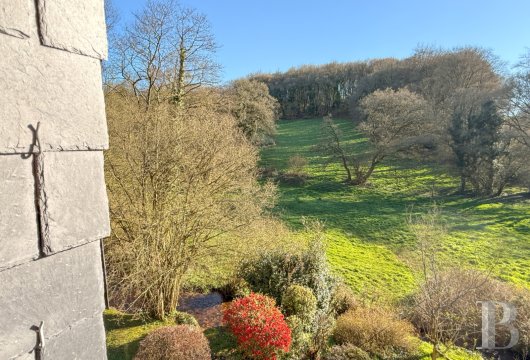
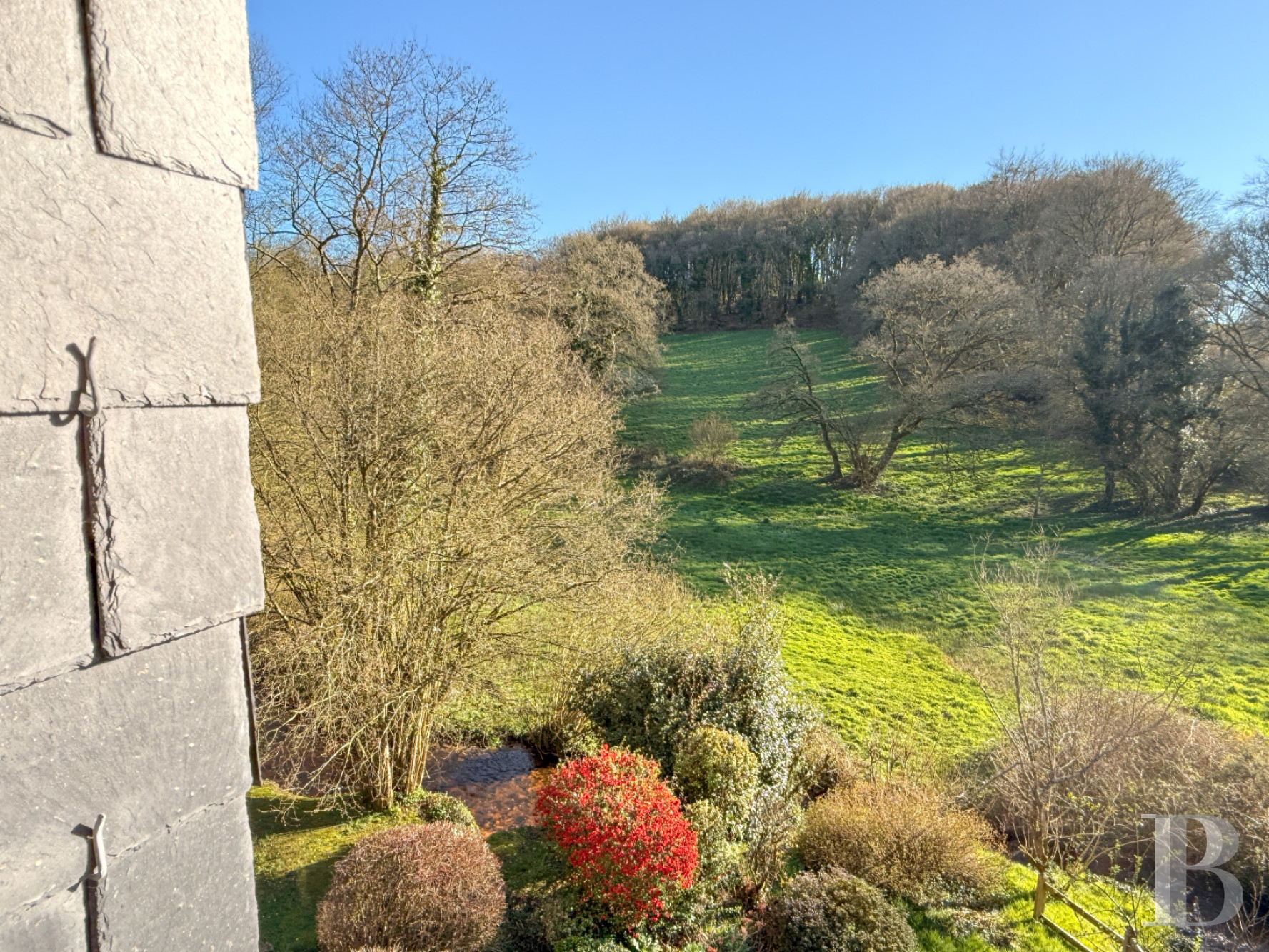
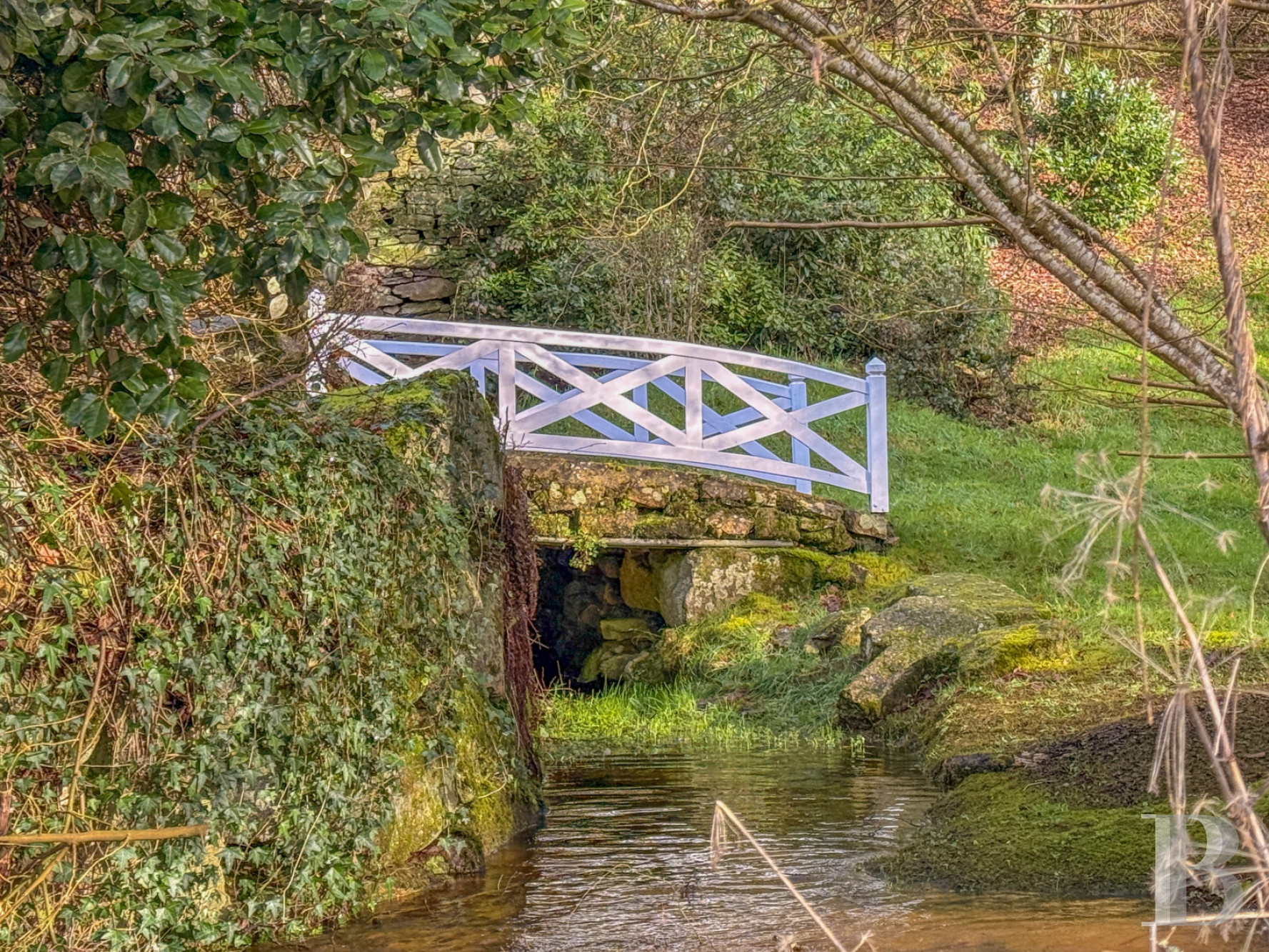
The estate is an unbroken expanse of gently undulating land with woods. It extends around the main building, which stands in a central position, surrounded by clearings and open meadows. A considerable portion of the land is taken up by dense woods, which form a natural, continuous enclosing barrier that creates absolute privacy. There is an ornamental garden too. You reach it via a small bridge with a walkway of stonework and a guardrail of wood painted white, designed in a cross-brace pattern. This footbridge crosses a narrow stream. The flat section of the grounds is given structure with hedges, clusters of flowering plants and tall trees. Beside the watermill’s gable end, you can see the remnants of the former millrace. The waterwheel has gone, but the old path of the water can still be noticed.
Our opinion
This delightful property is nestled in a calm, bucolic backdrop where time stands still. Even the entrance suggests a welcoming refuge, set back form the world’s bustle. The watermill, stream and woods together form a silent haven. With their back to a small hill, the buildings naturally follow the relief of the land, blending into their idyllic environment harmoniously. The stream that flows gently through the grounds was once harnessed, flowing into the millrace. It runs alongside the buildings. Traces of the former millrace remain, yet the waterwheel has gone. But a balance between the water, the sloping land and the vegetation undeniably remains here, giving this rural spot its pleasant coherence. Inside, some rooms need to be freshened up, adjusted or redesigned, but without the property’s character being altered. Everything here invites you to write the next chapter in the place’s long story. Through its layout, resources and fittings, this haven opens up all kinds of possibilities for exciting projects, whether you plan to host guests here or simply dwell in the country home at the gentle pace of life that you can enjoy in this picturesque corner of Brittany.
638 000 €
Fees at the Vendor’s expense
Reference 620307
| Main building floor area | 410 m² |
| Land registry surface area | 5 ha 13 a 85 ca |
French Energy Performance Diagnosis
Information on the risks to which this property is exposed is available on the website: www.georisques.gouv.fr
Share


NB: The above information is not only the result of our visit to the property; it is also based on information provided by the current owner. It is by no means comprehensive or strictly accurate especially where surface areas and construction dates are concerned. We cannot, therefore, be held liable for any misrepresentation.