



Steps from Guingamp's historic centre, on the banks of the River Trieux
a 19th-century mill with outbuildings on nearly 1 hectare
a 19th-century mill with outbuildings on nearly 1 hectare
Guingamp,
COTES-D'ARMOR
brittany
22200
FR

Location
Guingamp, at the heart of the historic pays of Trégor, sits within a rolling landscape traversed by the River Trieux, whose banks are linked by footbridges connecting the town's different quarters. This Petite Cité de Caractère, home to nearly 7,000 inhabitants, holds a rich architectural heritage anchored by the Basilica of Notre-Dame-de-Bon-Secours — built between the 12th and 16th centuries and listed as a Monument Historique — and by the Château des Salles. The mill bearing the same name stands within this historic setting, directly alongside the river. The town offers a full range of shops, services and schools.
The TGV station provides direct access to Paris-Montparnasse in approximately 2 hours 40 minutes. Rennes is approximately 1 hour 30 minutes and Brest approximately 1 hour 20 minutes via the RN 12. Brest-Bretagne airport is approximately 1 hour 15 minutes away. The Channel coast — including Paimpol and Perros-Guirec — is around 30 minutes by car.
Description
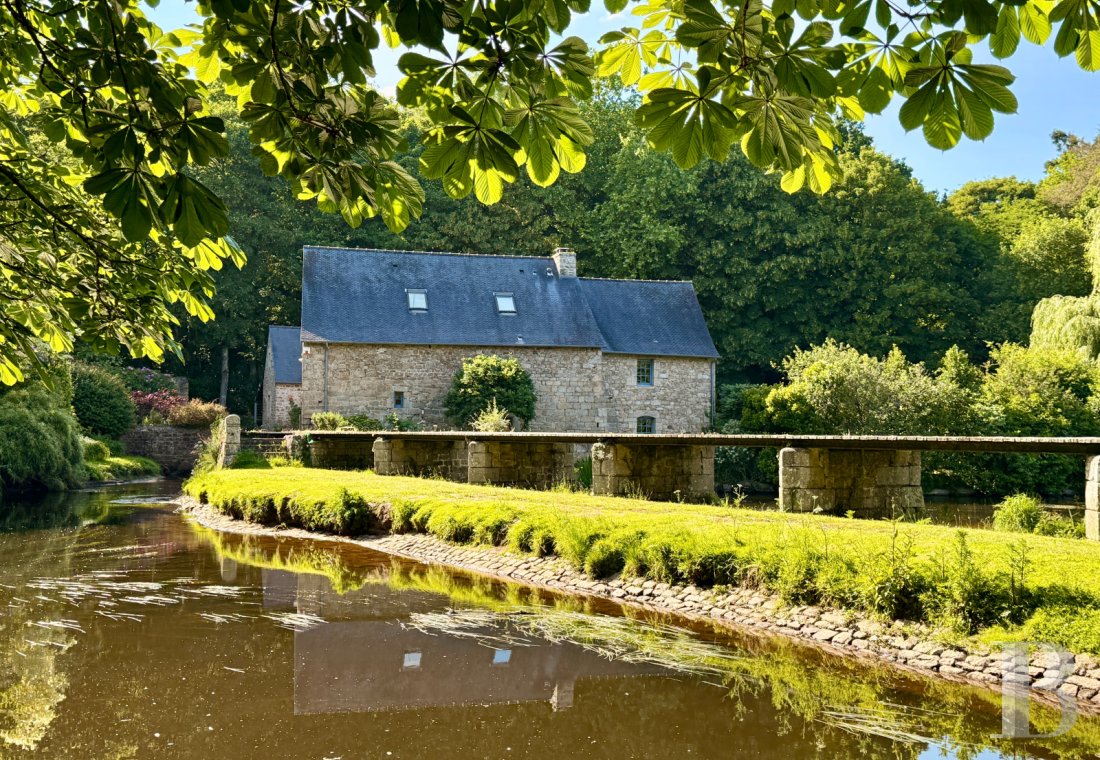
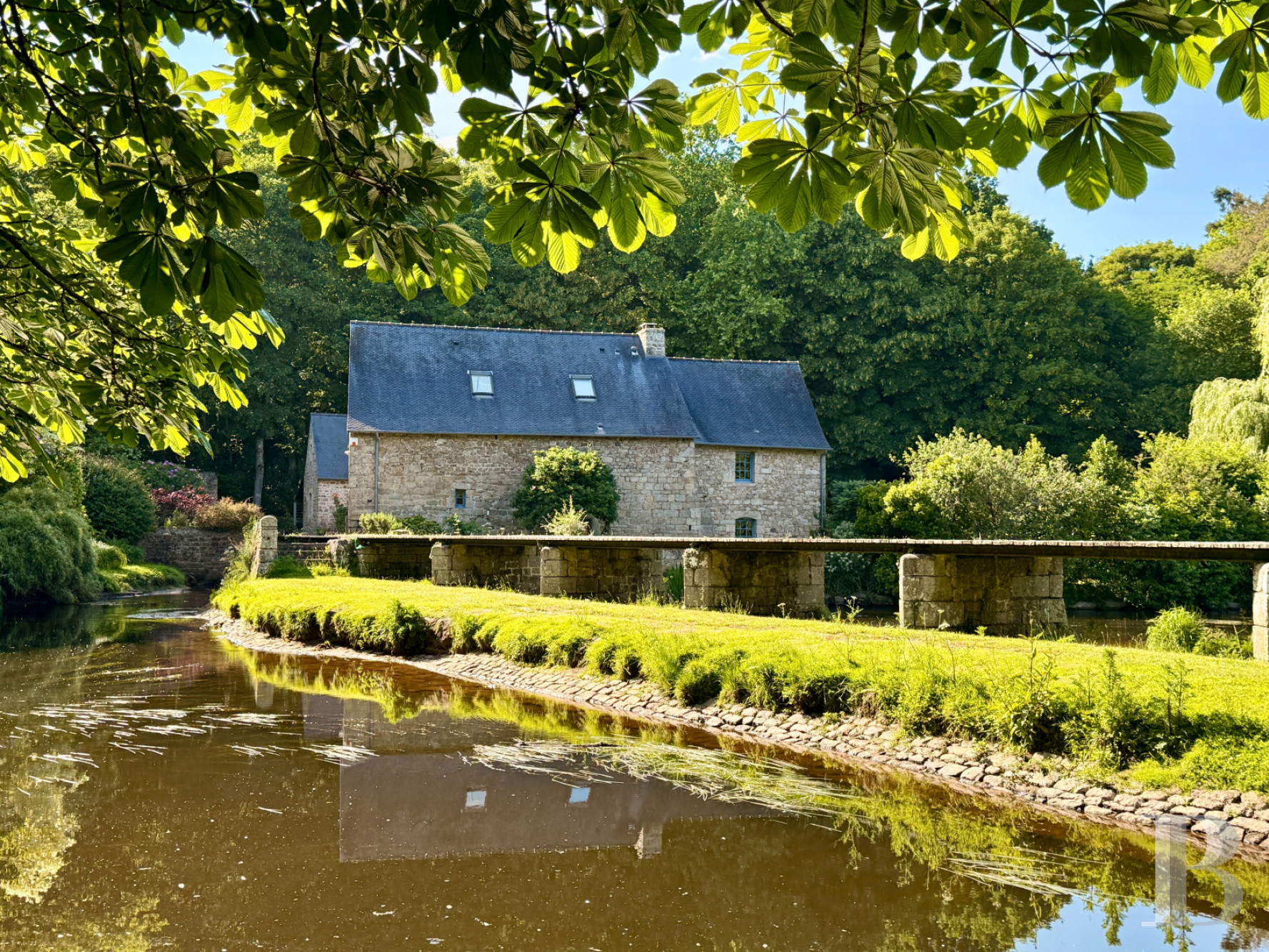
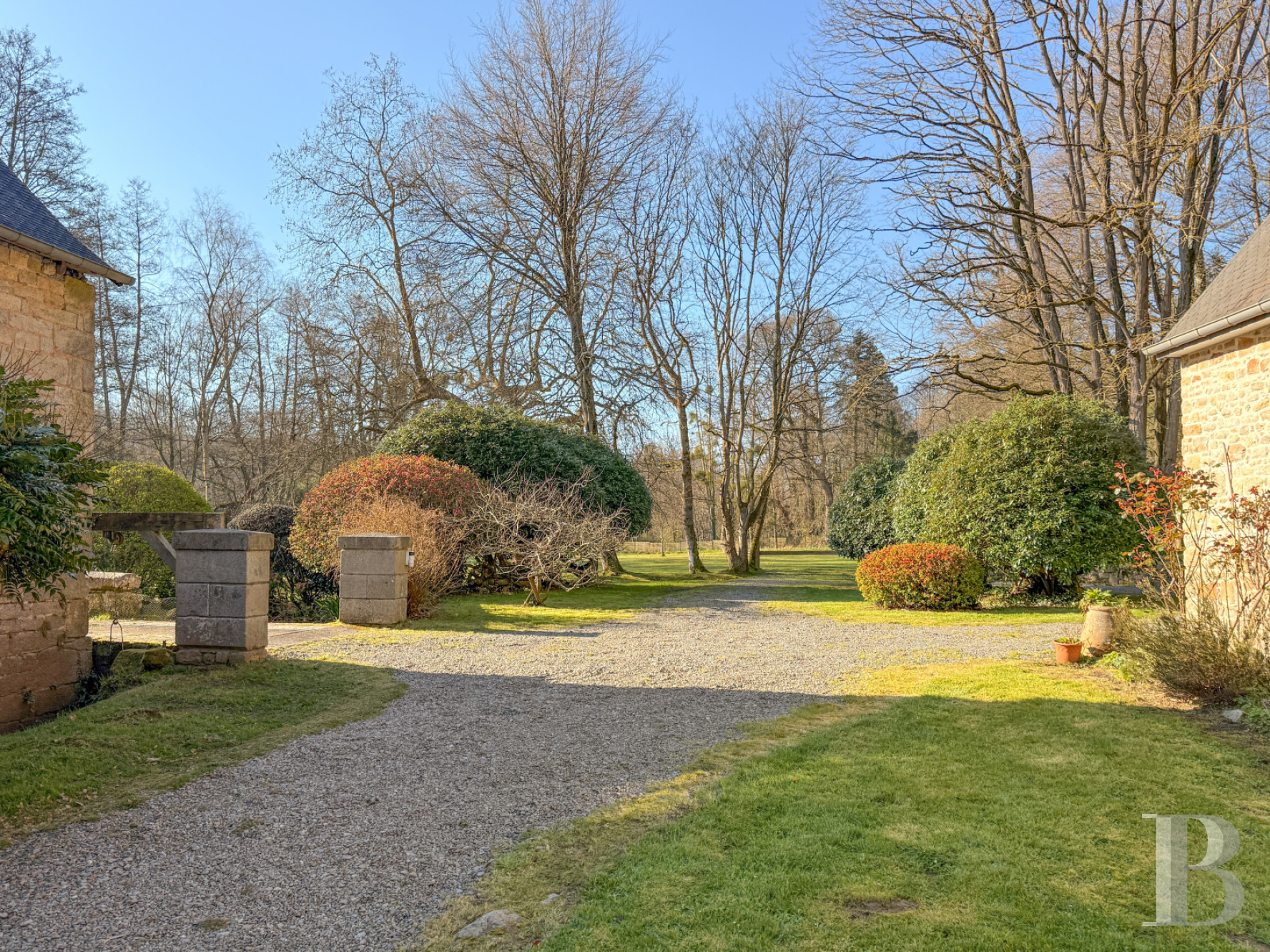
The property reveals itself at the end of a drive that crosses the Trieux by a stone bridge. A wrought-iron gate set between granite piers marks the entrance. The mill stands at the water's edge, within a wooded setting.
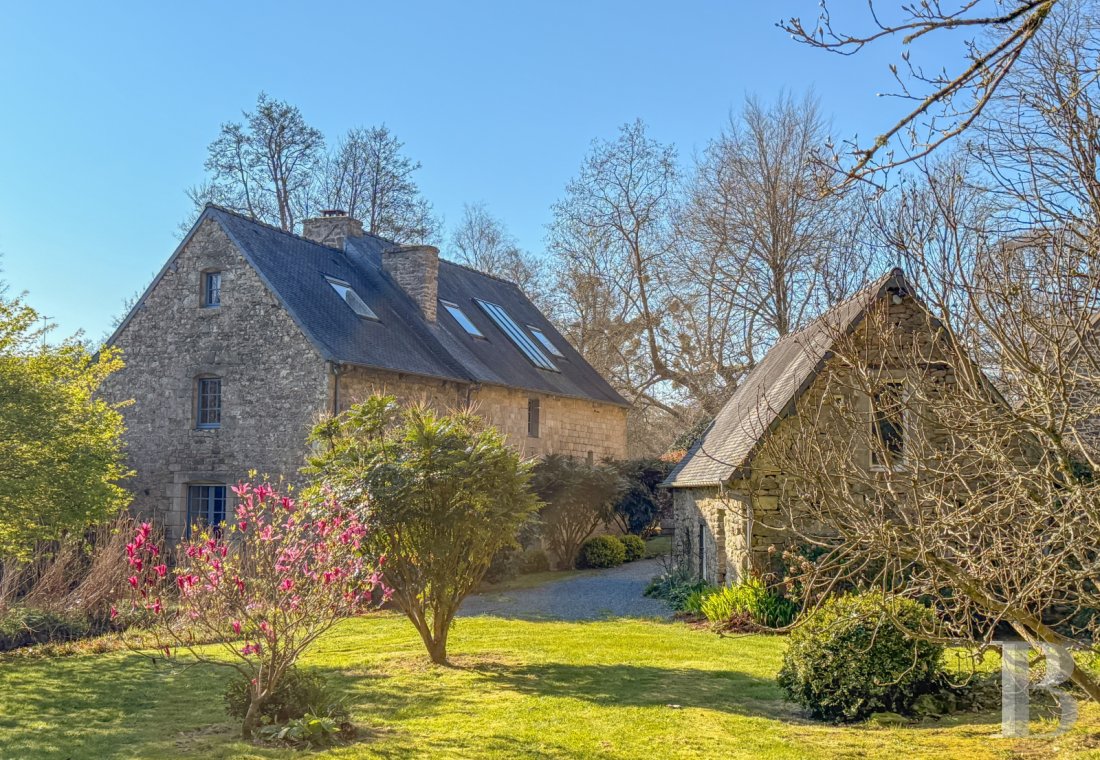
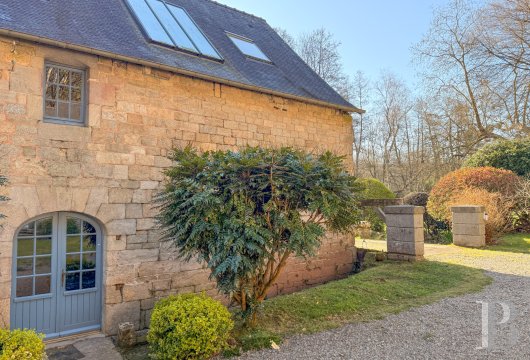
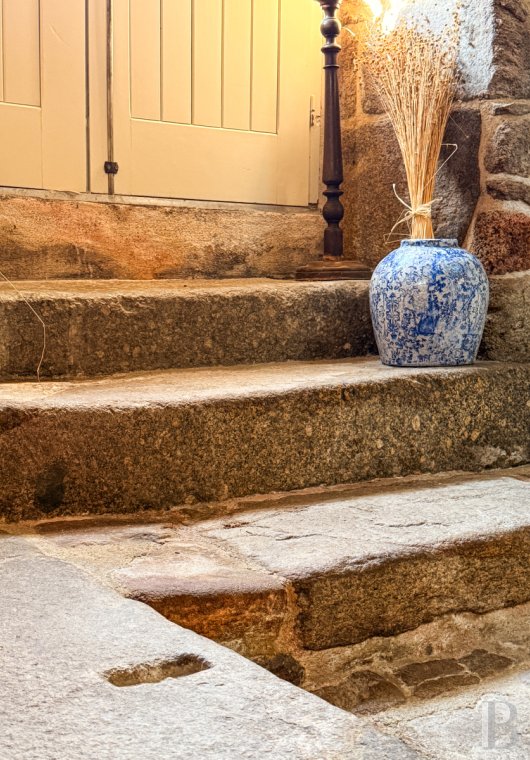
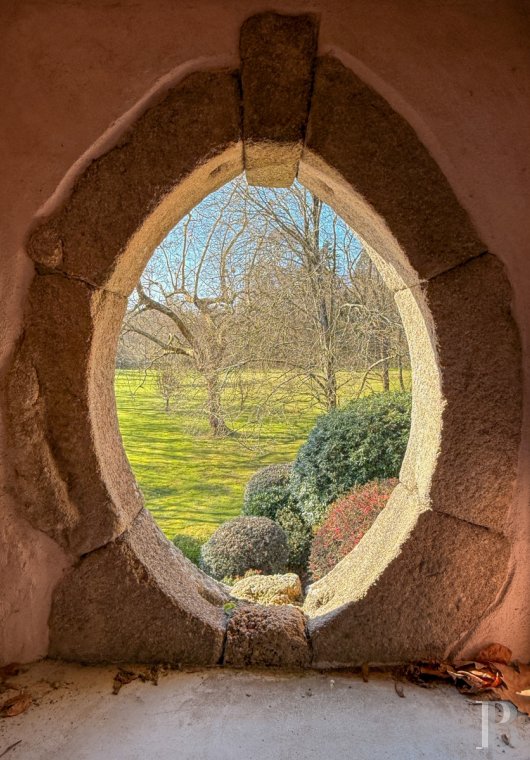
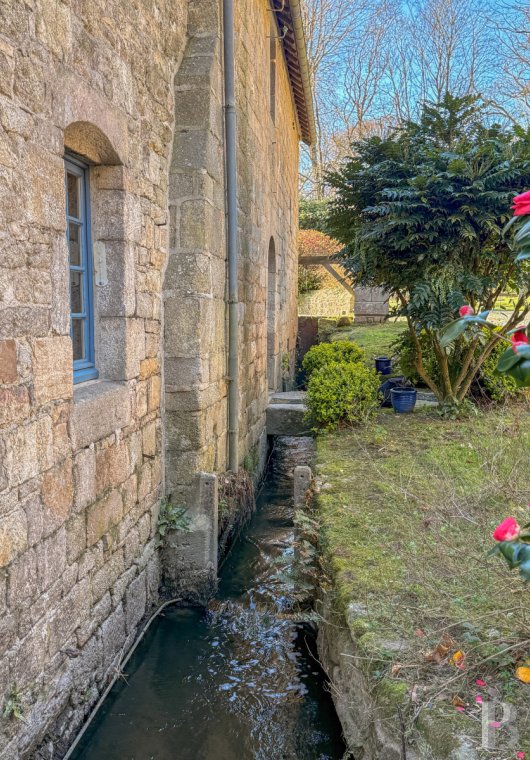
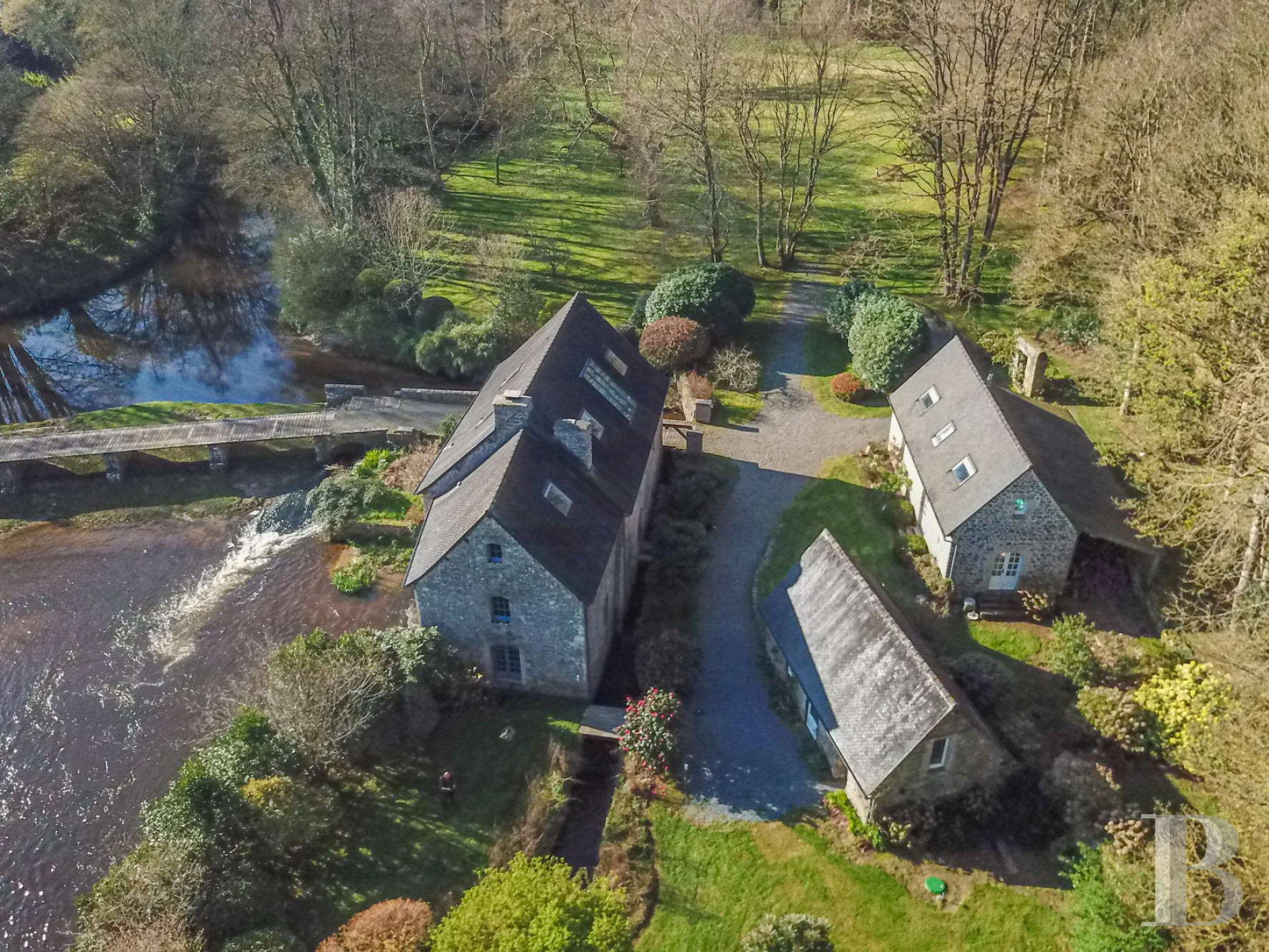
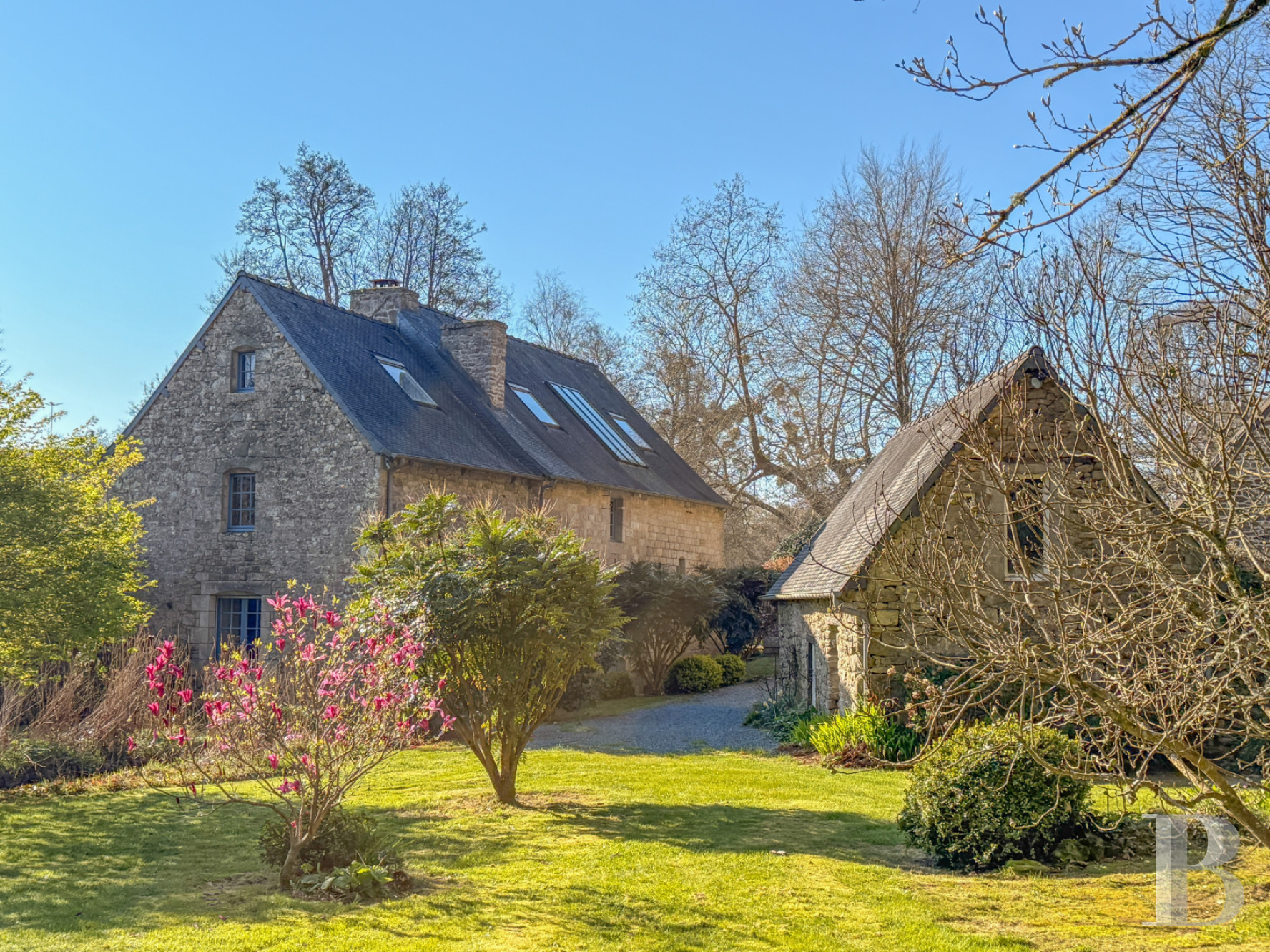
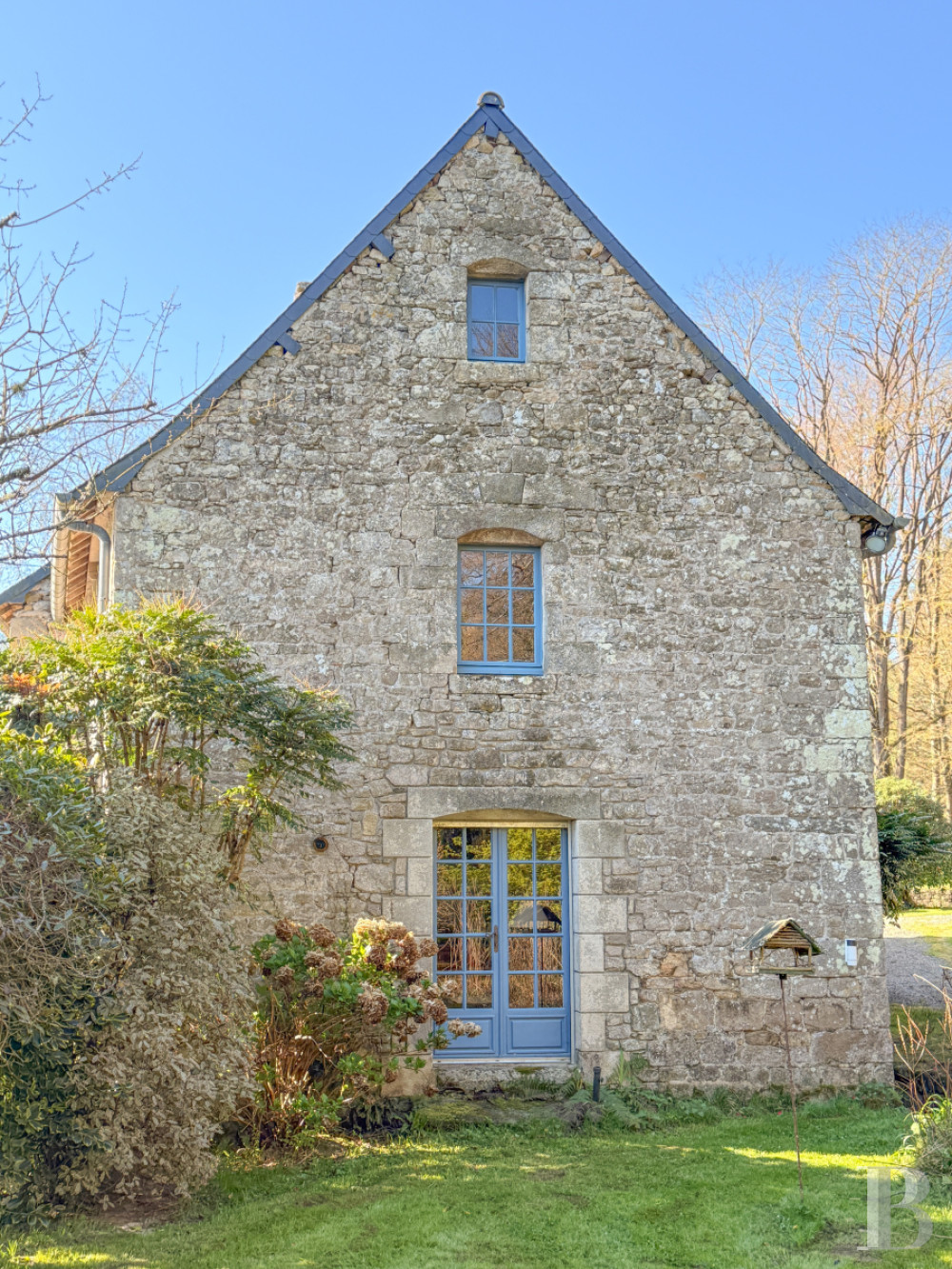
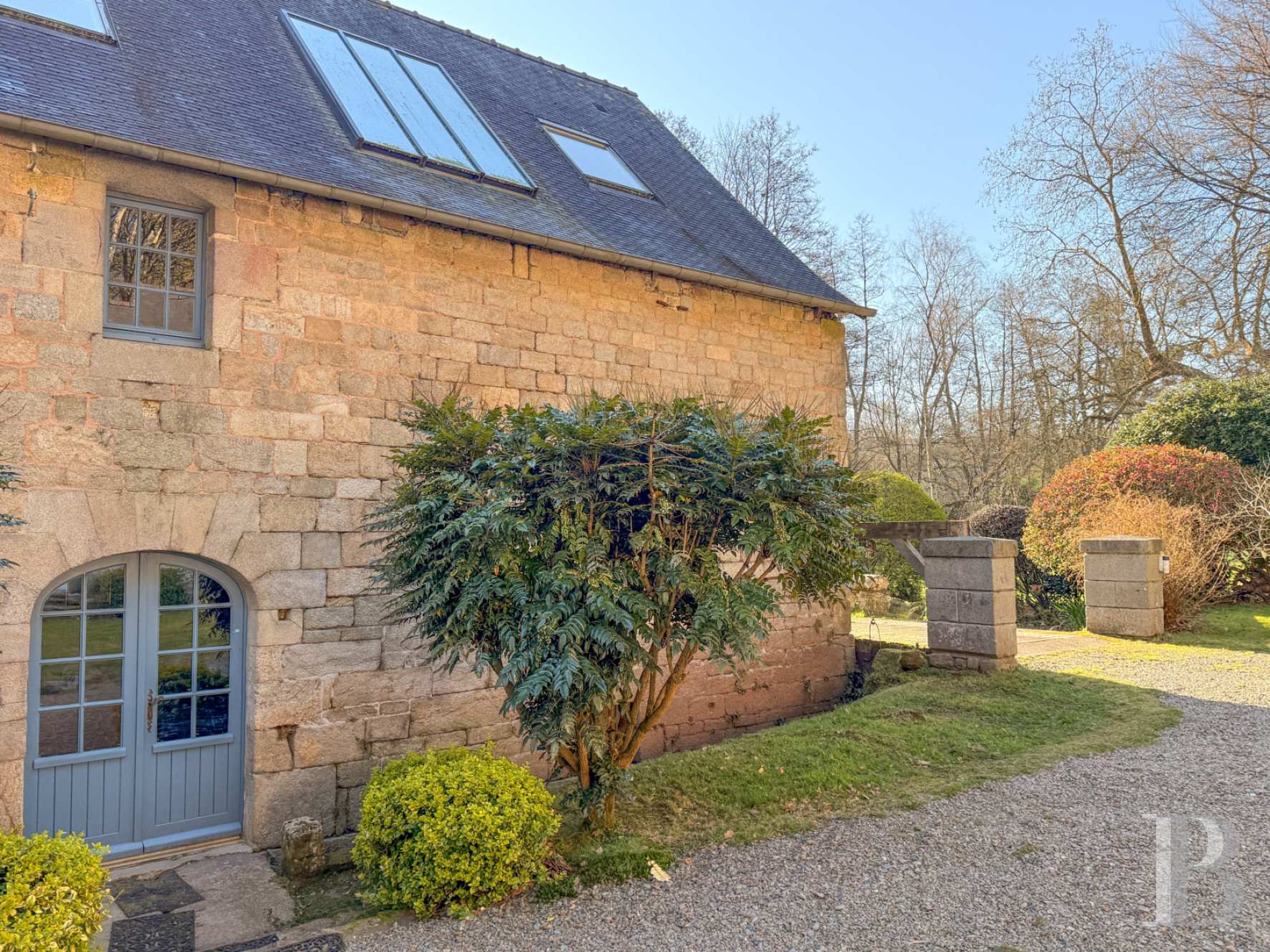
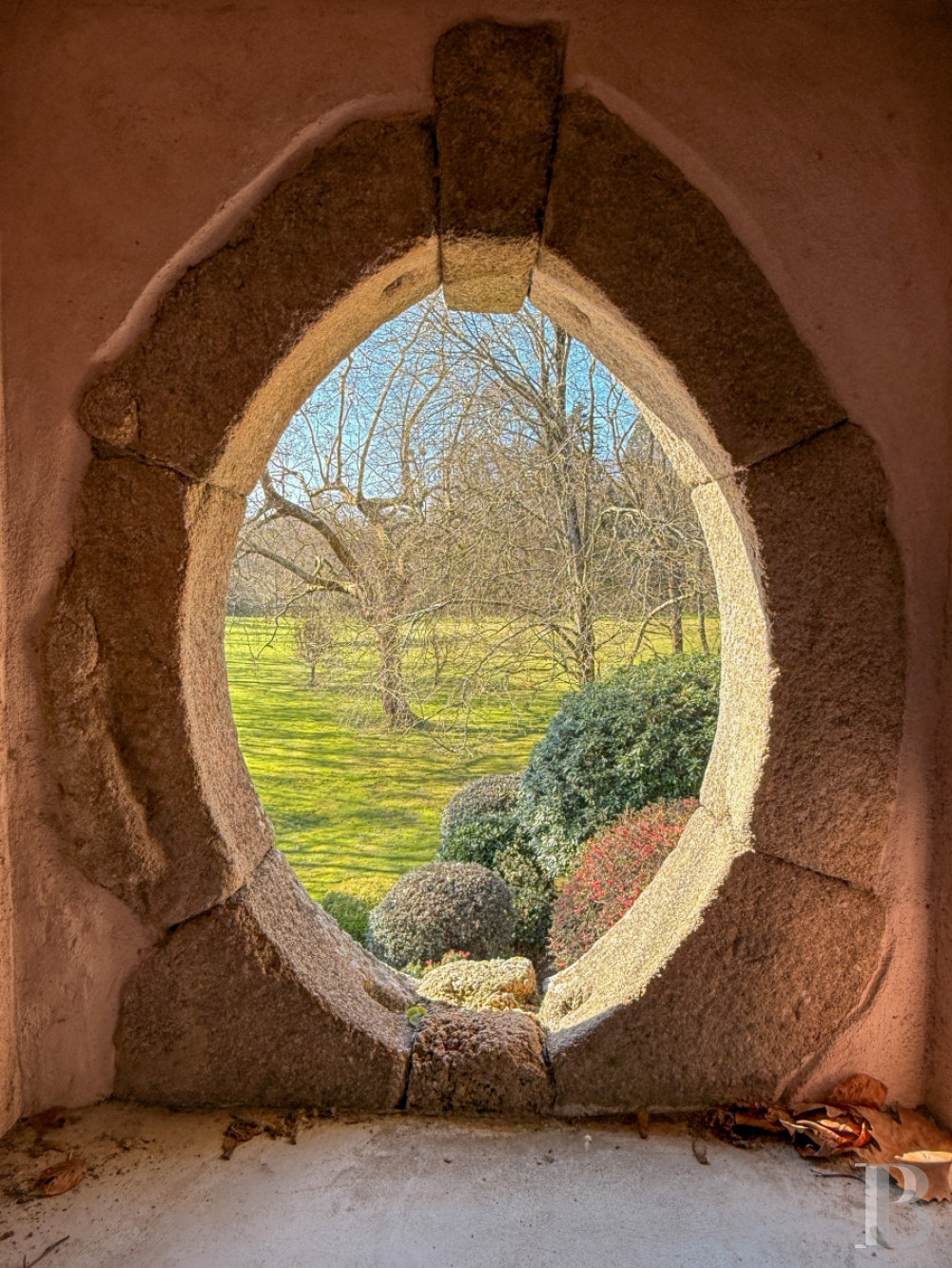
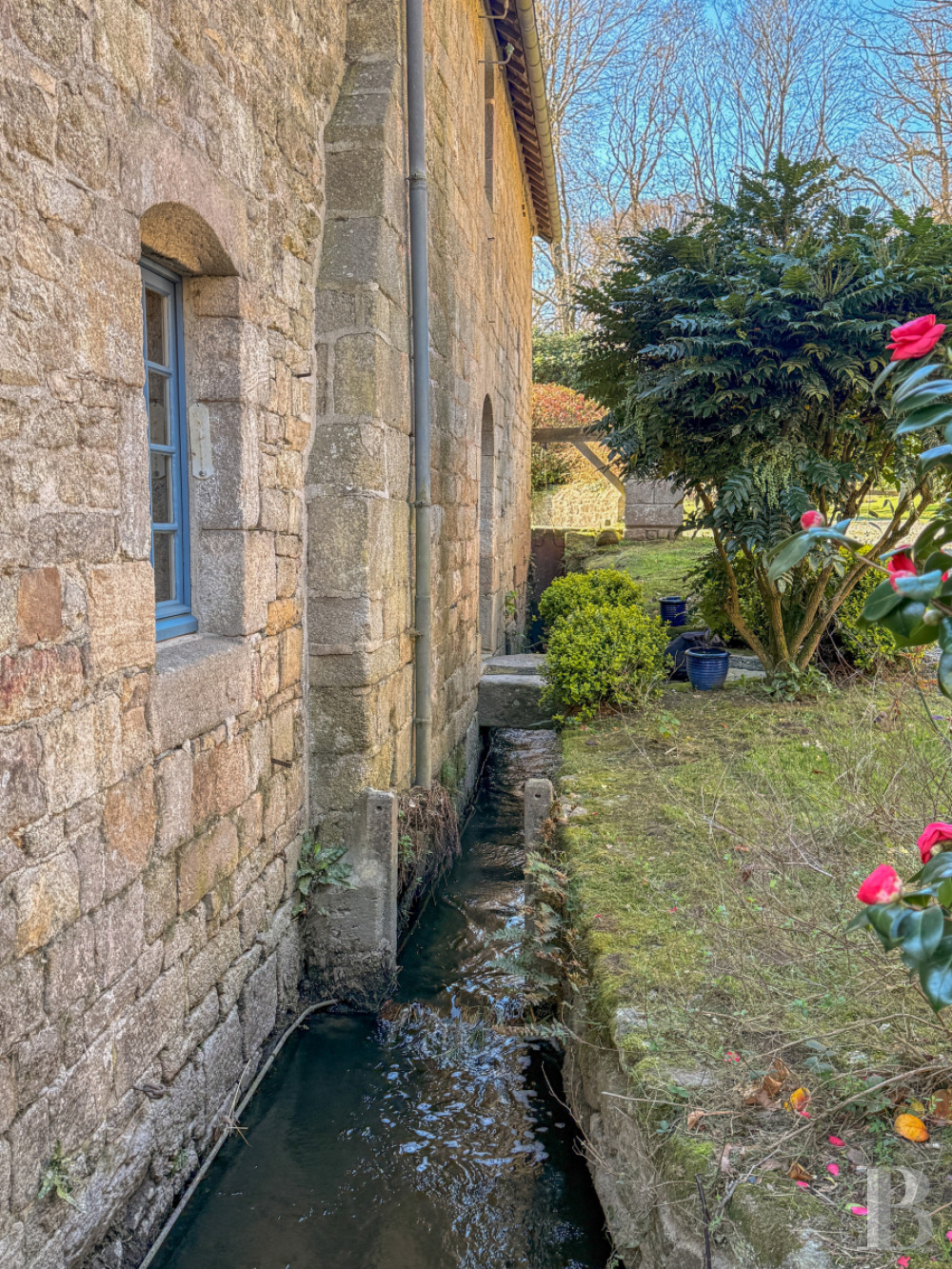
The main building is constructed in granite rubble stone with an irregular course and dressed-stone window and door surrounds. The gable walls are exposed and show an even, consistent masonry. The openings vary in size and are arranged functionally; some are narrow and vertical. The slate gabled roof has a pronounced pitch. It is pierced by rooflights and a larger glazed frame set into one of the slopes. Two chimney stacks rise from the ridge. The verges are in stone and the eaves overhang is minimal. At the base of the wall, a masonry structure incorporating a timber element marks part of the original hydraulic system. Nearby, a flagged passage and a gravelled area organise the immediate surrounds. The joinery, in painted timber, comprises glazed doors with solid lower panels and small-pane windows. Some openings are in segmental-arch form. A circular stone aperture, formed by a monolithic surround, is set into one of the gable walls.
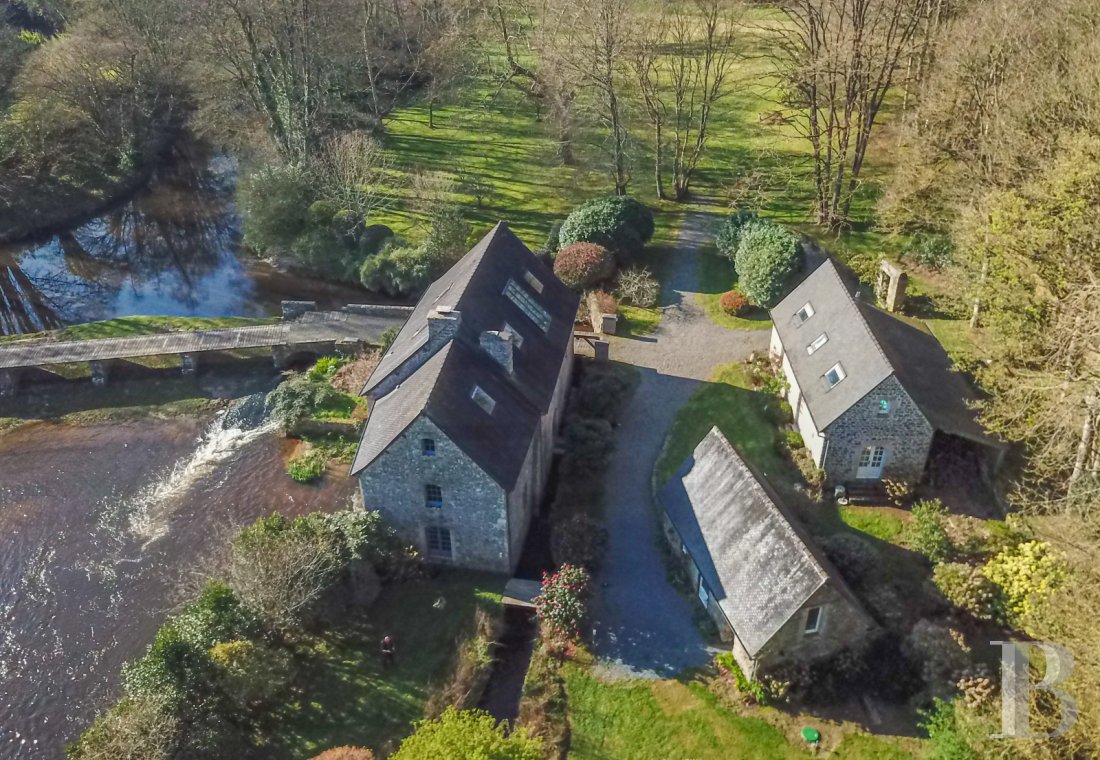
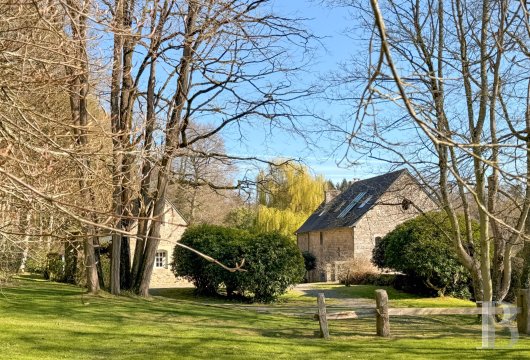
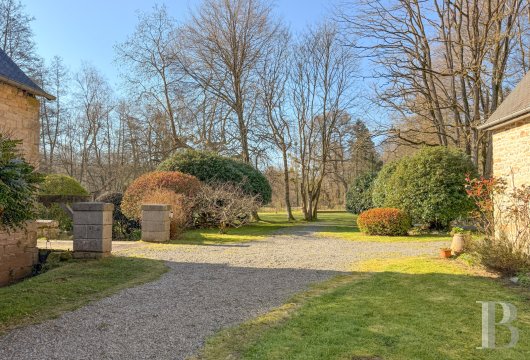
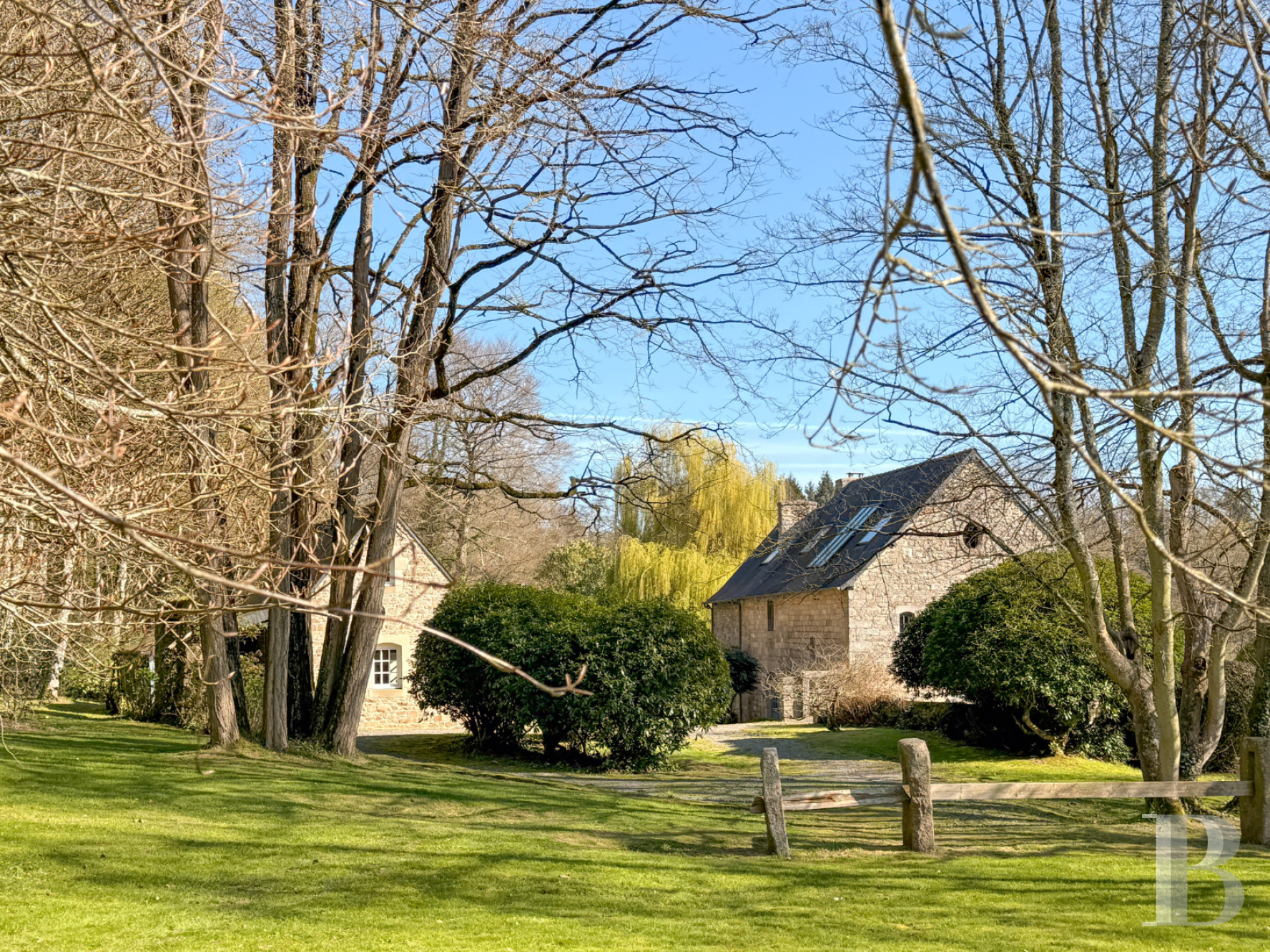
Beyond, a gravelled courtyard serves two outbuildings. The first, of elongated plan, is covered by a two-pitch slate roof. The second, built in the same materials, rises over two levels with converted upper space and is pierced by rooflights. The arrangement is organised around a tarmacked central area accessible from the entrance.
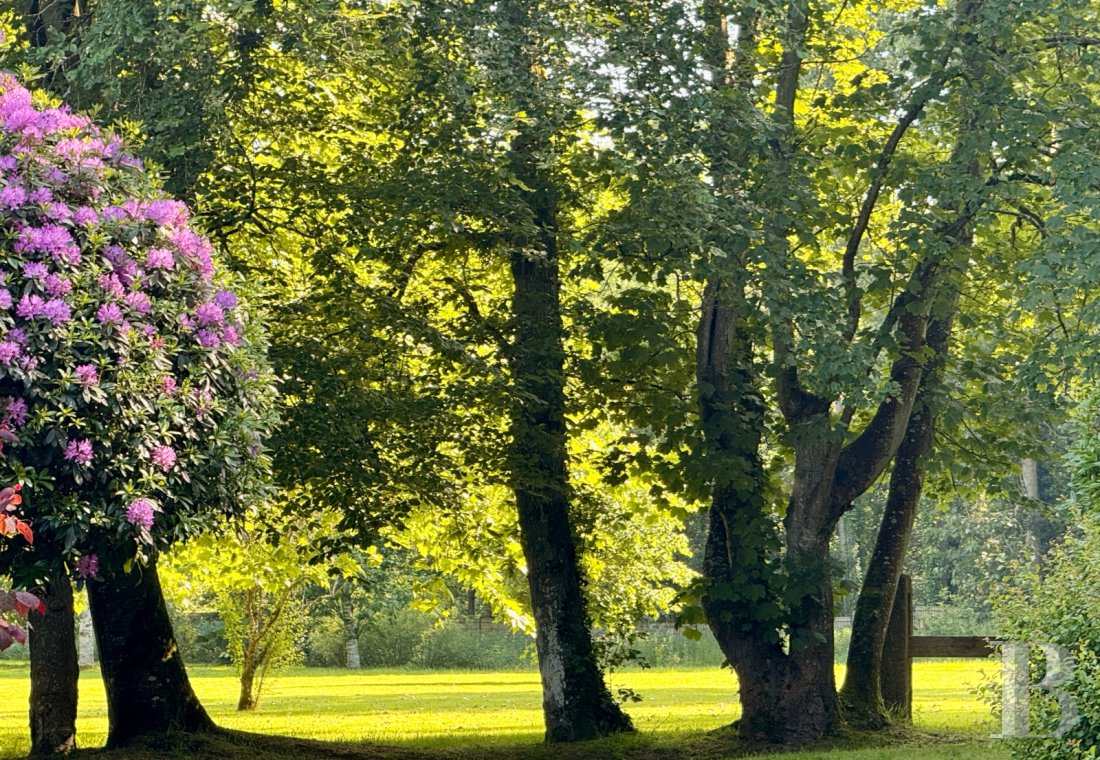
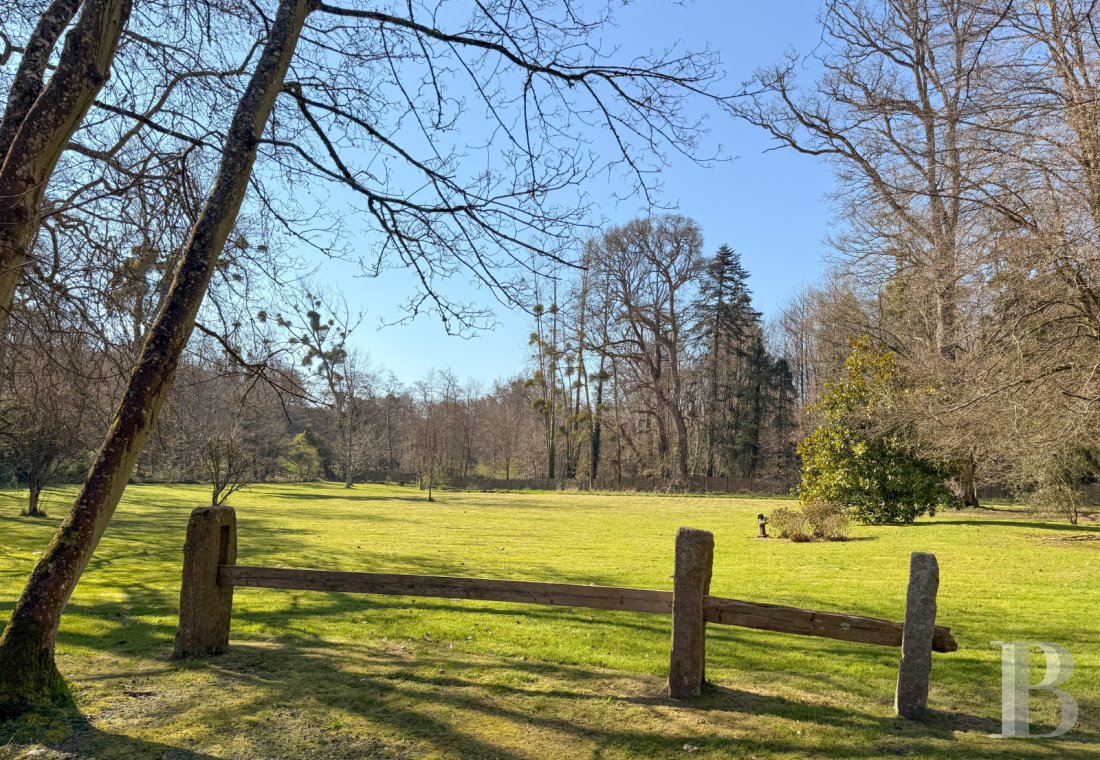
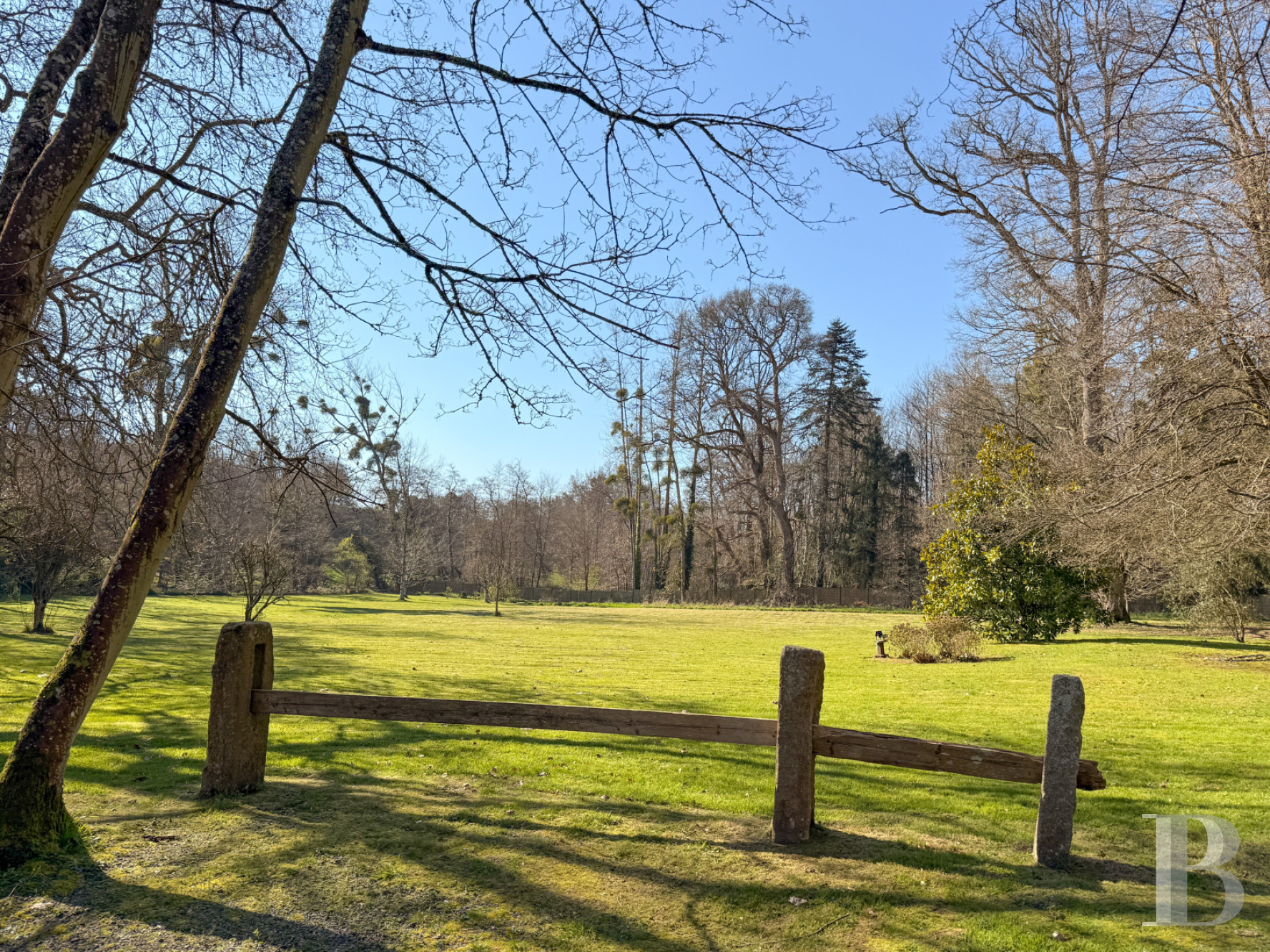
To the rear, the grounds — partly adjoining those of the Château des Salles — extend as a broad lawn punctuated by specimen trees and copses. Tall-standard tree lines border the whole, with planted boundaries providing further structure. Timber and stone fencing encloses certain sections.
The main building is constructed in granite rubble stone with an irregular course and dressed-stone window and door surrounds. The gable walls are exposed and show an even, consistent masonry. The openings vary in size and are arranged functionally; some are narrow and vertical. The slate gabled roof has a pronounced pitch. It is pierced by rooflights and a larger glazed frame set into one of the slopes. Two chimney stacks rise from the ridge. The verges are in stone and the eaves overhang is minimal. At the base of the wall, a masonry structure incorporating a timber element marks part of the original hydraulic system. Nearby, a flagged passage and a gravelled area organise the immediate surrounds. The joinery, in painted timber, comprises glazed doors with solid lower panels and small-pane windows. Some openings are in segmental-arch form. A circular stone aperture, formed by a monolithic surround, is set into one of the gable walls.
Beyond, a gravelled courtyard serves two outbuildings. The first, of elongated plan, is covered by a two-pitch slate roof. The second, built in the same materials, rises over two levels with converted upper space and is pierced by rooflights. The arrangement is organised around a tarmacked central area accessible from the entrance.
To the rear, the grounds — partly adjoining those of the Château des Salles — extend as a broad lawn punctuated by specimen trees and copses. Tall-standard tree lines border the whole, with planted boundaries providing further structure. Timber and stone fencing encloses certain sections.
The mill
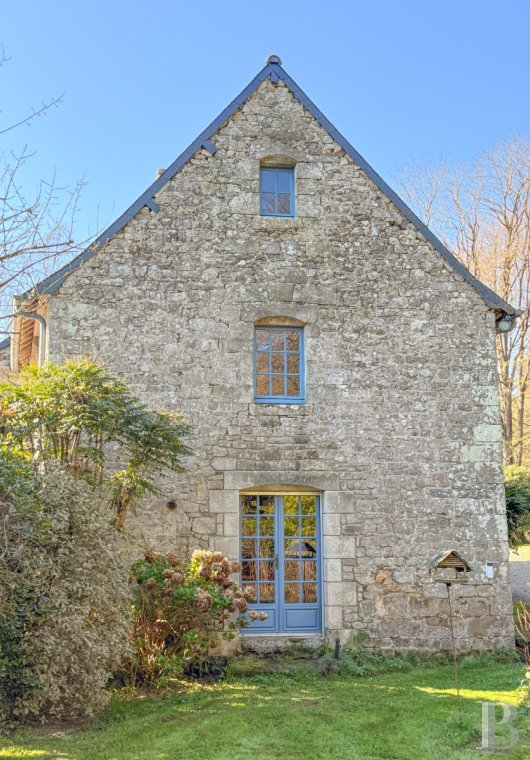
On the garden side, the mill opens through a double-leaf glazed door beneath a dressed-stone arch. The granite surround, with its irregularly coursed blocks, reflects the building's age.
The ground floor
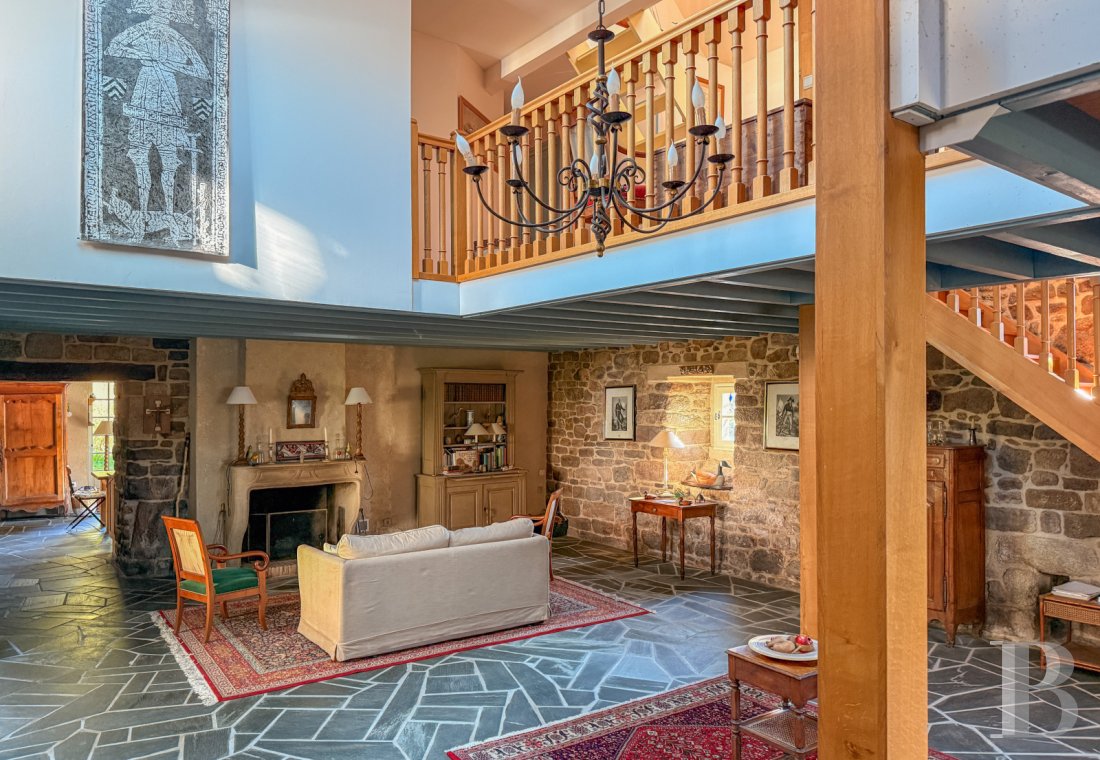
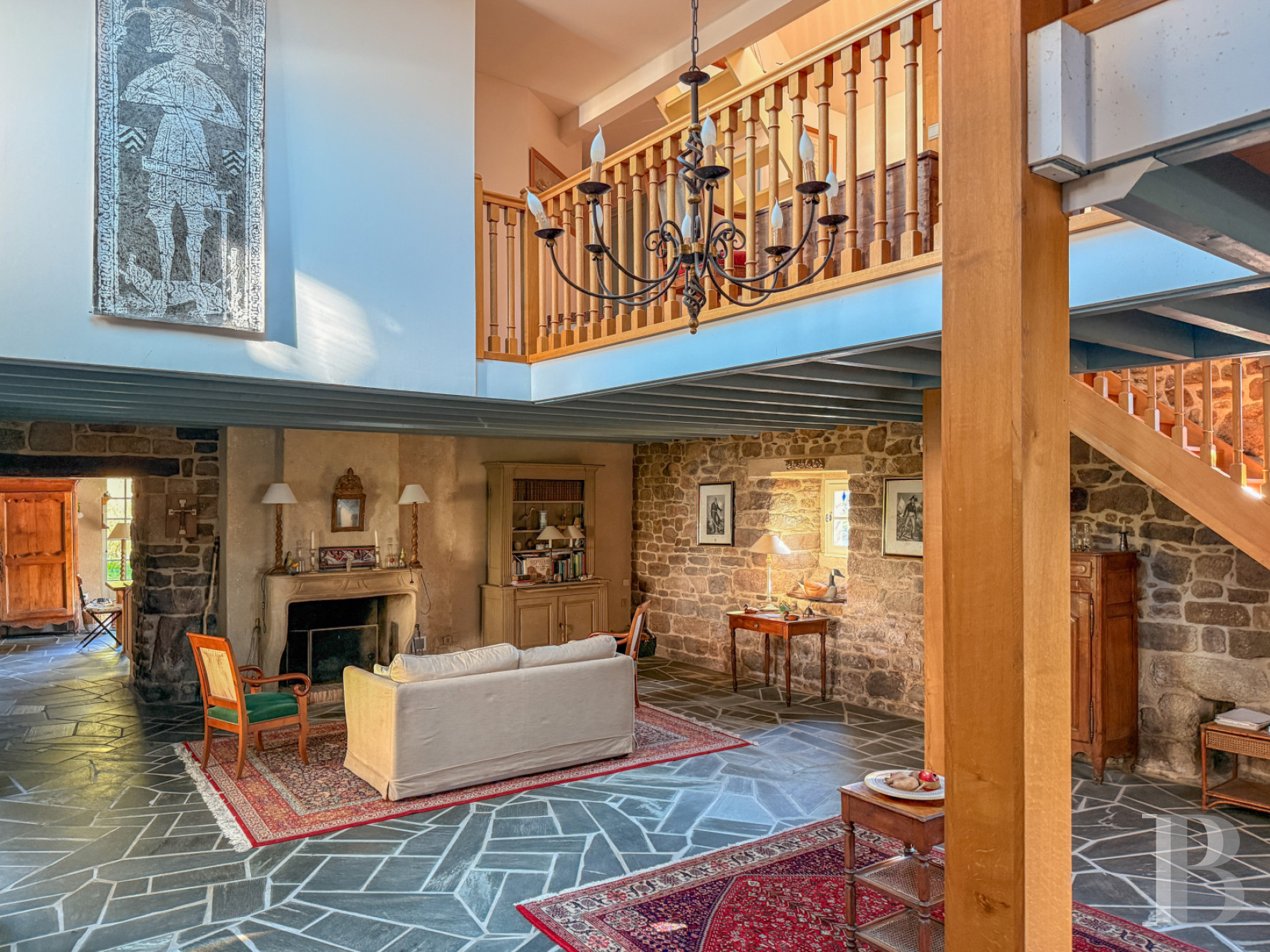
The entrance leads directly to a reception room with a ceiling height of nearly 8 m, defined by an upper light well and a timber gallery serving the level above. Stone flags with irregular joints cover the entire level. The rubble-stone walls alternate with plastered sections. A Louis XV stone fireplace, in working order, stands against one of the load-bearing walls.
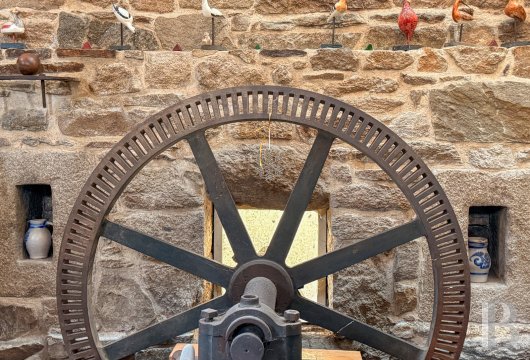
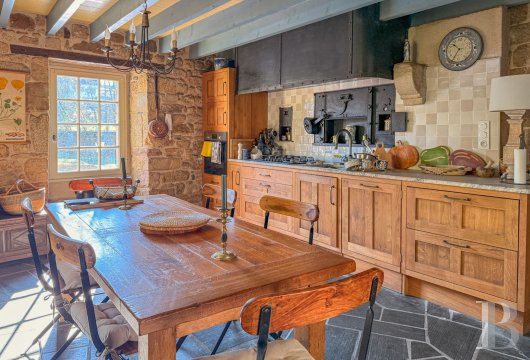
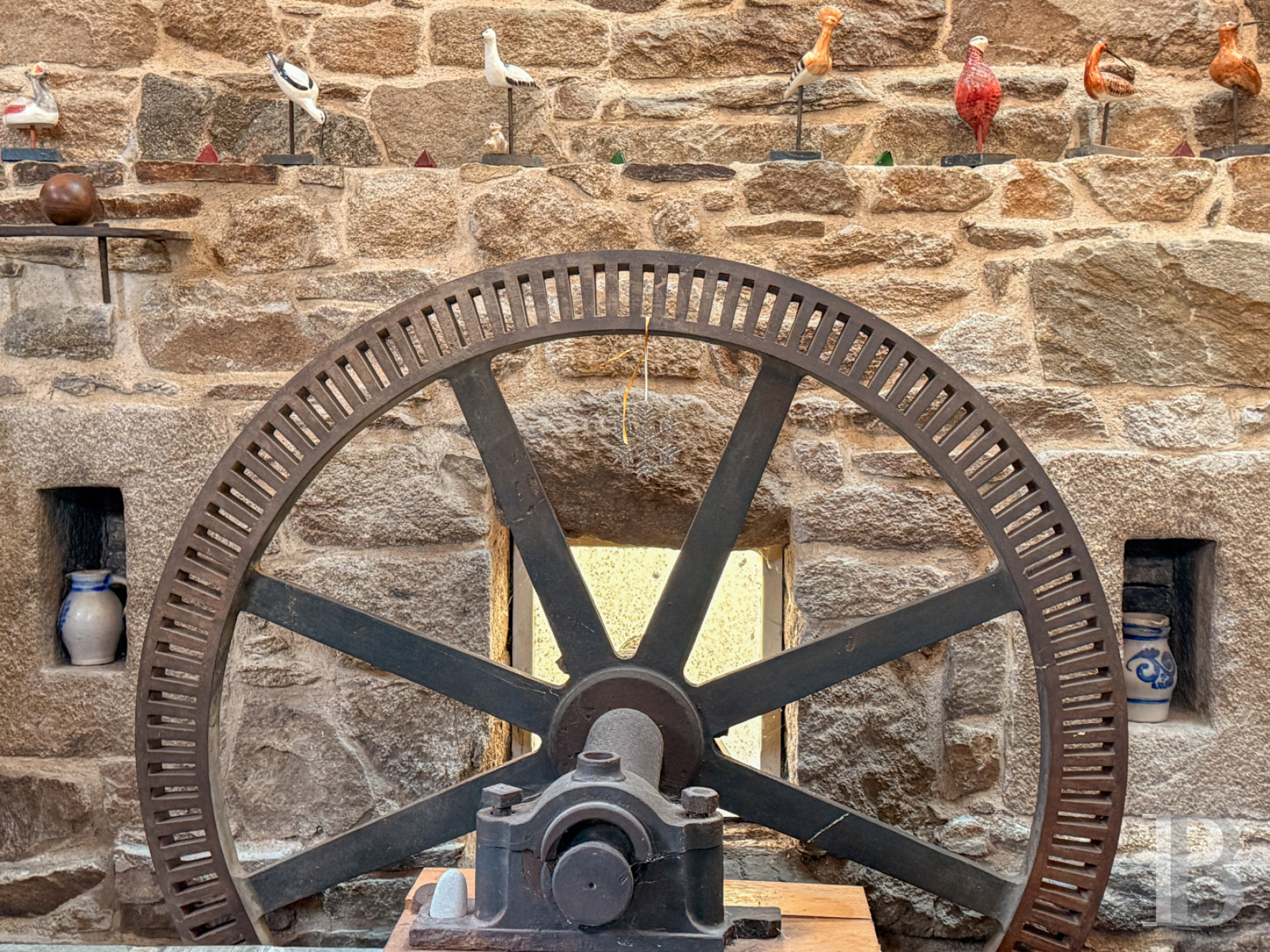
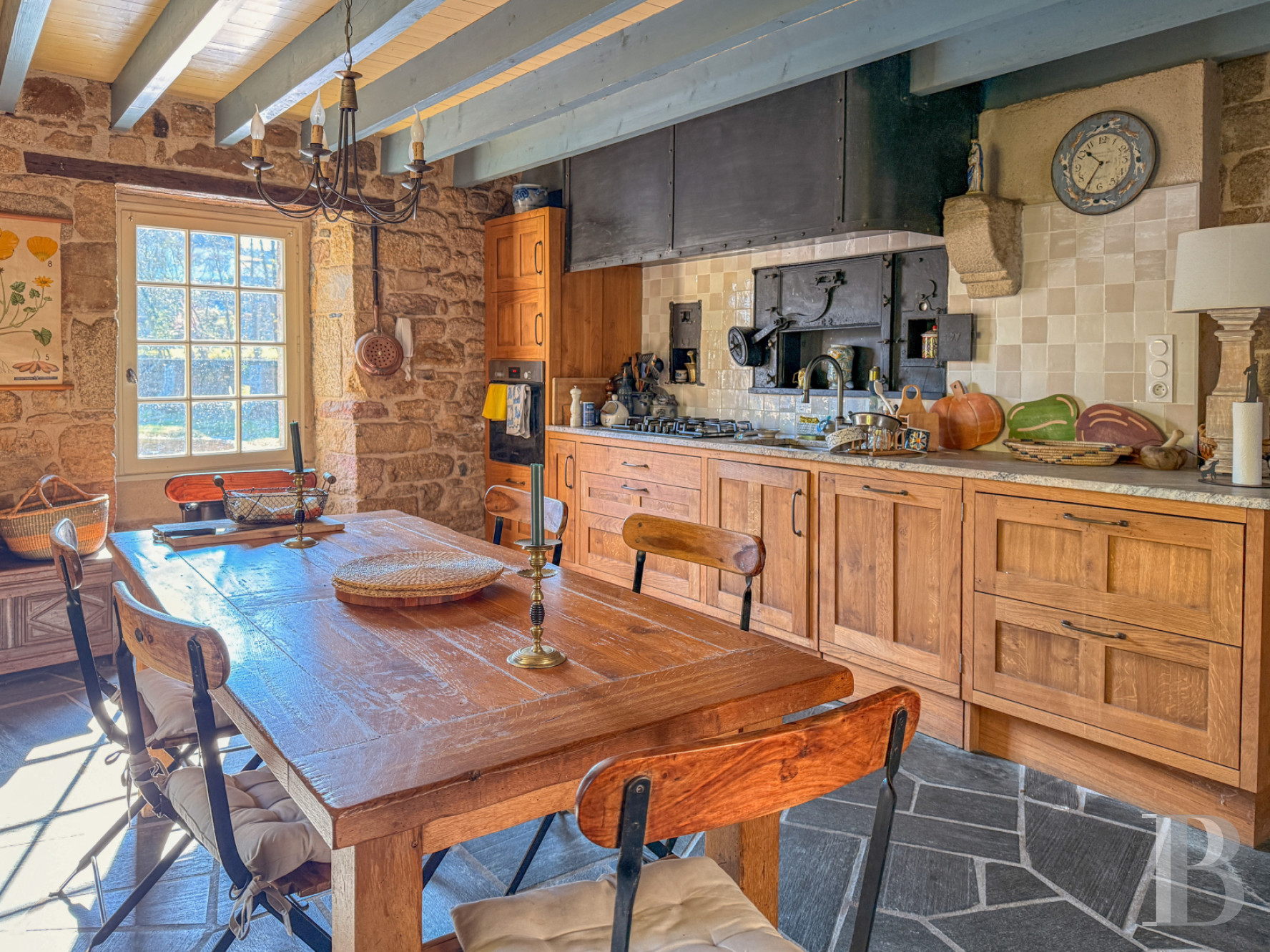
Several sitting areas occupy the open-plan space. An original wheel mechanism survives in place, visible below a hopper opening in the floor. Directly adjoining, the kitchen occupies a further room in the same spirit: solid timber units run along one wall, and an original masonry hearth survives above the cooking area.
The first floor
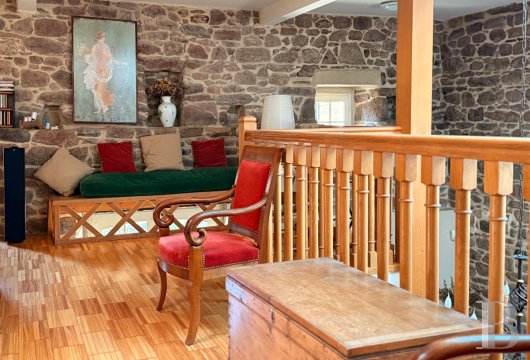
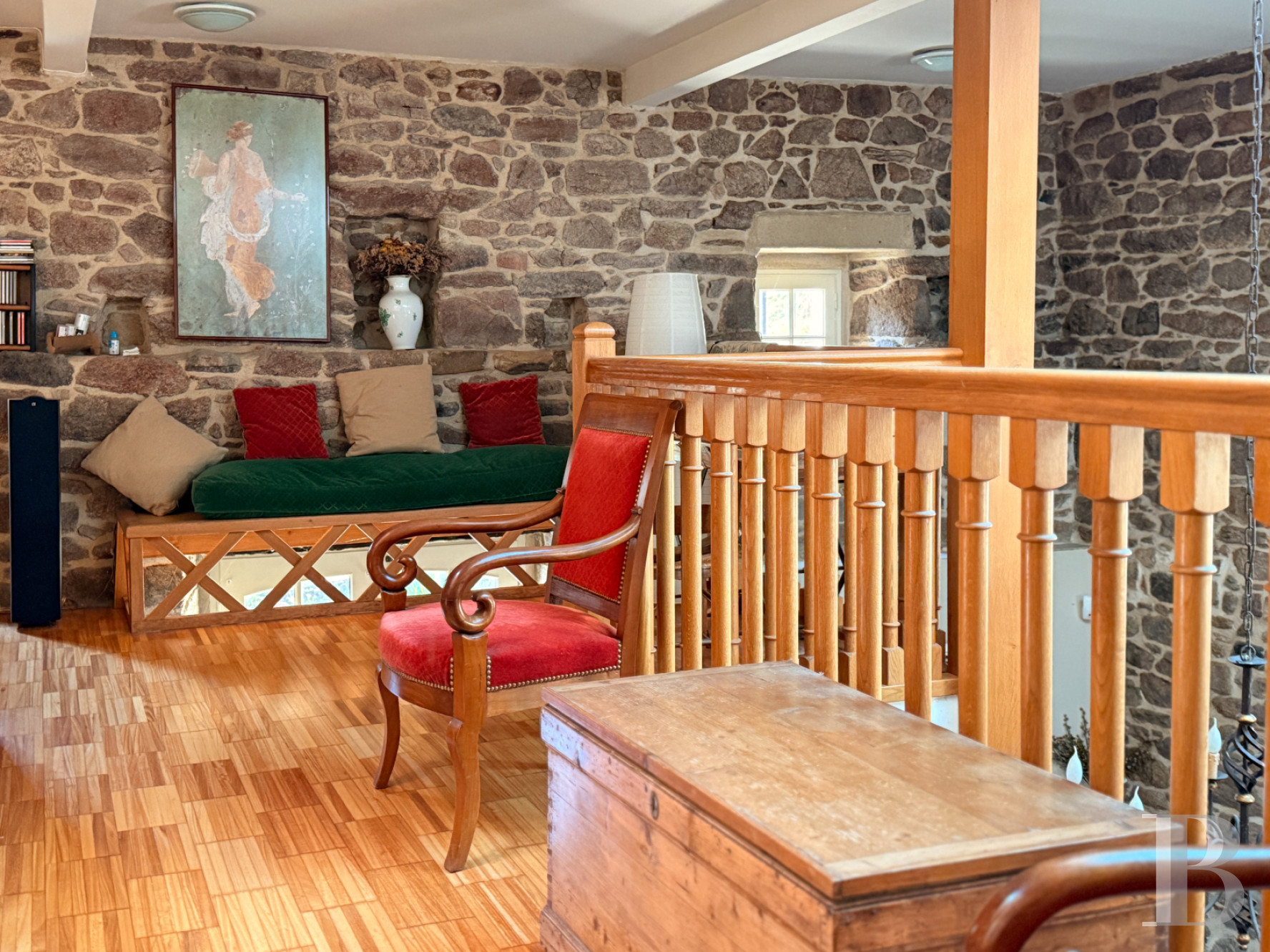
Centred on a mezzanine enclosed by a turned-timber balustrade, this level overlooks the reception room below. A corridor leads to a master bedroom — with access to a small attic study via a white-painted timber stair — a television room, a shower room with a level-access tray, glazed screen and vanity unit, and a lavatory. White-plastered walls alternate with sections of exposed stonework. The same narrow-strip wood flooring continues throughout, maintaining visual continuity. Openings of varying sizes bring in light, extended by the overhead light well.
The second floor
Following the same arrangement as the level below, the landing has narrow-strip wood flooring and plastered walls. A bedroom occupies each side.
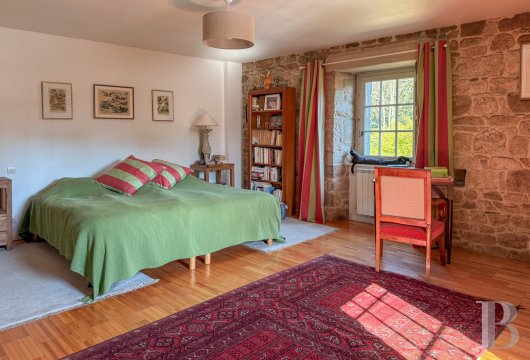
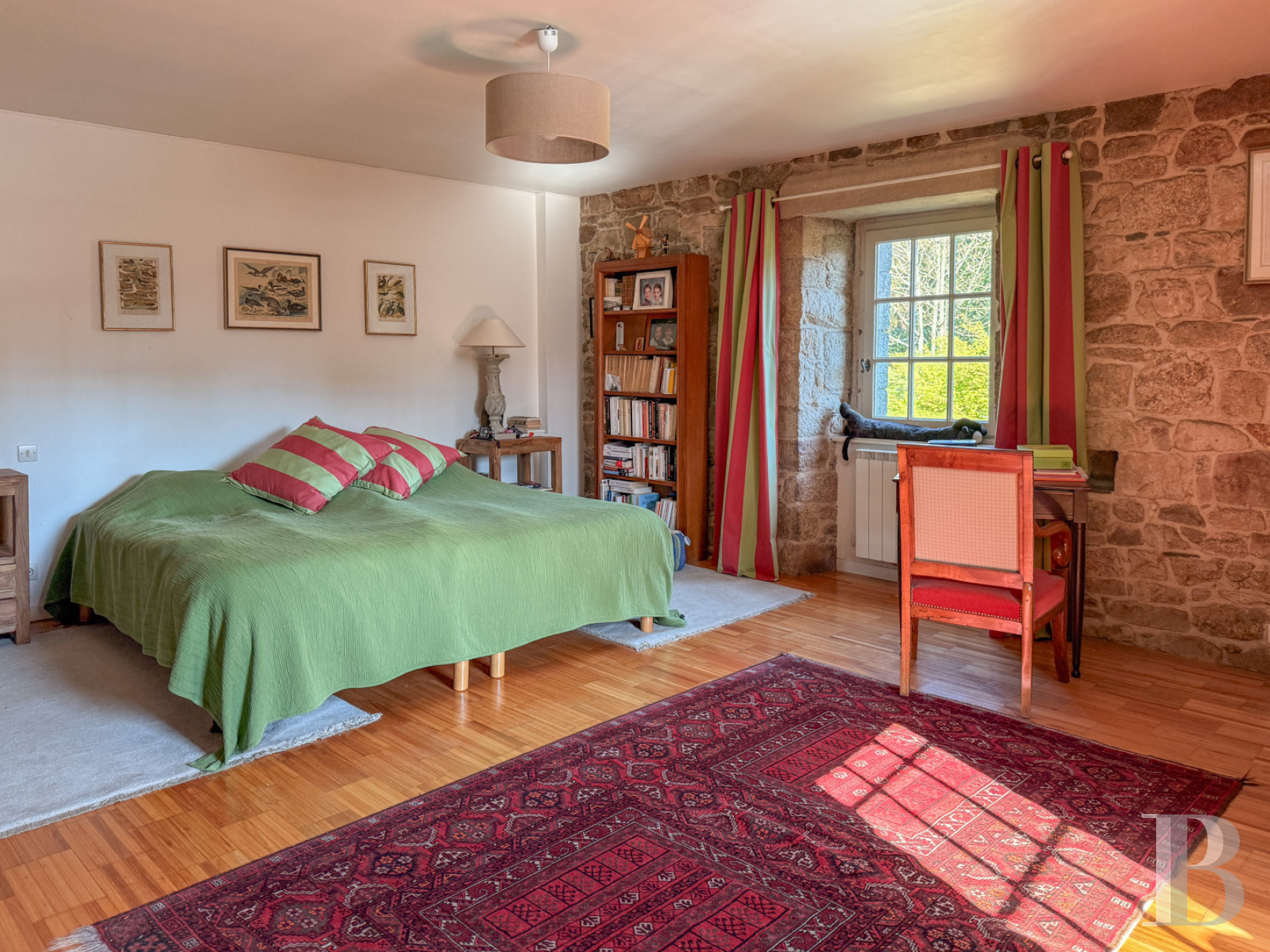
The first, with its pale blue tones, evokes the coast. The sloping ceiling heightens the sense of space, and a window in a painted timber frame brings lateral light.
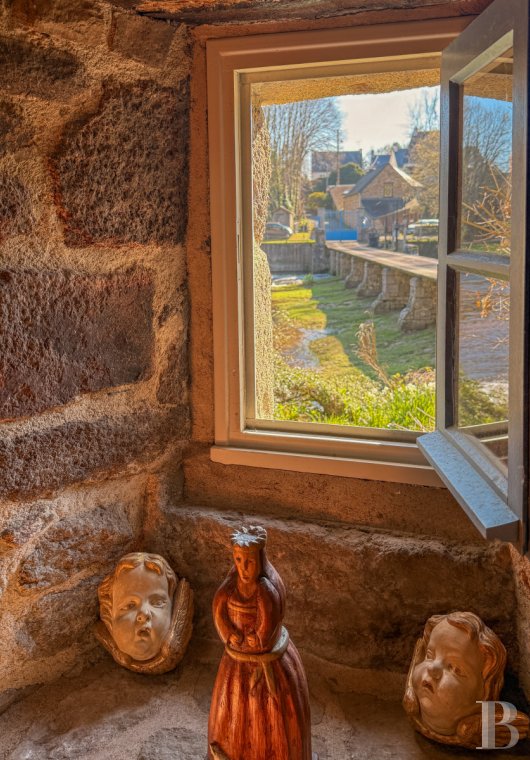
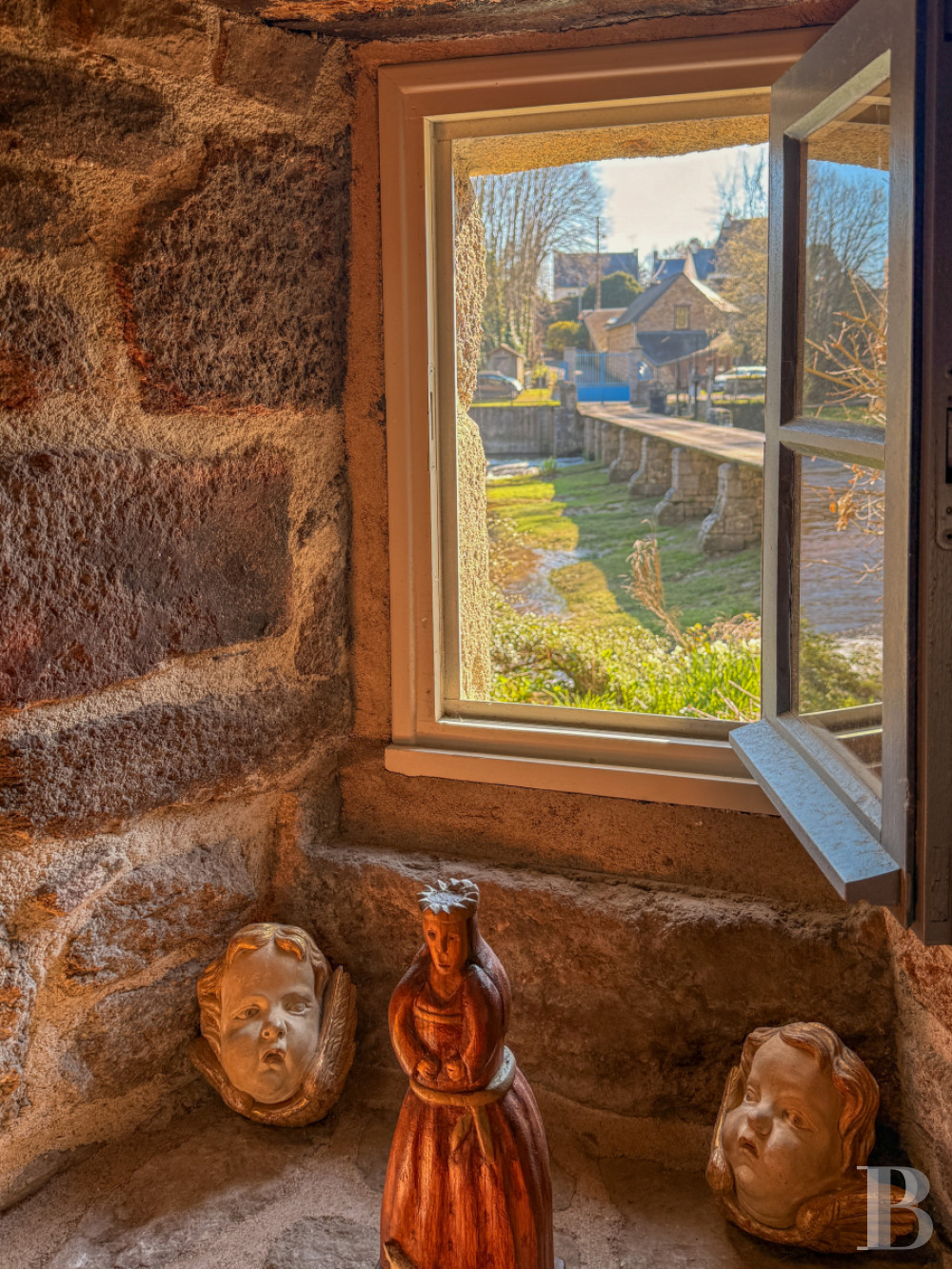
The second bedroom has yellow-plastered walls. Also under a sloping ceiling, it is lit by a rectangular window and an oval stone opening set into the depth of the wall. With its irregular outline, this opening frames an unobstructed view across the grounds and their trees.
The guest cottage
The guest cottage faces the mill. At the rear, a carport runs the full length of the building, providing log storage and parking for one vehicle.
The ground floor
It comprises two spaces. The first is a room serving as a kitchen-dining area, fitted with a simple run of units and kitchen appliances. A double-leaf glazed door, arched at the top, opens to the outside and brings in light. The floor is tiled. The second serves as a children's bedroom, lit by a window set into the thick façade wall with a stone sill. Its floor is also tiled.
The upstairs
A landing serves two bedrooms, a bathroom and a separate lavatory. Both bedrooms sit under sloping ceilings, with painted walls and sprung wood flooring, and each has a roof window bringing direct natural light. The bathroom has a built-in bath and a pedestal basin set against glazed wall tiles in contrasting yellow, black and white.
The workshop
Rectangular in plan, the workshop extends from the guest cottage. It has a concrete floor slab and it's wired for electricity. A miller's staircase provides access to the upper level.
The grounds
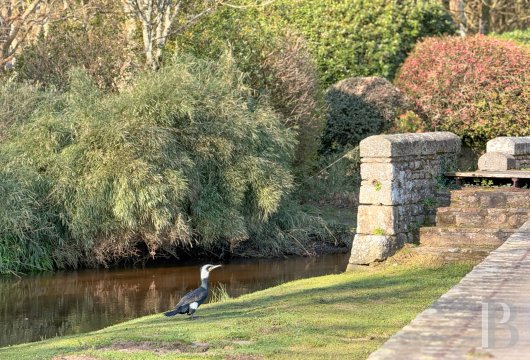
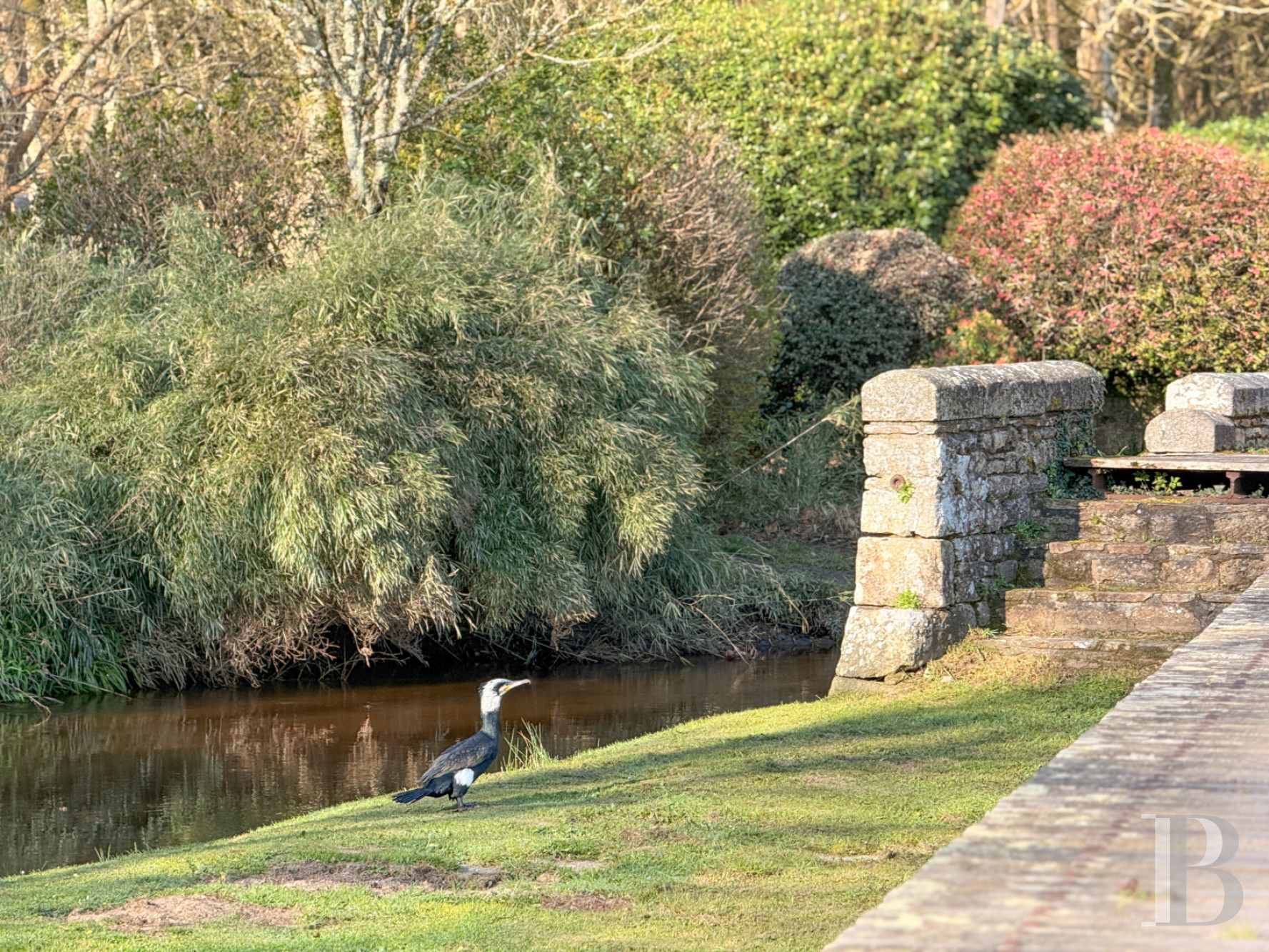
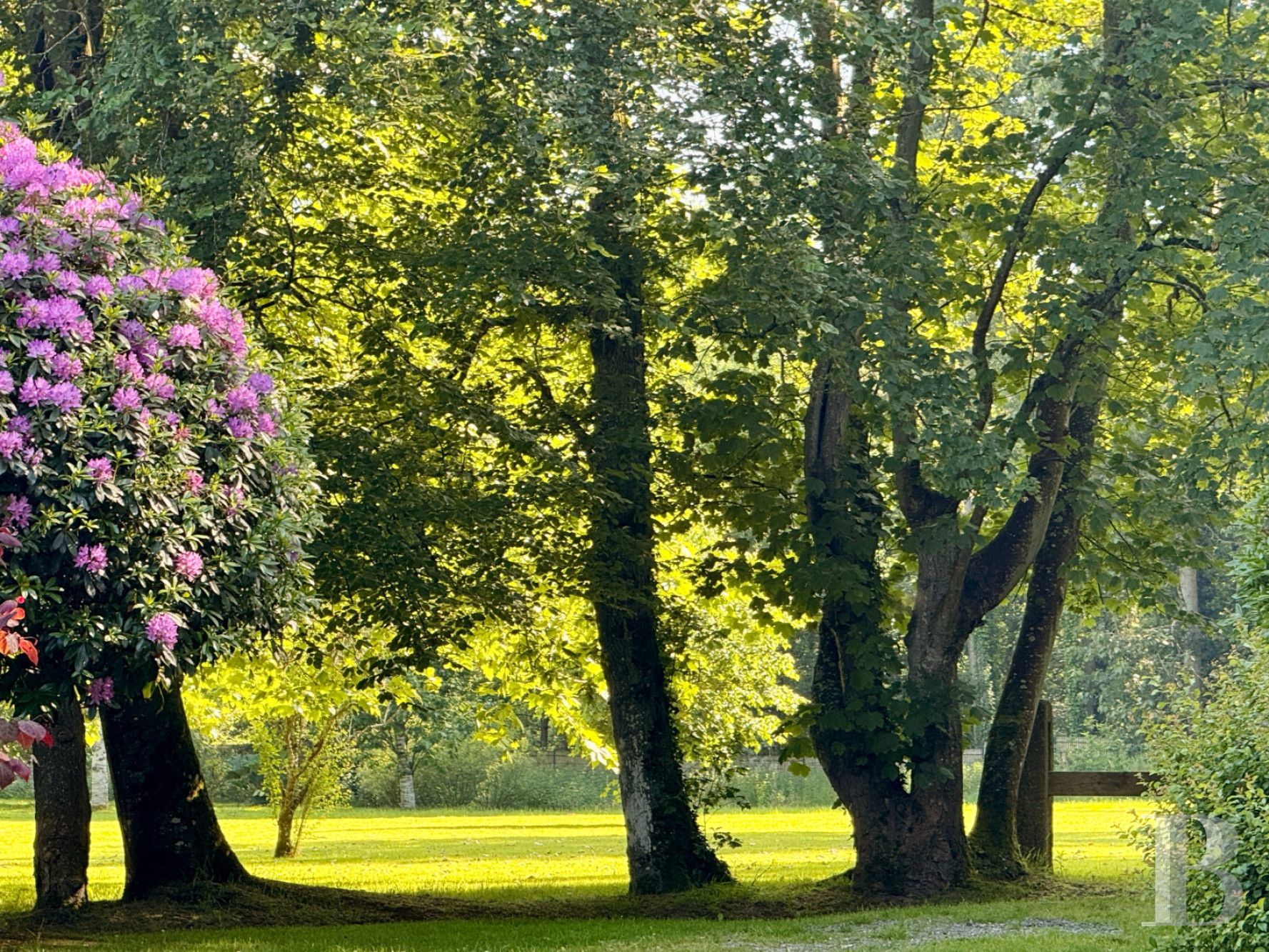
To the north, a fence several hundred metres long separates the grounds from a footpath; to the south, the River Trieux forms the boundary. Broad lawns dotted with specimen trees and copses form the greater part of the grounds.
The planting is varied, with limes, maples and yews alongside numerous shrub and flower beds throughout. Trees of varying heights structure the sightlines and line the paths.
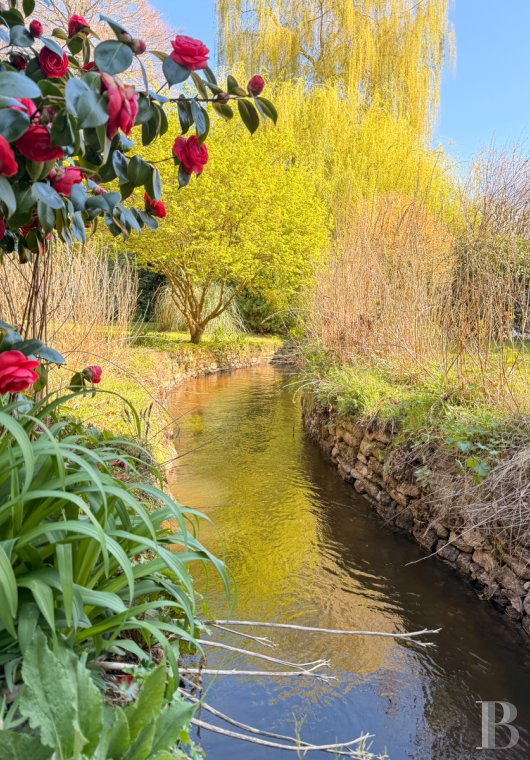
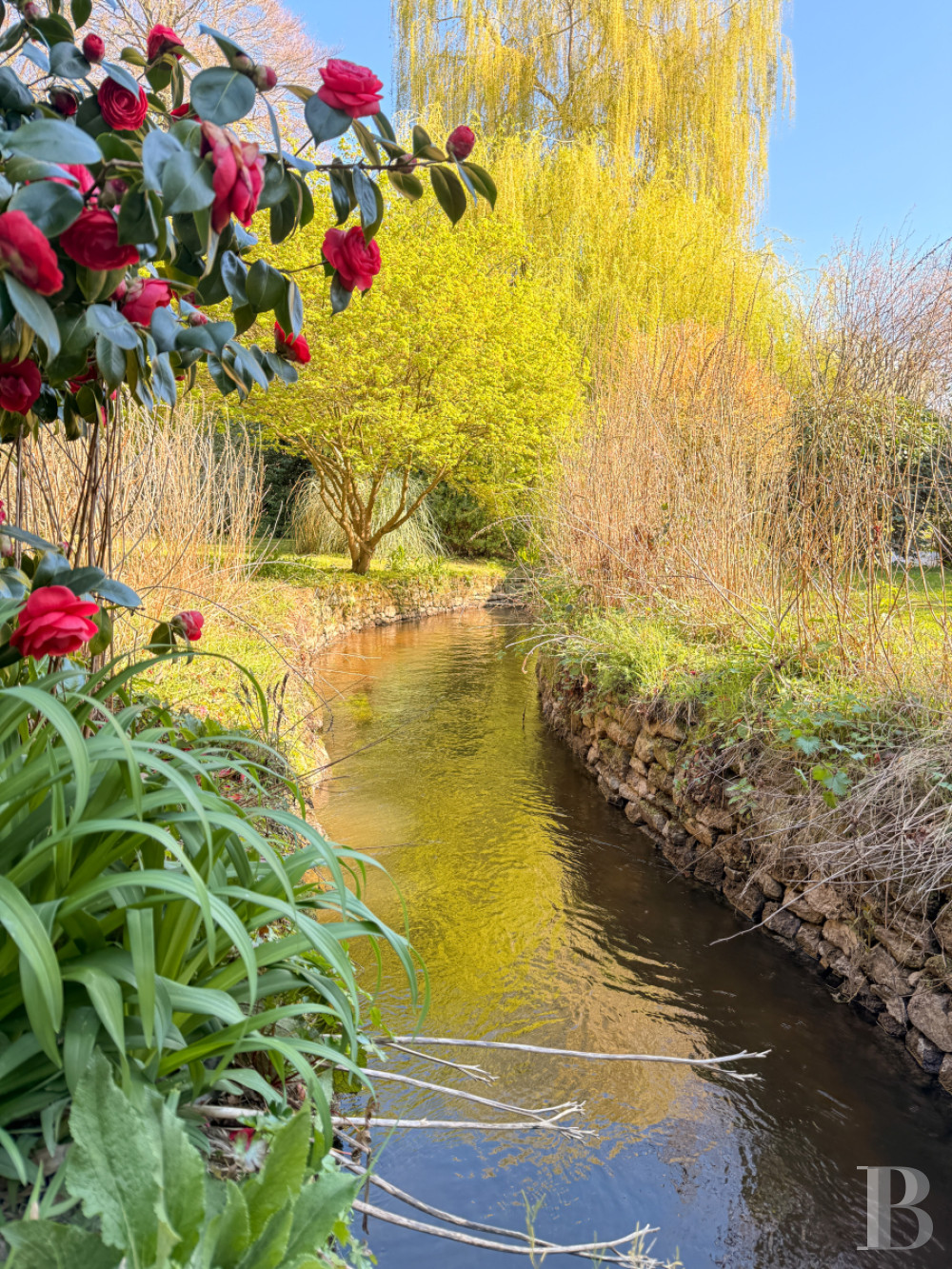
Planted banks and grassed areas extend the grounds to the water's edge. A millrace, bordered by stone masonry, runs through part of the garden, a reminder of the mill's former hydraulic system.
Our opinion
Past the gate, the footbridge crosses the water and leads to a secluded setting, where the world outside all but disappears. Once a working mill on the Trieux, the building has retained the traces of its original purpose in the channel and hydraulic structures that survive as vestiges, while becoming a carefully kept home. Consistently well maintained by its occupants, it requires no immediate works; the interiors offer a sound basis, ready to be made one's own.
The grounds form a single coherent landscape, and the outbuildings sit in architectural harmony with the main building — both contributing to a setting that is enclosed and sheltered, bounded by water on one side and screened from neighbouring paths on the other. An unexpected refuge, within reach of the city, for those drawn to mill architecture or to riverside living among trees.
632 300 €
Fees at the Vendor’s expense
Reference 725102
| Main building floor area | 261 m² |
| Outbuildings floor area | 102 m² |
| including refurbished area | 42 m² |
| Land registry surface area | 9953 m² |
| Total floor area | 303 m² |
French Energy Performance Diagnosis
Information on the risks to which this property is exposed is available on the website: www.georisques.gouv.fr
Share


NB: The above information is not only the result of our visit to the property; it is also based on information provided by the current owner. It is by no means comprehensive or strictly accurate especially where surface areas and construction dates are concerned. We cannot, therefore, be held liable for any misrepresentation.